The US Military Has Killed at Least 221 People in Boat Strikes on Suspected Drug Traffickers Since September 2025, No Trial Required. Two Days Ago, a Convicted Drug Trafficker Took the Stage at the Republican Convention to Thank the President Who Pardoned Him.
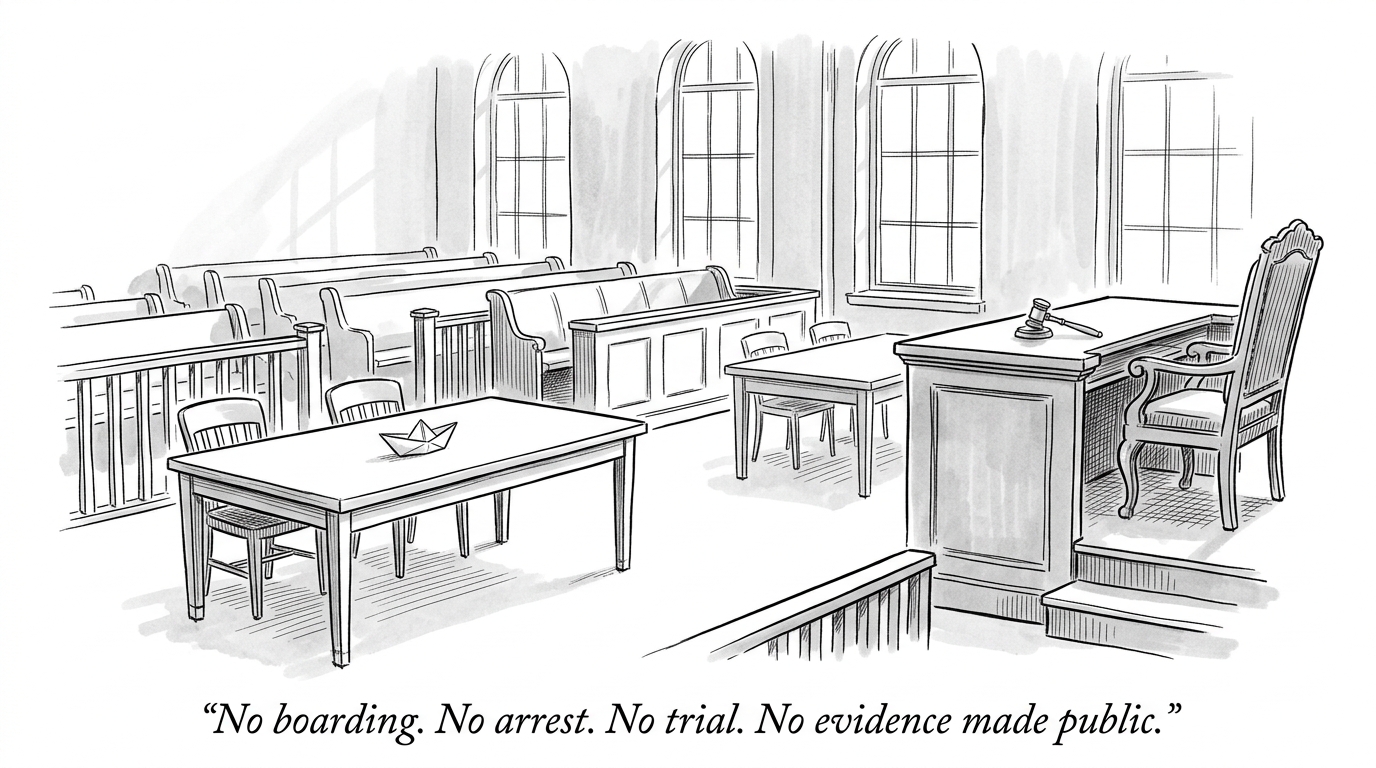
Since September 2025, US forces have destroyed at least 67 vessels in the Caribbean and Eastern Pacific and killed at least 221 people the government says were trafficking drugs. No boarding. No arrest. No trial. No evidence made public. The operation, part of what the Pentagon calls Southern Spear, is a real break from how the United States has handled this exact question for decades.[1]
What actually changed
The US has interdicted drug shipments at sea for generations through the Coast Guard, backed by Navy support, under legal authorities built specifically for this: warning shots, disabling fire, boarding, seizure of evidence, arrest. A patchwork of bilateral agreements sends suspects to US federal courts, where the government has to prove its case with evidence a defendant can actually see and contest. Southern Spear replaced that entire process with a strike. Legal scholars and international observers have called the result exactly what it is under international law when conducted without a clear legal basis in international waters: extrajudicial killing.[1]
The same government's other answer to the same question
Ross Ulbricht built Silk Road, the dark-web marketplace that moved more than $214 million in illegal drugs before his 2013 arrest. He was convicted in 2015 and sentenced to life without parole. In January 2025, Donald Trump pardoned him on his first full day back in office, fulfilling a promise he'd made to the Libertarian Party's convention the previous May. On September 10, 2026, Ulbricht stood on the stage of the Republican Party's own midterm convention in Dallas and thanked Trump directly: "He felt compassion for me because he, too, was a target of a weaponized government... He said that if the American people sent him back to the White House, he would free me. The day after he took office, he pardoned me." He called the pardon a "win for liberty."[2]
Name what's actually being compared, and what isn't. A boat strike in international waters and a presidential pardon are different legal instruments, aimed at different people, in different legal postures -- one is a use-of-force decision against foreign nationals never brought before a court, the other is clemency for a US citizen who was already tried, convicted, and sentenced through the actual legal system. That distinction is real, and collapsing it would be dishonest. But the distinction doesn't touch the actual claim on the table. Both are the same government's own answer to the same question: how grave is drug trafficking, and what does that gravity justify? Answered one way for people the government never named, never proved anything against in public, and killed at sea. Answered the opposite way for a man whose name, conviction, and evidence are all a matter of public record, standing on a stage two days ago being thanked for it.
The pardon itself is a state-vs-federal story too
Trump's pardon of Ulbricht worked completely, with nothing left for anyone to appeal or resist, for a specific structural reason: Article II gives the president power to pardon "Offenses against the United States" -- federal crimes -- and that power is essentially absolute. No congressional check exists on it, courts don't review how it's used, and no successor can undo a pardon once granted. But that same power stops dead at the state line. A president cannot pardon a state conviction, under any circumstances -- only a governor, or a state's own clemency process, can reach those. Ulbricht's prosecution was federal, in the Southern District of New York, which is exactly why one signature closed his case permanently. State courts handle 67.6 million cases a year against the federal system's 921,000 -- the overwhelming majority of everything, including most drug prosecutions in this country -- and nothing in Article II reaches any of it.[3] The same asymmetry between state and federal law that decides which circuit's reading of a statute you live under also decided that Ulbricht's specific case sat inside the one system a single president could end outright.
Who gets which answer
The pattern isn't random. The 221 people killed in Southern Spear strikes were, by the government's own description, foreign nationals on boats in international waters -- never named, never tried, never given the chance to contest the evidence against them, because none was made public. Ulbricht is a white American citizen with a network of supporters well-connected enough to get a presidential campaign promise made on his behalf at a party convention, then delivered on the first full day of the administration, then celebrated on that same party's convention stage eighteen months later. The same alleged conduct -- moving illegal drugs at scale -- produces a death sentence with no trial in one case and a standing ovation in the other, and the variable sorting which one a person gets was never the conduct itself.
Why does this matter? A government that says drug trafficking is grave enough to justify killing people without a trial has already made its claim about how serious the conduct is. It doesn't get to make a second, opposite claim about the identical conduct a year and a half later, for someone it likes better, without the first claim collapsing under the weight of the second. Either the conduct is grave enough to kill for, or it isn't. The government's actual answer, watched in full rather than in either single moment alone, was never really about the conduct at all.
Part of the same thread as "How Courts Actually Work" -- the same state/federal split that decides which circuit's reading of a law you live under also decided which system could end Ulbricht's case outright.
- NPR, What to know about U.S. military strikes on alleged drug boats
- CNN, US military strikes on alleged drug boats may not have worked
- Al Jazeera, Drug marketplace founder Ross Ulbricht speaks out after Trump pardon
- The Blaze, Ross Ulbricht reminds the world about Trump's quiet wins in the criminal justice system