A Camera Hidden Inside a Fake Construction Barrel Flags Your Car as "Suspicious." A Federal Agent Tells a Local Cop to Pull You Over. The Ticket Says Dangling Air Freshener. The Record Never Mentions the Camera At All.
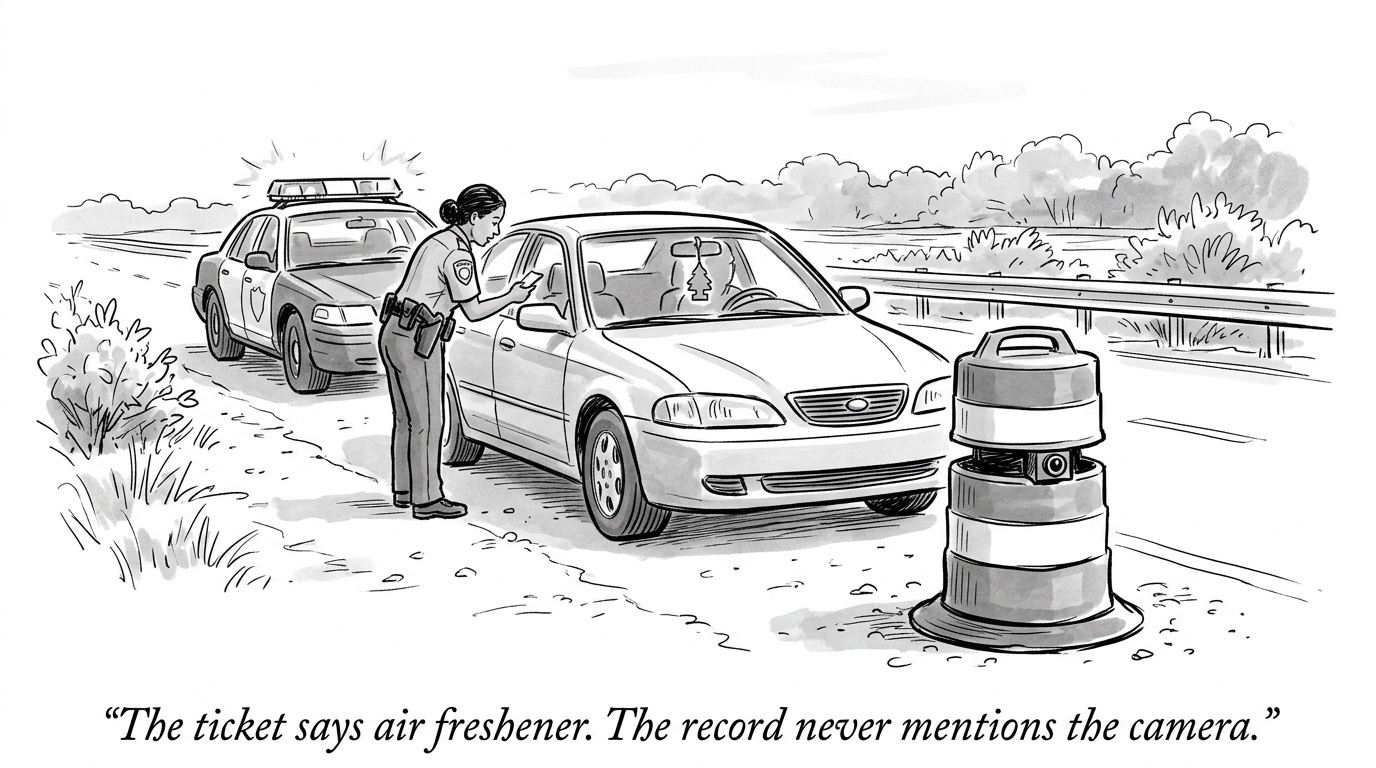
An Associated Press investigation published in November 2025 found that US Border Patrol has spent roughly a decade building a nationwide license-plate-reader network, expanding sharply over the last five years, that tracks millions of American drivers and flags "suspicious" travel patterns -- with no requirement that the driver be accused of any actual crime.[1] Some of the cameras are hidden inside fake electrical boxes or ordinary-looking orange and yellow construction crash barrels, positioned well beyond the border itself, into major metropolitan areas.[2]
The algorithm decides. The paperwork never says so.
The system logs a vehicle's plate, then an algorithm scores it as suspicious based on where it came from, where it was going, and which route it took -- travel-pattern analysis, not evidence of a specific offense.[1] When the algorithm flags a driver, federal agents pass the tip to local police, who then make the actual stop -- and the reporting has a specific term for what happens next: a "whisper," "intel," or "wall" stop, named that way because the true reason for the stop is deliberately walled off, kept secret even from the courts that later handle the case.[3] The stop itself is built on something else entirely: a rolling stop, window tint, a cracked windshield, a dangling air freshener blocking the view.[3]
This is the sharpest version yet of the mechanism this thread keeps finding: the record a court actually sees is not the decision that actually happened -- and here, the gap between them isn't an accident of how paperwork gets built, it is the explicit design. Drivers are almost never told a stop originated from a federal system that had already analyzed weeks or months of their travel. Because the official record shows only a traffic infraction, defendants and the courts that hear their cases typically never learn a federal algorithm triggered the stop at all.[3] Every other piece in this thread has shown a public record trailing a private decision by accident or convenience. This one is built to make sure the public record never catches up at all.
The reach beyond the border, and both sides of the argument
Border Patrol also draws on plate data collected by other federal, state, and local agencies, and by private license-plate-reader companies -- not just its own cameras.[1] This outlet has already covered the largest of those private networks directly: Flock Safety's cameras, whose footage has documented access by ICE, the Secret Service, and the Navy on top of ordinary local police use.[2] Amazon's Ring announced a direct integration sending doorbell footage into that same Flock network in October 2025, then canceled it in February 2026 after public backlash over Flock's ICE ties -- but Ring did not step back from police access altogether. It rebuilt the same function through a different route: a partnership with Axon (Taser's parent company) and its own "Community Requests" feature, which lets a camera owner choose to share footage with local police investigating a specific case.[6] The specific pipe got cut. The surveillance layer it was built to feed did not. Senator Ed Markey wrote directly to CBP's commissioner that the program "represents, at best, a profound invasion of privacy and, at worst, a violation of the Fourth Amendment," naming a specific chilling-effect concern: the same system could identify women traveling across state lines for abortion care, or track journalists, activists, and political opponents.[4] Rep. Dan Goldman asked the plainer version of the same question: if someone can be stopped and detained "based on an algorithm, not warrants or evidence," what happens to the Fourth Amendment at all.[4] CBP's own response, on the record: the program is "governed by a stringent, multi-layered policy framework, as well as federal law and constitutional protections," and exists to identify threats and disrupt criminal networks.[4]
The funding pipeline: nearly two decades old, about to get an AI budget
None of this runs on hidden cameras alone. CBP is now positioned to receive more than $2.7 billion specifically to layer artificial intelligence and other emerging technology onto this exact surveillance system.[1] The pipeline that gets local police participating in the first place already exists and predates this expansion by nearly twenty years: Operation Stonegarden, a federal grant program running since 2009, has funneled hundreds of millions of dollars to state and county law enforcement -- funding both officer overtime and the license-plate-reader equipment itself -- specifically to work Border Patrol's own enforcement priorities.[5] The "whisper stop" is not an improvised workaround by a few local departments. It runs on a funding stream built for exactly this, for most of a generation.
Why does this matter? A traffic stop for a dangling air freshener and a traffic stop ordered because a federal algorithm flagged a decade of your driving history look identical in the paperwork, on purpose. This thread has spent several pieces showing that the taught, public version of a government mechanism is downstream of a private decision that actually runs it. This is the version where the gap between the two isn't left to chance -- it has its own name, and it was built specifically so the record would never have to answer for the decision underneath it. Philip K. Dick wrote a Precrime division in 1956 that acted on predicted guilt before any crime occurred, and treated that as the premise readers would find disturbing. The real version doesn't even need a prediction of a specific future crime -- a travel pattern an algorithm scores as unusual is enough to trigger a stop, and the paperwork is built so no court ever has to rule on whether that was a legitimate basis in the first place.
This outlet has already traced the earlier half of this same story: before 1967, distance was a real reset -- a criminal record in one state genuinely might never reach another, simply because no infrastructure existed to check. The FBI's National Crime Information Center ended that, making a record travel faster than the person it belonged to ever could.[7] This system is the same erosion carried one step further. NCIC required you to have actually been convicted of something before your past could follow you nationwide. A travel-pattern algorithm requires nothing at all -- no conviction, no charge, not even an accusation. The thing that now follows you and can trigger a stop isn't a record of something you did. It's a record of where you drove.
Companion pieces on this outlet: "Florida Just Banned License Plate Readers From State Roads..." and "A 1967 Database Made Sure Your Record Never Stays Local..."
- PBS NewsHour, Border Patrol Monitoring Drivers and Detaining Those With Suspicious Travel Patterns
- WWNY / AP, AP Investigation: Border Patrol Secretively Monitors Drivers for Suspicious Travel
- Reason, Mass Surveillance Is Powering a New Era of Pretextual Traffic Stops
- WWLP, Massachusetts Senator Urges US Border Patrol to Stop License Plate Tracking
- North Country Public Radio, This Program Pays New York Cops to Help Border Patrol Arrest Immigrants
- TechCrunch, Amazon's Ring Cancels Partnership With Flock, a Network of AI Cameras Used by ICE, Feds and Police
- DoAyni, A 1967 Database Made Sure Your Record Never Stays Local...