One Billionaire's $7.5 Billion Bet Helped Pull Detroit Out of the Largest Municipal Bankruptcy in US History.
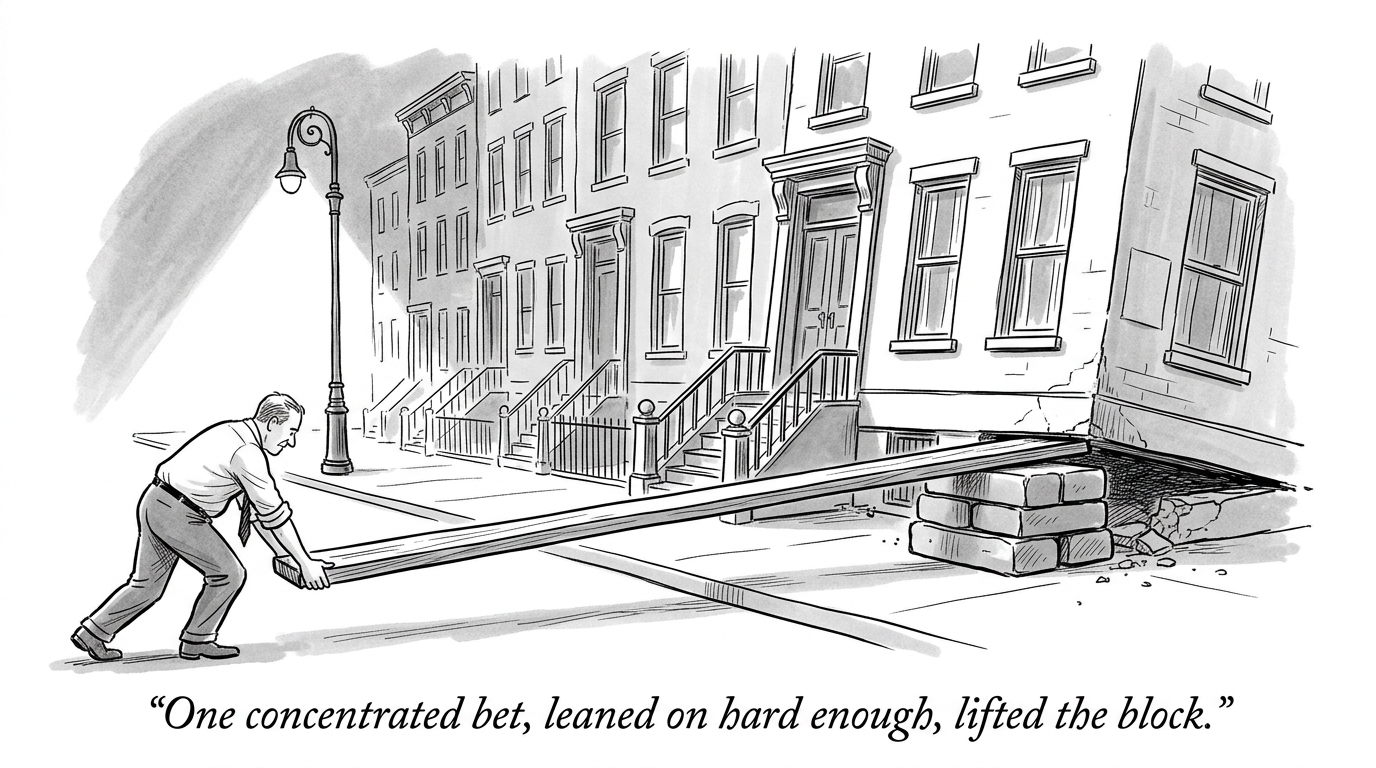
Downtown Detroit's collapse and Paradise Valley and Black Bottom's destruction by I-375 construction around 1960 are already documented in full elsewhere on this site.[1] What follows picks up decades later, at the city's actual financial bottom, and traces the specific, concentrated mechanism that pulled its downtown back out of it.
The bottom, named with a date
Detroit filed for Chapter 9 bankruptcy in July 2013, carrying approximately $18 billion in debt -- the largest municipal bankruptcy in United States history. The city exited court supervision just eighteen months later, in December 2014, one of the fastest resolutions of a major municipal bankruptcy on record. The case itself, tracking the city's ongoing fiscal recovery under a federal judge's oversight, did not fully close until May 2026 -- nearly thirteen years after the initial filing.[2]
The lever: one billionaire's concentrated real-estate bet
In 2010, Dan Gilbert moved Quicken Loans' headquarters from Livonia, Michigan, twenty miles outside the city, into downtown Detroit -- bringing roughly 8,000 employees with it. His real estate arm, Bedrock, has since acquired or redeveloped close to 100 downtown properties, investing or committing more than $7.5 billion across 140 commercial real estate projects in Detroit and Cleveland combined. Bedrock's flagship project, Hudson's Detroit, is a $1.4 to $1.5 billion mixed-use tower built on the site of the old J.L. Hudson department store -- the city's first new skyscraper in nearly fifty years. Gilbert's companies today employ roughly 17,000 people in Detroit, making him the city's largest private employer and largest private taxpayer at once.[3]
The city's own books back up the recovery independent of any one developer's portfolio. Detroit has now run twelve consecutive balanced budgets, built more than $500 million in reserve funds, and earned eleven separate credit-rating upgrades since exiting bankruptcy -- as of 2024, its general obligation bonds are rated more highly than Chicago's.[4]
The recovery is real, and it is not evenly distributed
Two real complications sit inside this story, not outside it. A ProPublica investigation found that Gilbert benefited substantially from federal Opportunity Zone tax breaks that were designed to direct capital into struggling communities -- breaks that in practice flowed heavily to a small number of well-connected, well-capitalized developers already positioned to use them, Gilbert prominent among them.[5] And downtown's turnaround has not reached the whole city evenly: CNN's own November 2025 assessment of Detroit's recovery was titled, plainly, "Detroit is back from the dead. But not everyone is feeling it."[6] A much smaller, quieter version of the identical mechanism has been running in Erie, Pennsylvania -- a visible industrial employer collapsing while a far less visible institution becomes the real anchor of what recovery there is. The Lehigh Valley ran a third variant entirely: no single Gilbert-style concentrated bet, just two unrelated private economies, healthcare rivalry and warehouse geography, that happened to outgrow Bethlehem Steel's old employment without either one intending to.
Newark and Detroit both lost a real neighborhood or downtown core to a specific, dated collapse, and both have a real, documented recovery to show for the decades since. The mechanism each city actually ran on is close to opposite. Newark's repair moved through five separate public institutions -- Rutgers-Newark, NJIT, the medical school, Rutgers Law, Essex County College -- formally coordinating since 1971 and compounding in pieces across five decades, no single actor ever holding more than a fraction of the credit. Detroit's repair moved through one man and one company, concentrating billions of dollars and tens of thousands of jobs into a single real estate portfolio inside about fifteen years. Newark's model spreads the benefit and the risk across many hands, which is also why it took fifty years to add up to something visible. Detroit's model moved fast enough to be undeniable within a decade, which is also why the ProPublica and CNN pieces both land on the same real question: undeniable for whom, exactly.
- Oluwadi, One arc — why Newark, Detroit, and Harlem are the same story told three times
- Spectrum News 1 / City of Detroit, Detroit historic bankruptcy case officially closes after 13 years
- Commercial Observer, How Commercial Real Estate Investment Fueled Detroit's Comeback
- Kresge Foundation, The calculus of Detroit's bankruptcy, 10 years later, shows a city on the rise
- ProPublica, How a Tax Break to Help the Poor Went to NBA Owner Dan Gilbert
- CNN Business, Detroit is back from the dead. But not everyone is feeling it