AI Can Generate Ten Ideas a Second Now. It Still Can't Tell You Which One Is Worth Keeping. That Judgment Call Was Never the Machine's Job.
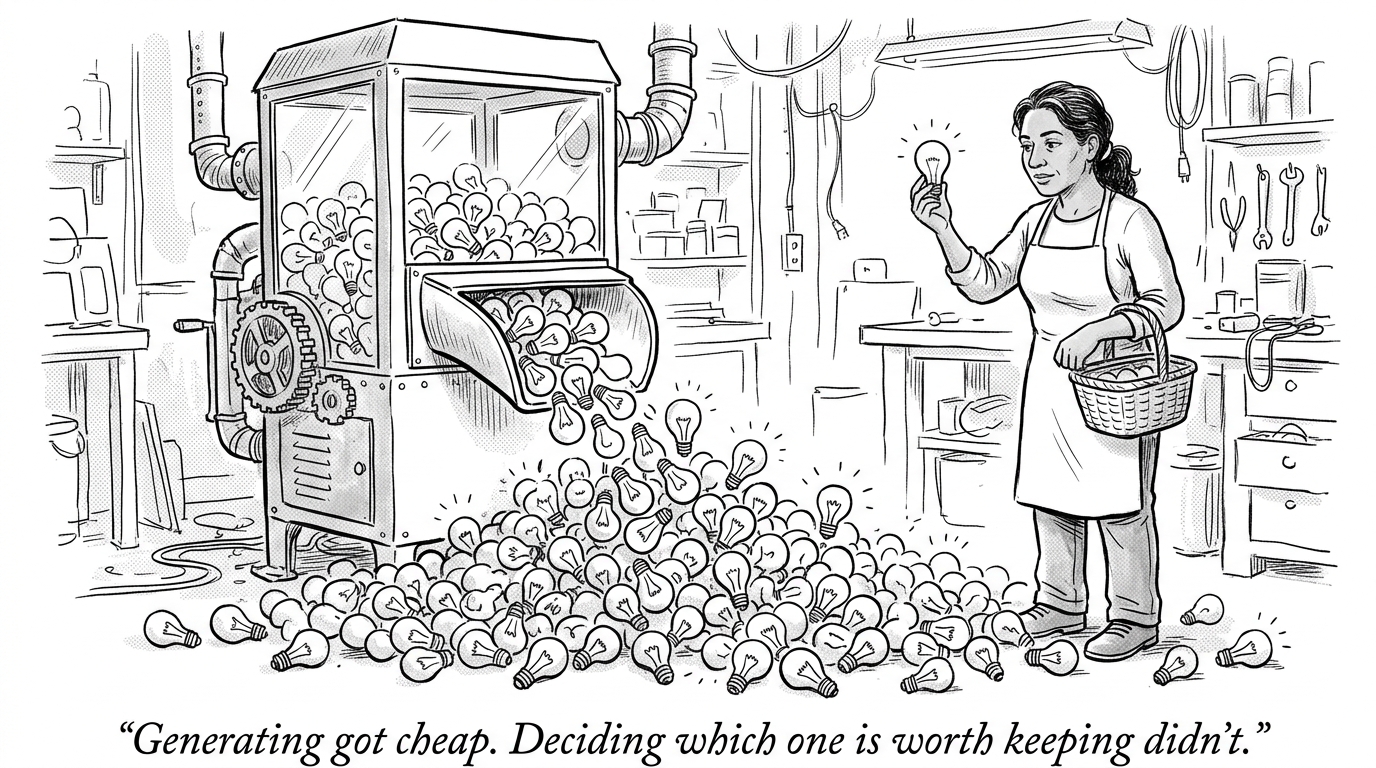
There are at least two genuinely different ways to work with an AI system well, and they ask for opposite things from the human in the room. The first is convergent: you give the system a draft or a claim, it corrects and revises against your instructions, and rigor comes from iteration -- each pass gets closer to one right answer. The second is divergent: you ask the system to generate widely, react to what comes back in short, honest signals (interesting, boring, wrong), and explicitly forbid it from converging too early, because early convergence is exactly what kills a genuinely new idea before it has room to exist.
Blend the two and both break. Correcting facts mid-brainstorm kills the divergence you asked for. Refusing to converge while you're trying to finish a sourced piece of writing just produces something unpublishable. The modes aren't stylistic preferences. They're opposite instructions, and using the wrong one for the goal you actually have doesn't just work worse -- it actively fights the outcome you were trying to reach.
What's actually different between the two modes, and what stays the same
In the convergent mode, the AI drafts and the human's irreplaceable act is judging what's true, sourced, and worth keeping. In the divergent mode, the AI generates and the human's irreplaceable act is judging what's interesting, boring, or worth pursuing further. Generation is outsourced in both modes. Judgment is outsourced in neither. That is the actual, unglamorous answer to a much louder question people keep asking about AI replacing human reasoning -- not a reassurance, a description of what's actually happening in both cases. The reasoning that matters most -- deciding what's correct, deciding what's worth pursuing -- was never the generative half of the work to begin with, and neither mode moves it off the human side of the table.
Discernment is not one thing a mind does among several others. It's closer to the actual point of having a mind at all. Strip discernment out of either mode and what's left is a store -- something that holds everything and judges nothing. And generation alone is no longer a sufficient reason to keep a human in the loop, now that AI has made generation cheap and effectively infinite. A taste function evaluating output is what both of these working modes actually depend on. The output by itself was never the scarce part.
Why this matters more than it sounds like it should
The instinct, faced with a system that can draft, code, and brainstorm faster than any person, is to ask what's left for the human to do. The honest answer, worked out across enough real sessions to see the pattern twice: judgment is what's left, and it was always the harder half. A convergent session with the correcting step skipped doesn't save time -- it produces confident-sounding output nobody actually checked. A divergent session where every idea gets accepted doesn't produce more good ideas -- it produces noise with nothing filtering it. The machine's speed is real and it is not the bottleneck. The bottleneck was always whether a human being was actually applying judgment to what came back, and that step doesn't get faster just because generation did.
The legal industry is running this exact experiment live, right now
Google entered the legal-AI market this year with Gemini Enterprise for Legal, joining an already-crowded field that includes Thomson Reuters' CoCounsel and startups like Harvey. Google's general counsel, Halimah DeLaine Prado, described the actual division of labor almost exactly the way this piece names it: "I view it as a complement, not a replacement." Her own reasoning for why: "the practice of law will always fundamentally rise and fall on the exercise of good judgment." AI's real contribution, in her framing, is speed on the generative side -- "you can now access that information in minutes, not days, which gives you more time to think" -- which is a claim about the convergent mode specifically: faster drafts and faster research don't replace the judgment step, they buy more time to actually do it properly.[1]
The cautionary side of the same industry shows exactly what happens when the judgment step gets skipped anyway. A live, continuously updated database run by legal researcher Damien Charlotin has documented more than 2,000 real court cases worldwide involving generative-AI hallucinations -- fabricated case citations, misattributed quotations, and misrepresented rulings, over 650 of them involving a practicing lawyer rather than a self-represented litigant.[2] In one 2026 case, the Georgia Supreme Court suspended a Clayton County assistant district attorney from practicing before the court for six months after she acknowledged filing a brief that cited nonexistent cases generated by AI.[1] The Ninth Circuit separately sanctioned two lawyers over a brief with fabricated citations, and was explicit about what it was actually punishing: not the use of AI itself, but the failure to verify what it produced before filing it as fact.[1] Every one of those cases is the same failure this piece already names -- generation treated as if it had already been judged, because it arrived fast and fluent.
Why does this matter? Most conversations about AI collaboration are really conversations about which mode to run and when, mislabeled as conversations about whether AI is good or dangerous. Naming the two modes precisely -- and naming discernment as the actual constant across both -- turns a vague anxiety into a practical choice: know which outcome you actually want, and choose the mode built for it, rather than assuming one general-purpose way of "using AI" has to cover every case.
This piece is one part of a longer argument. The full essay: "How to Build a Mind".