The CIA's Investment Arm Can Take an Equity Stake in Your Company. The Pentagon's Cannot -- It Can Only Write You a Check That Expires. Same Government, Two Completely Different Sets of Rules.
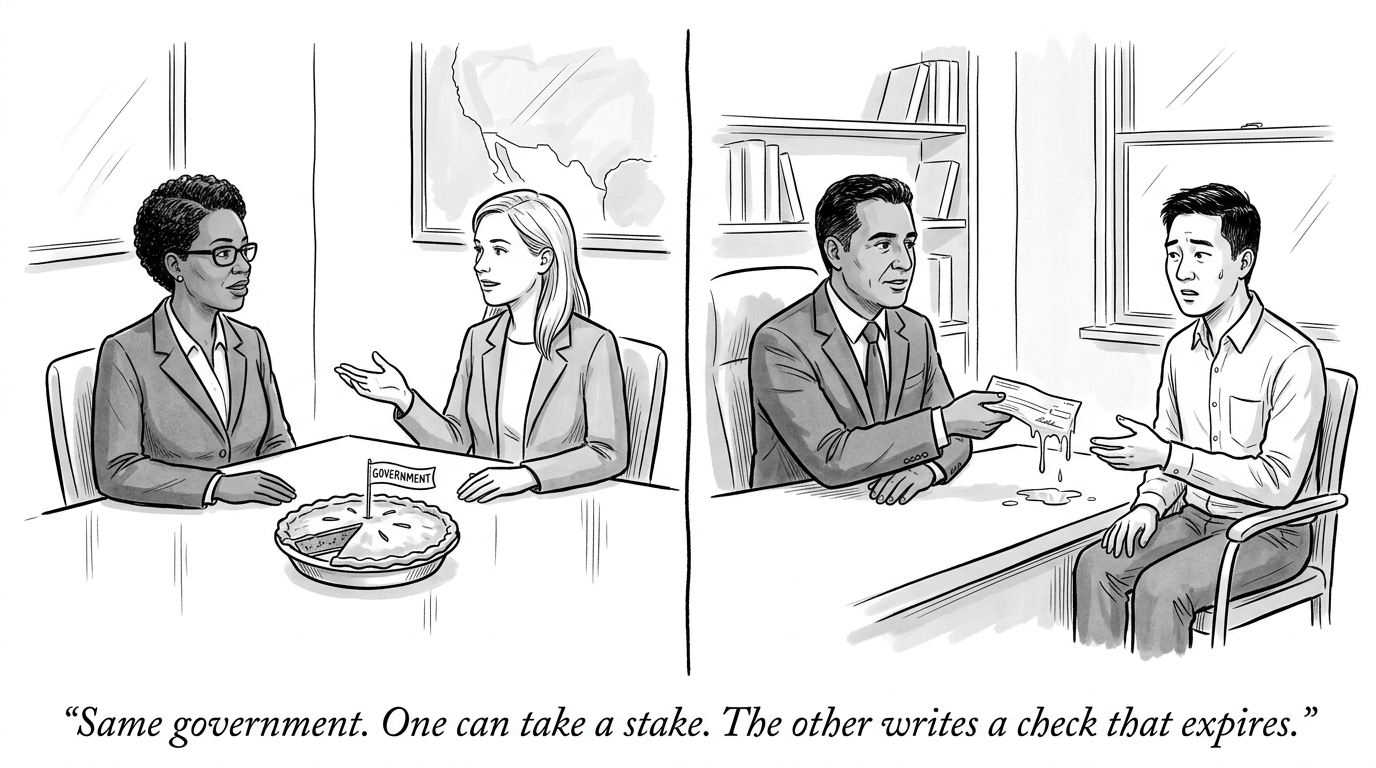
In-Q-Tel, the CIA's investment arm, and National Security Innovation Capital, the Department of Defense's equivalent, both exist to get government money into startups building technology the government wants. From the outside they look like the same kind of institution. The actual authority each one operates under is not remotely the same -- and this outlet has already covered part of why: "the seals of the IC are not equal," the CIA Act of 1949's Section 7 confidentiality exemption, which shields the CIA's organization and personnel from disclosure laws.[1] The gap between IQT and NSIC is that mechanism made concrete, in two real institutions operating side by side.
What IQT is allowed to do
In-Q-Tel takes real equity stakes in the companies it funds -- venture investment in the ordinary sense, just funded and directed toward the CIA's and broader IC's technology needs. It is a not-for-profit, founded by the CIA in 1999, and not part of the CIA itself.[4] The statutes that govern the CIA's own money do not name it. What they do give the CIA is spending flexibility: sums available to the Agency "may be expended without regard to the provisions of law and regulations relating to the expenditure of Government funds" for objects of a confidential, extraordinary, or emergency nature.[5] The CIA Act's separate confidentiality exemption protects the Agency's organization and personnel from disclosure laws; it is a non-disclosure provision, not a spending one.[6] What is observable is the result: broad discretion, and no requirement to build the kind of public content apparatus -- journal, podcast, speaking circuit -- an ordinary VC firm needs to build legitimacy and deal flow.[1]
What NSIC is restricted to
National Security Innovation Capital, launched by DIU on September 13, 2021 with a $15 million congressional appropriation, cannot take equity at all.[2] It operates through Other Transaction Agreements -- prototype contracts, not investments -- awarding hardware startups that have already reached a minimum technical maturity (TRL3 or higher) between $500,000 and $3 million, for a fixed 12-to-18-month performance period, to hit specific product milestones.[3] No ownership stake, no open-ended investment horizon, no board seat -- a defined contract with a defined end date, because DoD components operate under Title 10 acquisition oversight, and the CIA's spending flexibility in the CIA Act does not extend to them.
Both institutions were built to do the same job -- get government money to the startups building technology it needs -- and neither one had the option of copying the other's tools. IQT can own part of a company because it is a not-for-profit investment firm, not a DoD component. NSIC cannot, no matter how much it might want to, because it sits inside the Department of Defense under Title 10 oversight -- it can only write a contract, milestone-bound, with a defined dollar figure Congress actually appropriated for the purpose. The difference isn't strategy. It's the specific set of rules each institution sits inside, and no amount of institutional ambition moves either one outside its own charter.
Why does this matter? "Government investment arm" sounds like one category, and IQT and NSIC get discussed as if they were interchangeable instances of it. They are not permitted to operate the same way, by two different sets of rules written for two different parts of the government -- and a startup deciding which one to work with is choosing between a real equity partner with broad discretion and a milestone-bound contract with a hard expiration date, not between two flavors of the same offer.
Companion piece on this outlet: "The Government Picks Winners Two Ways. Only One Shows Up in the Record."
- DoAyni, The Government Picks Winners Two Ways. Only One Shows Up in the Record.
- Defense Innovation Unit, U.S. Department of Defense Launches National Security Innovation Capital
- National Security Innovation Capital, NSIC Announces Funding Milestone
- In-Q-Tel, Frequently asked questions
- Legal Information Institute, Cornell Law School, 50 U.S.C. § 3510, Termination of employment of agency employees; reports (subsection (b))
- Legal Information Institute, Cornell Law School, 50 U.S.C. § 3507, Protection of nature of Agency's functions