OpenAI Bought Its Own Mac Minis and Racked Them in Its Own Buildings. Anthropic Signed a $45 Billion, Six-Year Commitment to Rent Someone Else's Chips Instead. Same Industry, Opposite Bet on Ownership.
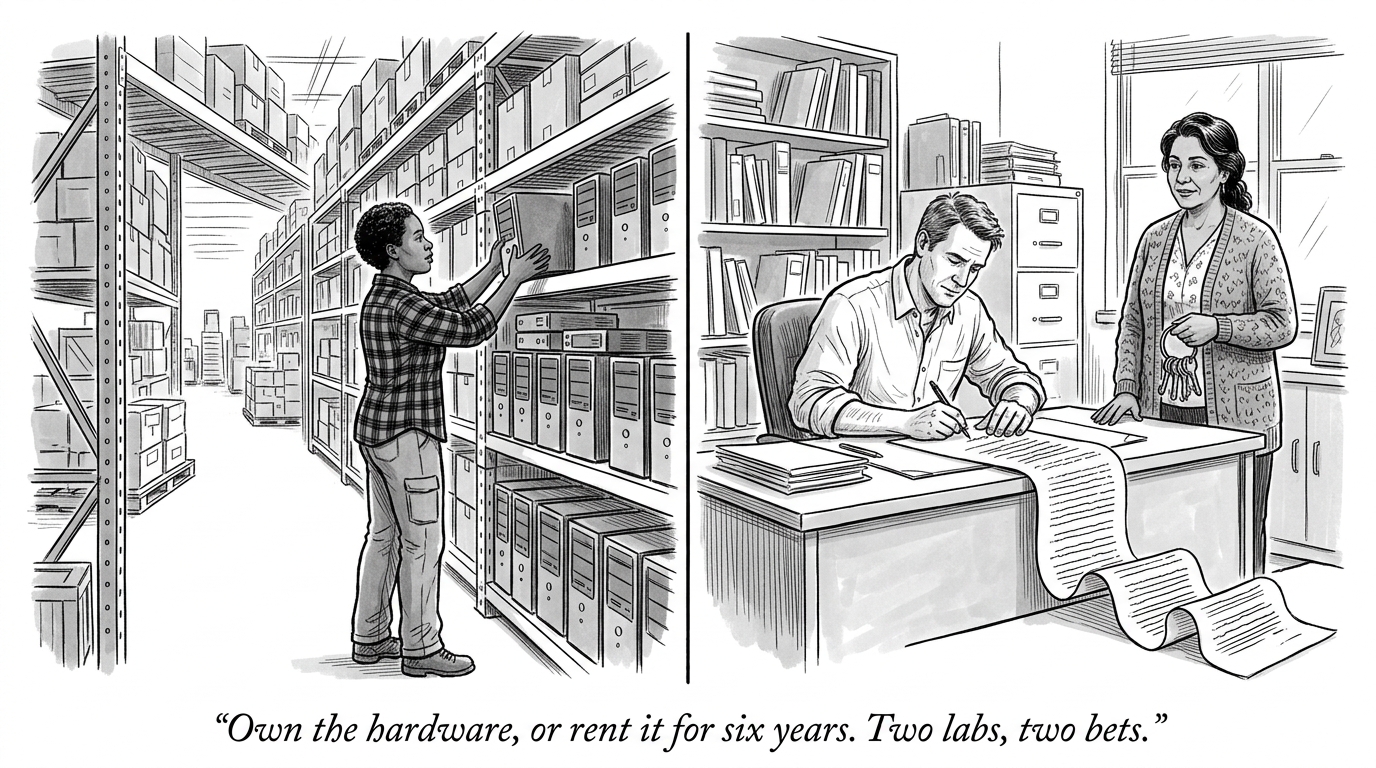
OpenAI and Anthropic both need enormous, constantly growing amounts of compute, and they are answering the question of how to get it in structurally opposite ways. OpenAI has reportedly purchased tens of thousands of Mac minis and Mac Studios outright, racked them in its own facilities, and depreciates them on its own books -- hardware it owns, available for reinforcement-learning workloads with no metered cloud bill attached.[1] Anthropic's own infrastructure commitments run almost entirely the other direction: in November 2025, a $50 billion US infrastructure program built with partner Fluidstack; a $10 billion order for Google's Ironwood TPUs, placed through Broadcom; and in August 2026, roughly $45 billion committed over six years for Nvidia Vera Rubin compute at a neocloud partner's West Virginia campus.[2] Owning hardware and committing to rent it long-term are different bets, and the two leading labs in the industry each picked a different one.
OpenAI already has a second, separate hardware bet running in parallel
The Mac mini purchases aren't OpenAI's only ownership move. This outlet has already covered OpenAI's first custom AI chip, Jalapeño, designed with Broadcom, unveiled June 2026, and built specifically to strip out training logic and optimize purely for running -- not building -- large language models, beating Nvidia's own Blackwell systems on inference-efficiency benchmarks in early testing.[3] A custom chip and a warehouse of owned Mac minis are two different scales of the identical bet: that owning the hardware, rather than renting someone else's, is worth the capital and the depreciation risk.
Neither bet is obviously the correct one, and that is what makes the divergence worth naming. Owning hardware outright means no metered bill and full control over availability, at the cost of real capital outlay and the risk of the hardware aging out before it's paid for itself. Renting at scale, the way Anthropic has structured its commitments, trades that ownership risk for long-term contractual exposure to a partner's own pricing and capacity decisions. Both labs are making a real, multi-billion-dollar bet on which risk is worse -- and they have reached opposite answers, at the same moment, competing directly against each other.
Why does this matter? "AI labs are spending enormous amounts on compute" is true of both companies and explains almost nothing about how they're actually built. OpenAI is accumulating owned, depreciating hardware assets, from Mac minis to a custom Broadcom-designed chip. Anthropic is accumulating long-term rental and purchase commitments to other companies' infrastructure. Those are different balance sheets, different risk exposures, and different bets on where compute costs go next -- not two versions of the same spending story.
Companion piece on this outlet: "Broadcom, AMD, Intel, and Micron Are All Posting Record AI Numbers Right Now..."
Update: The $45 Billion Commitment Was One Deal Among a Dozen
Three weeks after this piece published, The Information tallied every compute-capacity agreement Anthropic has signed since October 2025 and put the total at $517 billion across 14.8 gigawatts of capacity, spread across more than a dozen providers -- not the $45 billion Vera Rubin deal alone, but that deal as one line item in a portfolio more than eleven times its size.[4] Most of the contracts are structured as take-or-pay reservations: Anthropic commits to a minimum spend whether or not it uses the capacity, and none of the deals in the tally carry a clear, disclosed timeline for when the compute comes online or the bill comes due.[5]
This sharpens rather than changes the divergence this piece described. Anthropic's bet was never a single $45 billion decision -- it is a standing posture, repeated across Fluidstack, Google's Ironwood TPUs, and now more than a dozen additional providers, each one adding to the same rented, take-or-pay exposure instead of owned, depreciating hardware. The scale just went from this piece's combined disclosed total of roughly $105 billion ($50B Fluidstack + $10B TPUs + ~$45B Vera Rubin) to $517 billion -- reported by The Information ahead of Anthropic's own confidential IPO filing, meaning the rental-exposure side of this ledger is what public investors will be underwriting first.
- Shattered.io, OpenAI Buys, Anthropic Rents: Apple's AI Server Pivot
- EnkiAI, OpenAI AI & Data Center Energy 2026, $300B Oracle Deal
- DoAyni, Broadcom, AMD, Intel, and Micron Are All Posting Record AI Numbers Right Now...
- The Information, How Anthropic Clinched $517 Billion in Compute Deals in 11 Months
- 24/7 Wall St., Anthropic Locks Down $517 Billion in Compute Ahead of IPO — and It's Still Not Enough