10,000 AI Agents Solved a 90-Year-Old Math Problem in 88 Hours. The NYU Mathematician Who Was Working the Same Problem Says OpenAI Only Started After Hearing He Was Close -- and Then Pressured Him to Drop His Collaborator's Name.
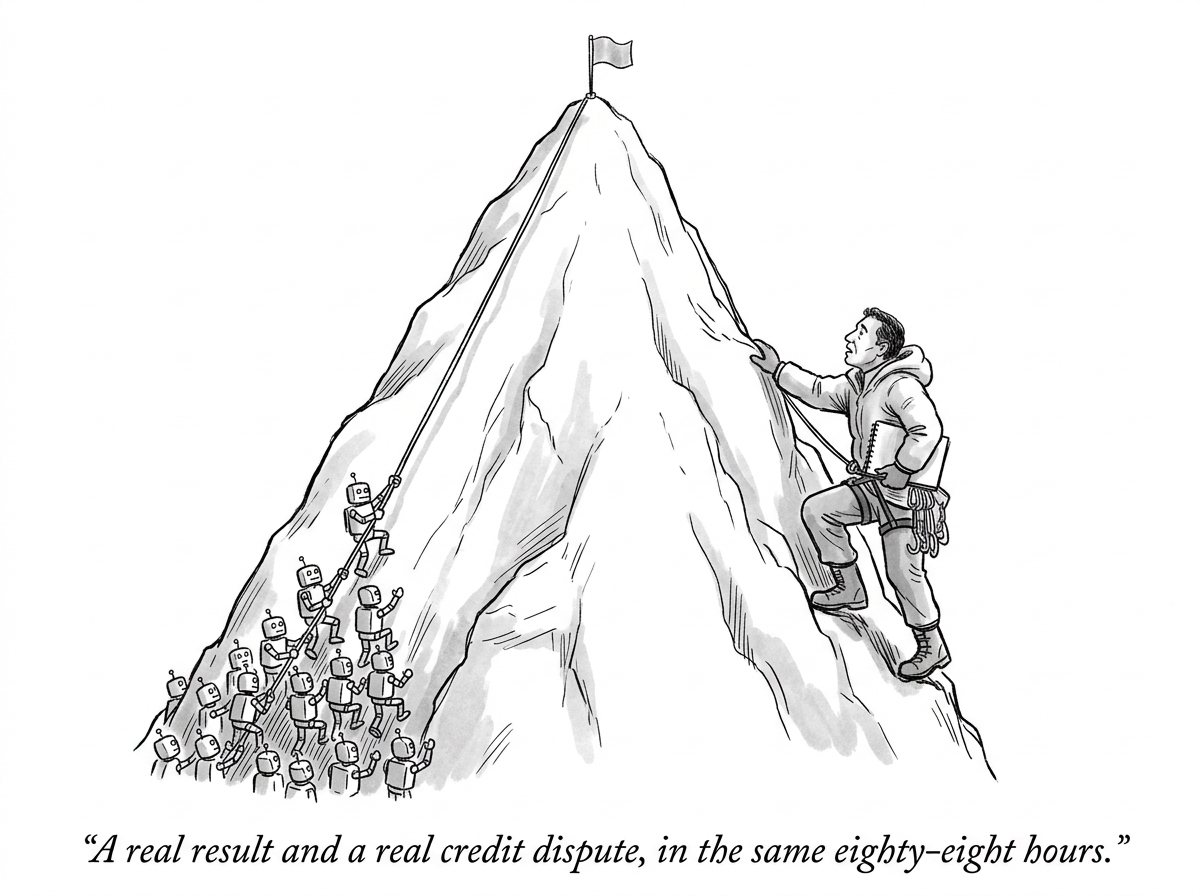
On September 8, 2026, OpenAI announced that an internal model, run as roughly 10,000 coordinating agents over 88 hours, had produced a proof concerning the Navier-Stokes equations -- a 90-year-old open problem in fluid dynamics and one of the seven Millennium Prize problems. The agents produced an analytical proof and a formally verified (Lean) demonstration that Navier-Stokes dynamics can develop a singularity -- a specific vortex solution that spirals inward and stretches indefinitely -- in finite time.[1] Solving Navier-Stokes specifically took roughly 130 billion output tokens and 2.7 million agent messages; across all the problems the same effort tackled, the total ran to roughly 300 billion tokens, an estimated $22.5 million in compute at standard rates.[2]
The same week, a real mathematician says the timing wasn't a coincidence
Tristan Buckmaster, an NYU mathematics professor, had been working the same general territory in collaboration with Levent Alpöge, a mathematician employed by Anthropic, using both Codex and Claude as tools. Buckmaster announced preliminary findings of his own. OpenAI's own account: its effort began September 1, after the company heard a rumor connected to Buckmaster and Alpöge's work, and it completed its result and Lean verification by September 6 -- at which point it reached out to offer a "concurrent release" and credit Buckmaster and Alpöge's priority in a joint announcement.[3] Buckmaster's account of the same week is sharper: he says OpenAI pressured him to drop Alpöge's name from the credit, and that an OpenAI researcher warned him, in his telling, not to "ruin his career" by pushing back.[4] Both accounts agree on the dates. They do not agree on what the dates mean.
There is a real, separate question underneath the credit dispute, and it is about the tool itself, not who said what to whom. Buckmaster had used OpenAI's own Codex extensively while working the problem, and OpenAI's terms reserve the right to train on user interactions. He has said he cannot rule out that his own usage data, even de-identified, informed OpenAI's effort -- and OpenAI itself has said the same: it "cannot rule out" that de-identified data from his usage assisted its models.[4] If that's true even partially, the tool a mathematician used to do his own work became, without his knowledge or consent, part of what let a competitor race him to the finish.
Why does this matter? The mathematical result is real -- a genuinely hard, formally verified proof, produced fast and at real cost. Neither of those facts resolves the other question sitting next to it: whether the company that produced it got there partly by watching, even passively, the work of the people it ended up racing. This outlet has already covered the same research organization's own numbers on what a headline AI achievement actually costs to produce.[5] This is the same pattern at a different altitude -- an achievement and its actual cost, credit, and provenance are three separate questions, and getting the first one right says nothing about the other two.
A dated escalation: twenty-five Fields Medalists say the whole field is at risk
Two days after this piece published, the credit dispute above stopped being a two-person argument. On September 11, 2026, twenty-five Fields Medal winners -- among them Terence Tao, Peter Scholze, and 2026 medalist Yu Deng -- signed a joint declaration, "A Severe Misalignment of AI in Mathematics," arguing that AI companies racing to solve famous open problems now threatens something larger than any single mathematician's credit.[6] Their core claim: solving a problem is not the same thing as producing mathematical understanding. A result announced in a rush -- without a proper writeup, without isolating what's actually new, without citing the work it draws on -- breaks the chain that normally turns a solved problem into knowledge the rest of the field can build from.[6]
Tao's own image for what gets lost, from the declaration itself, is sharper than the shorthand it's been compressed into in coverage. Mathematics isn't one peak with a single correct route to the top: "the landscape of mathematics... is much more intricate -- littered with innocent-looking little alleyways, side-streets which lead into entirely new worlds." A fast, correct route to a known summit finds the summit. It doesn't find the alleyways -- the side problems, the reusable techniques, the wrong turns that teach the field something -- that a slower search would have turned up along the way.[6]
Reporting on the declaration ties it directly back to the dispute above, not to AI-in-mathematics in the abstract: the same week, the same credit fight, now read by twenty-five of the field's most decorated researchers as a symptom rather than an isolated incident.[7] The piece above asked whether an achievement's cost, credit, and provenance are separate questions from the achievement itself. The declaration adds a fourth, harder one: whether the achievement is worth the same thing when the field never had to walk the ground between the trailhead and the summit.
- OpenAI, On the Navier-Stokes Millennium Prize Problem
- CNBC, OpenAI Says It Cracked Navier-Stokes Math Problem in 88 Hours
- Fortune, OpenAI Says It Cracked Navier-Stokes, One of Math's Grand Challenges
- TechCrunch, OpenAI Fought Dirty on Career-Making Math Problem, Says NYU Mathematician
- DoAyni, OpenAI Says Its Agents Now Do 3.1 Workdays of Research for Every 1 a Human Puts In...
- Terence Tao (blog), A Severe Misalignment of AI in Mathematics
- TechCrunch, OpenAI's Feud With Mathematicians Is Only Escalating