Park City Mountain's Ski Patrol Struck for 13 Days to Win a $2-an-Hour Raise. A Peak-Day Lift Ticket There Now Costs $369 -- Up 42% Since Vail Resorts and a Rival Conglomerate Started Competing to Out-Build Each Other's Half of the Same Town.
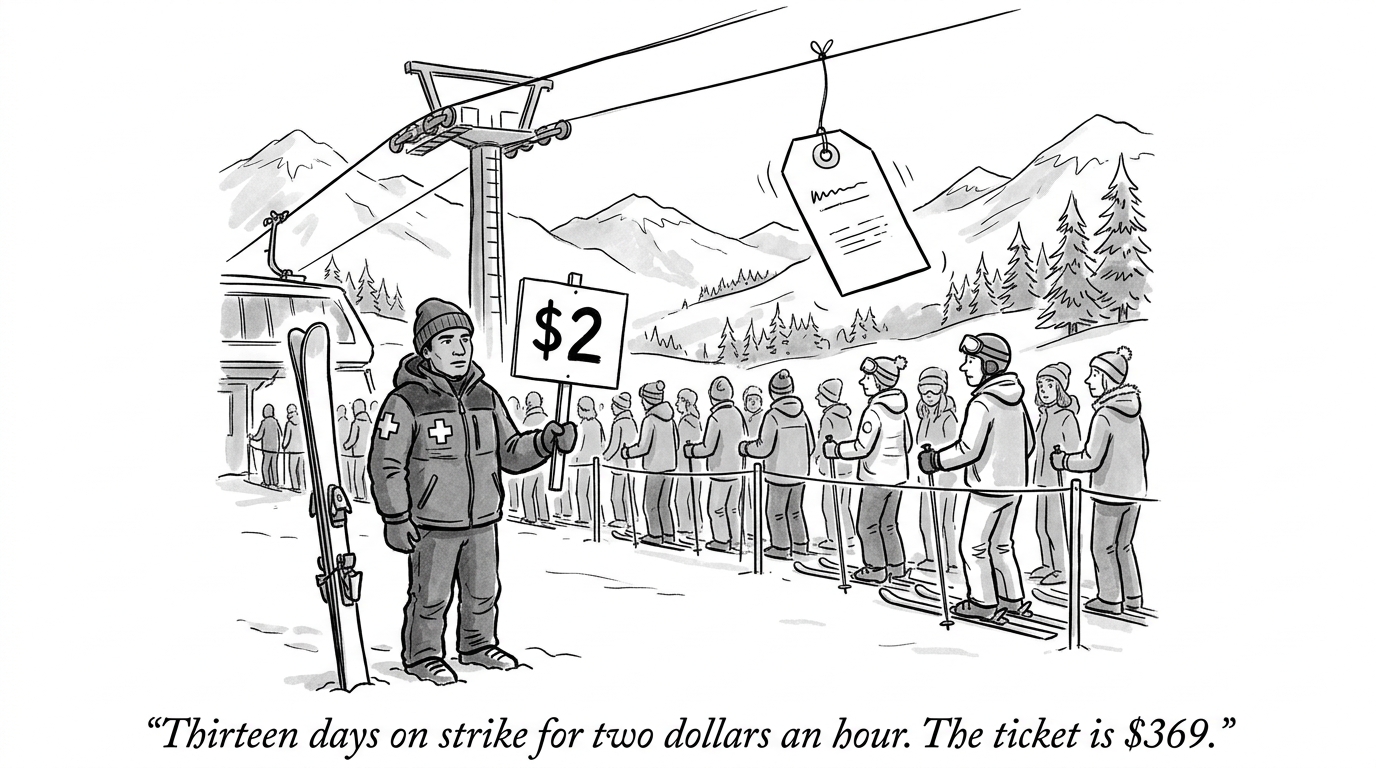
Roughly 200 ski patrollers and mountain-safety workers at Park City Mountain Resort walked off the job on December 27, 2024, launching an unfair-labor-practice strike against Vail Resorts that ran thirteen days through the resort's busiest week of the year. The Park City Professional Ski Patrol Association had been working without a contract since April 2024, demanding starting wages rise from $21 to $23 an hour; Vail's counteroffer was a 4 percent raise plus a $1,600 equipment allowance. The union filed four separate unfair-labor-practice charges with the National Labor Relations Board, citing a 55-day delay before Vail even returned a counteroffer. A new contract was signed in January 2025, ending the strike at the largest ski resort in the United States.[1]
Two rival empires, one small town
Park City Mountain -- combined with the neighboring Canyons Resort under a connecting gondola Vail Resorts built in 2015 -- covers roughly 7,300 skiable acres, making it the largest single ski resort in the country.[2] Deer Valley, a separate resort inside the same small town, is not part of that combination at all -- it's owned and operated by Alterra Mountain Company, Vail's direct rival, which runs the competing Ikon Pass against Vail's Epic Pass.[3] Park City, Utah is not one company's consolidated mega-resort. It's the ground floor of a turf war between two of the ski industry's largest conglomerates, operating side by side in the same town.
Both sides are pouring money into out-building each other
Alterra announced more than $400 million in new investment at Deer Valley -- resort expansion, on-mountain infrastructure, and, notably, "meaningful enhancements to employee benefits and housing."[4] Trade press described the resulting build-out as the largest ski-area expansion underway anywhere in the US as of summer 2025.[5] Park City Mountain, for its part, is explicitly positioning itself to compete directly with Deer Valley on hospitality and guest experience, not just terrain.[6] Two publicly traded and private-equity-backed giants are spending hundreds of millions of dollars competing for the same skiers, in the same valley, at the same time.
The capital arms race and the wage floor are not obviously connected in either company's own spending, and that gap is the actual story. A peak-day ticket at Park City Mountain now costs $369 -- up 42% in four seasons, and among the priciest in the country, behind only Vail Mountain and Beaver Creek.[7] The people whose job is to keep that mountain safe to ski on had to strike, file federal labor charges, and hold out through the resort's highest-revenue week of the year to close a two-dollar-an-hour gap. Hundreds of millions of dollars are visibly flowing into terrain expansion and hospitality upgrades on both sides of this rivalry. Whether any comparable amount is flowing toward the wage floor of the people who make either mountain operable at all was not something either company chose to lead with.
Why this isn't just a ski story
Utah's tech sector markets itself as "Silicon Slopes" -- and the skiing in that name is not a metaphor. Among Utah natives working in tech who left the state and later moved back, 82% cited outdoor recreation and access to wilderness as the single most important reason for returning, ranking above family, career opportunities, and cost of living. Among tech workers who turned down a higher salary elsewhere to stay in Utah, 85% named the same reason.[8] One Utah tech CEO has described an informal "powder rule": six inches of fresh snow overnight, and employees are expected to go ski it.[9] Utah's entire tech-recruiting pitch runs, in real and measured part, on the assumption that the mountains above Park City stay affordable, accessible, and well-run. Who owns those mountains, what they charge to ski them, and how they treat the people who run the lifts and patrol the runs isn't a story adjacent to Silicon Slopes. It's sitting underneath the actual recruiting pitch.
Why does this matter? The Park City strike and the Vail-Alterra rivalry both got covered, separately, as ski-industry news. Read together, they're a single, sharper story: two of the largest companies in outdoor recreation are competing to out-spend each other on terrain and guest experience in one small Utah town, while the workers who keep either resort actually running had to strike to close a wage gap smaller than the price increase skiers absorbed in the same stretch of time -- and the entire arrangement sits underneath a tech-recruiting identity that depends on skiers, workers, and mountains all staying in a kind of balance neither company's spending was obviously built to protect.
- Utah News Dispatch / Deseret News, Park City Mountain Ski Patrollers Go on Strike / Labor Dispute
- CBS Colorado / Fox News, 2 Utah Ski Resorts Owned by Vail Combined Under One Gondola, 7,300 Acres
- Alterra Mountain Company, About Us -- Ownership of Deer Valley and Solitude Mountain Resort, Ikon Pass
- Alterra Mountain Company, Alterra Mountain Company Announces Major Expansion of Deer Valley Resort
- Park Record, Largest Ski Area Expansion in U.S. Bites Off Big Chunk This Summer
- Salt Lake Tribune, A New Ski Rivalry? Park City Mountain Says It Can Beat Deer Valley at Hospitality
- TownLift, Park City, Deer Valley Among the Country's Priciest Ski Days as 2026-27 Tickets Climb Again
- Utah Office of Economic Opportunity, Survey Respondents Cite Trails, Skiing, and Access to Wilderness as Most Important Perks in Utah's Tech Industry
- Fortune, Startups, Utah, Silicon Slopes: Engineering, Funding, Talent