In 1981, One Phrase Explained How Steve Jobs Got an "Impossible" Deadline Met Anyway. AI Can Now Produce the Same Confidence -- Without Anything Behind It That Could Actually Close the Gap.
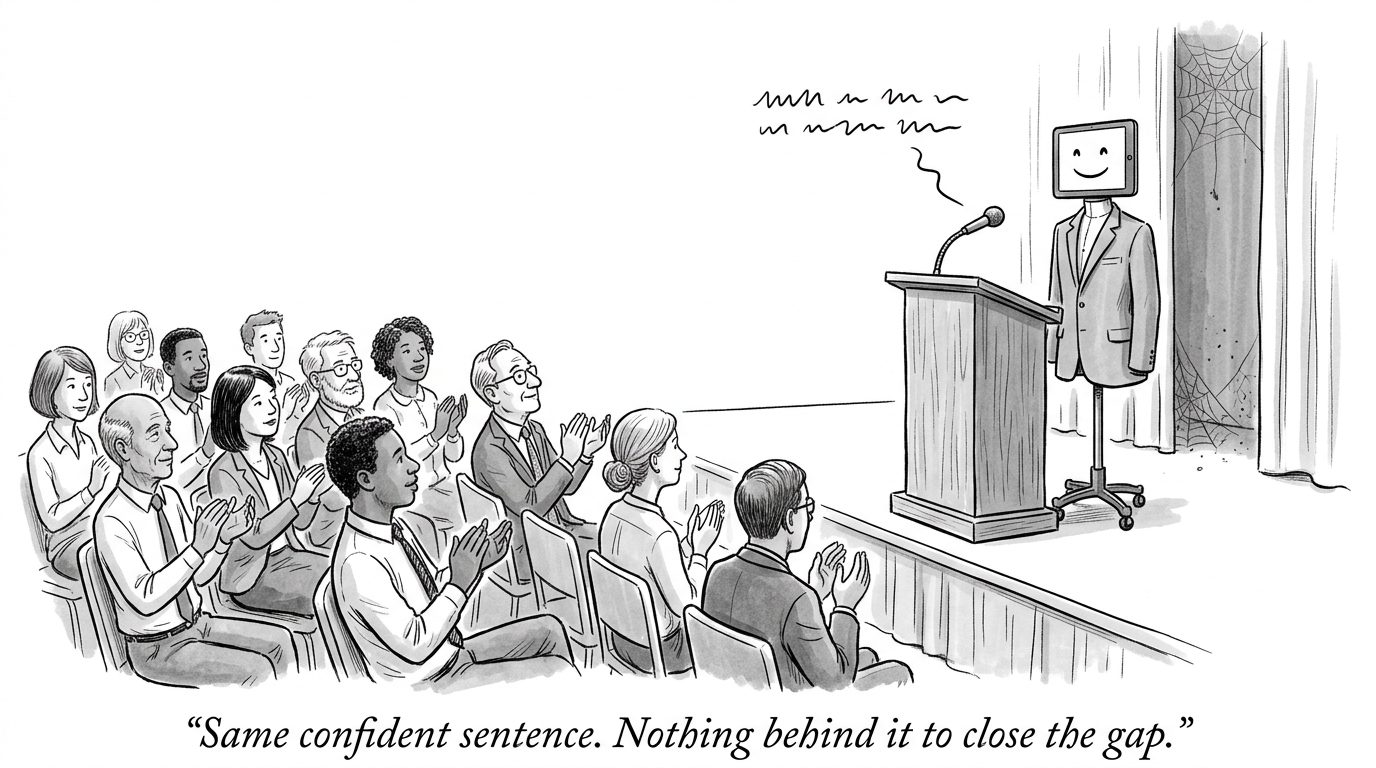
In 1981, Apple software engineer Bud Tribble coined a phrase to describe working for Steve Jobs on the original Macintosh team: the "reality distortion field." Tribble borrowed the term from a Star Trek episode, "The Menagerie," in which aliens create entire virtual realities inside other people's minds. Jobs, in Tribble's telling, used a mix of charm, charisma, bravado, hyperbole, and sheer persistence to convince people -- himself included -- that an "impossible" spec or deadline was achievable, distorting everyone's sense of what was actually realistic.[1] The phrase stuck because it named something real: teams that believed the impossible thing was possible sometimes made it possible, purely by acting as if it already were.
The uncomfortable, honest part: sometimes it wasn't false belief. The conviction was the cause.
The easy version of this story treats Jobs' reality distortion field as a con -- a founder lying to his team about what was achievable, and getting lucky often enough that the myth survived. The harder, more honest version is different: except for the hard limits of physics, human conviction is a genuine, if unreliable, creative mechanism. A team that believes a deadline is real works differently than a team that's been told it's impossible -- innovates faster, adapts under pressure it wouldn't otherwise have found, closes gaps that looked unclosable from the outside. The belief didn't just misdescribe the situation. In real cases, it changed what the team actually did, and that changed effort is what closed the distance between "impossible" and "shipped." Physics is the one hard boundary an actual physical law does not bend to conviction. Short of that, will is a real, if gambling, causal force.
AI-generated confidence has no equivalent mechanism, and that is the entire difference. A confident, fluent AI output can produce the identical psychological effect on a listener that a Jobs-style pitch produced on a 1981 Apple engineer -- persuasive, assured, hard to argue with in the moment. What it cannot do is marshal any actual effort, innovation, or adaptation into existing. Jobs' conviction changed what people then went and did. An AI telling someone a plan will work doesn't change what anyone does at all unless a human separately decides to act on it -- it only changes what someone believes, with nothing behind that belief that could close the gap between believing it and it being true.
Why this isn't the same risk at a bigger scale -- it's a different risk entirely
It's tempting to treat AI-generated overconfidence as just a faster, more available version of a Steve Jobs pitch -- the same danger, just no longer requiring an actual rare, gifted individual to be in the room. That framing undersells the real difference. The human version is a genuine gamble that sometimes pays off, precisely because conviction is a real causal force that can produce real effort. The AI version is pure downside risk with no corresponding upside mechanism at all -- confident language with nothing generative attached to it. Whether AI-induced overconfidence is actually dangerous in a given situation depends on what kind of constraint is actually in play: a physics-like constraint (attrition, logistics, a fixed force ratio) that will genuinely does not move, or a will-like constraint (morale, improvisation, adaptation under pressure) where belief has historically made a real difference. Confusing which kind of constraint is actually in front of you is where the real danger sits -- not confidence by itself, and not AI by itself.
Human self-deception, unlike AI confidence, is bounded by something real
Behavioral economist Dan Ariely's research on dishonesty found something specific and measurable about how people deceive themselves: most people who cheat given the chance don't cheat as much as they could get away with. Ariely calls the ceiling on this a "fudge factor" -- roughly the amount of self-serving distortion a person can indulge while still seeing themselves as fundamentally honest, typically far short of the maximum available.[2][3] That boundary is the real difference worth naming. Human self-deception, including the Jobs-style conviction that an impossible deadline is achievable, stays tethered to something -- a self-image, a stake in being right later, a real cost if the belief turns out false. AI-generated confidence has no comparable ceiling, because it isn't protecting anything of its own. There is no fudge factor limiting how confidently a system will state something, because there is no self on the other side of the output with anything on the line.
Why does this matter? "Don't trust an overconfident AI" is true but not useful on its own -- humans are frequently, sometimes usefully, overconfident too, and that hasn't made human conviction worthless. The sharper test is whether anything real is happening behind the confident sentence: with a human, conviction can be the thing that goes and does the work. With an AI, the sentence is the whole event. Nothing follows it unless a person separately supplies the will -- which was the actual scarce ingredient in the Jobs story all along, not the confidence itself.
This piece is one part of a longer argument. The full essay: "How to Build a Mind".