A Federal Law Requires Public Schools to Fund Boys' and Girls' Sports Equally. No Law Requires Funding Band or Art at All. One California High School's Band Program Covers 77% of Its Own Budget Through Bake Sales and Ticket Sales.
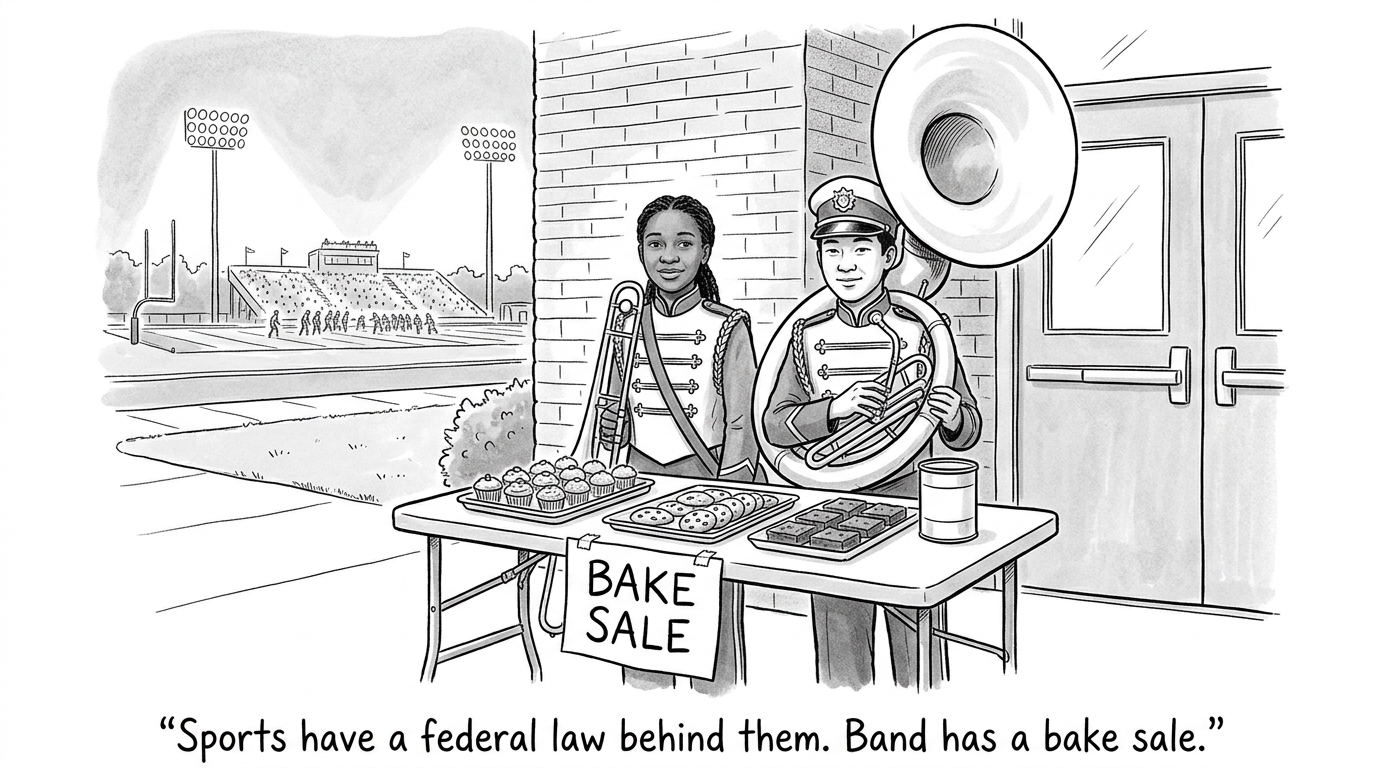
San Dimas High School's band program runs on an $80,000 annual budget. Only $18,000 of it -- about 22 percent -- comes from the district and school. The remaining $62,000, roughly 77 percent, comes from fundraising and ticket sales the program has to generate itself.[1] That ratio is not a story about one underfunded school. It's the normal operating model for school music programs nationally -- band booster clubs exist specifically because, as one music-education resource puts it plainly, "the funds allocated do not come close to fulfilling the actual program needs."[2] Bake sales, car washes, and ticket sales aren't a fundraising strategy layered on top of a functioning budget. For most band programs, they are the budget.
One law protects athletics funding. No law protects band's.
Title IX, the 1972 federal civil rights law, does not just prohibit sex discrimination in school athletics -- its 1979 Policy Interpretation imposes a real, enforceable funding test: schools must provide proportional financial assistance and equal opportunity across men's and women's athletic programs, backed by federal compliance review and the threat of lost funding.[3] No equivalent exists for arts or music education. The closest federal language is the Every Student Succeeds Act (2015), which names music and the arts as part of a "well-rounded education" -- a description, not a funding mandate. ESSA creates no proportionality test, no compliance review, and no enforcement mechanism comparable to Title IX's.[4] One program category has a federal law that can force a district to spend money on it. The other has a sentence saying it's important.
A second federal policy pushed arts funding down further
The No Child Left Behind Act (2002) tied federal school funding directly to standardized test scores in reading and math, and districts responded exactly as the incentive predicted. A 2006 Center on Education Policy study of districts nationwide found 71 percent had cut instructional time from other subjects specifically to increase time spent on English and math; 22 percent of elementary schools reported reducing music and art education as a direct result.[5] Title IX and NCLB were not written with each other in mind, and neither mentions band directly. But run together, one law legally protected athletics funding while a separate law was actively incentivizing cuts to arts and music -- two independent federal policies pulling in opposite directions on two different school programs, for two decades, without either one intending the outcome.
The equity cost isn't evenly distributed either
An estimated 7,000 US public schools have no music program of any kind, and those schools are concentrated disproportionately in districts serving Black, immigrant, and low-income student populations.[2] A funding model that depends on a booster club raising $62,000 a year doesn't just create inconvenience where it applies -- it silently gates the entire opportunity behind whether a school's parent body has the time, connections, and discretionary income to run that fundraising operation at all. A district's 22 percent isn't the floor a program needs to survive. It's the floor the district is legally required to provide nothing more than.
This isn't really a story about which program a district values more, and treating it as one misses the actual mechanism. A NAMM Foundation study of ten school districts found music programs spend an average of just $368 per music student in district-level costs -- and, counterintuitively, large ensemble programs are one of the few courses that actually save a district money as participation grows, because per-pupil funding formulas reward enrollment while the marginal cost of one more chair in a band room is small.[6] Band isn't expensive to a district in the way people assume, and it still runs on bake sales -- because the constraint was never really about cost. It's about which program has a federal law forcing the money to show up, and which one only has a sentence saying it matters.
Why does this matter? The honest question underneath "why does the band need a bake sale" isn't about band directors, football coaches, or which activity a superintendent personally prefers. It's about two federal policies, written decades apart for unrelated reasons, that together decided which school programs get a legally enforceable funding floor and which ones get an unenforceable mention in a well-rounded-education clause -- and a national pattern of nearly 7,000 schools with no music program at all shows exactly where the unprotected side of that line actually lands.
- School Music Consulting, The Cost of Not Playing: How Music Participation Shapes the Financial Health of a School District
- Save the Music Foundation, Why Are Schools Cutting Music Programs? Learn the Facts
- Congressional Research Service, Title IX and Athletics: Legal Basics
- Music & Arts, Title IV Part A: A Look at New Federal Funds for Music Education
- Center on Education Policy (2006 study, via secondary reporting), Impact of No Child Left Behind on Arts and Music Education -- 71% of Districts Cut Time From Other Subjects
- NAMM Foundation (10-district study, via School Music Consulting), Average District-Level Music Education Spending Per Student -- $368