Singapore Pays Its Prime Minister $2.85 Million a Year -- More Than 7 Times the US President's Salary. The Argument Is That Underpaying the Job Is What Makes a Government Corrupt.
Singapore's Prime Minister Lawrence Wong will see his salary rise 64%, to roughly S$3.6 million (about $2.85 million), starting October 15, 2026 -- making him, again, the world's highest-paid head of government by a wide margin.[1] For comparison: the US president is paid $400,000. The UK prime minister is paid roughly $230,000. Singapore's premier will be paid more than seven times the American figure and more than twelve times the British one.[2]
The number isn't arbitrary -- it's pegged to a formula
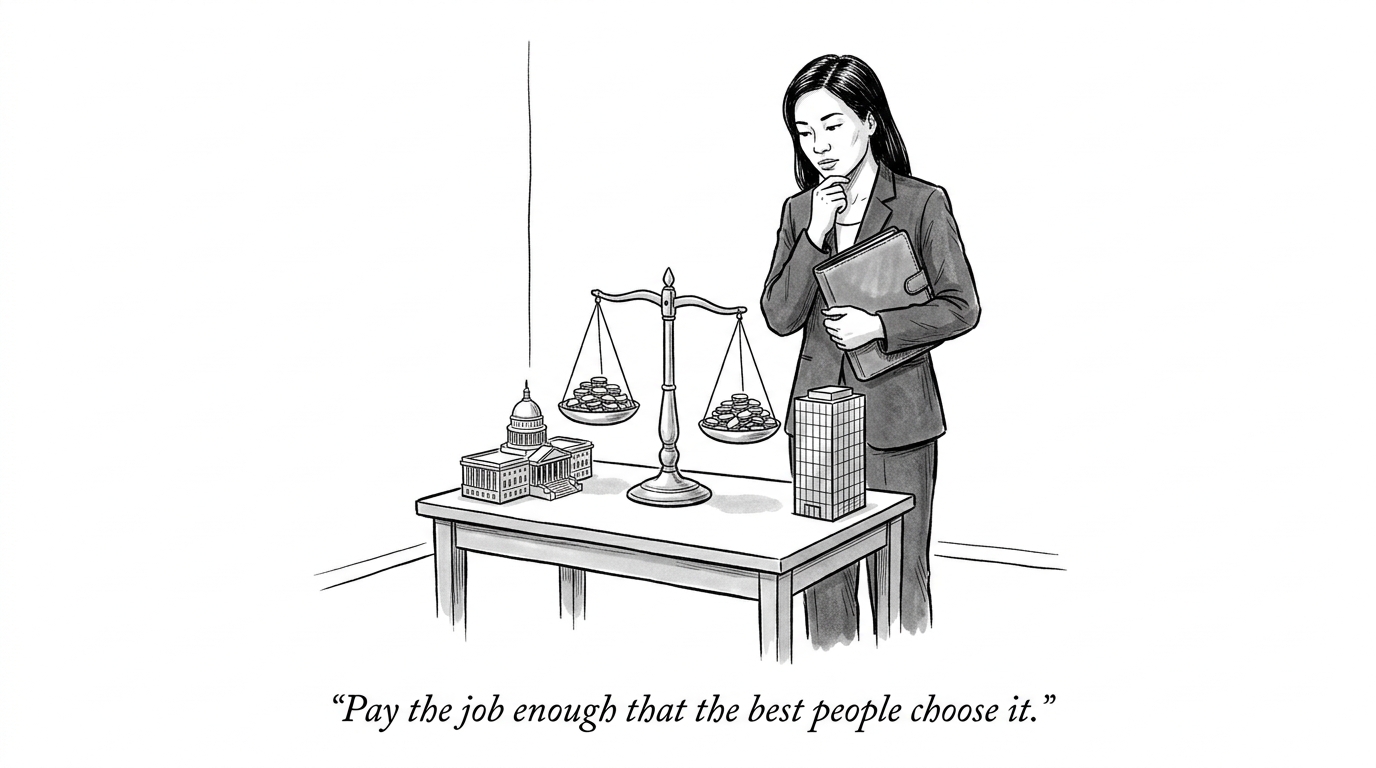
Singapore benchmarks political salaries against the median income of the country's top 1,000 private-sector earners, then applies a mandatory 40% discount to reflect the nature of public service.[1] This is the first revision to that formula in 15 years. The stated logic, running back to the policy's origin under Lee Kuan Yew: if a country wants its most capable people choosing government over the private sector, the government has to be able to compete on pay -- and a government that underpays its officials is a government that has priced in, and therefore invited, the alternative forms of compensation corruption usually takes.
The honest complication, not smoothed over: correlation here is not the same as a clean causal proof. Singapore ranks third of 182 countries on perceived public-sector corruption -- a genuinely strong result. But Hong Kong, which pays its officials far less, scores well on the same measure too.[1] High pay is not sufficient on its own; Singapore's model pairs it with something the salary number alone doesn't capture -- corruption there is, by every account, reliably and severely punished, regardless of rank. The pay buys less temptation. The enforcement is what closes the rest of the gap.
Why does this matter? Every country makes a version of this trade whether it names it or not. Pay a public job below its private-sector equivalent, and you get some mix of three outcomes: people willing to take a pay cut for the mission (real, and finite), people who plan to make up the difference some other way (the corruption risk), or a talent pool that simply self-selects out before it ever applies. Singapore's $2.85 million figure is a country making that trade-off explicit and betting on the first option being crowded out by the third if the number is too low -- an uncomfortable, fully disclosed piece of civic-design math that most systems leave as an unstated assumption instead.