John Tyler Declared Himself President in 1841. It Took Congress 126 Years to Write That Rule Down. The Senate's 60-Vote Threshold Still Isn't Written Anywhere at All.
On April 4, 1841, William Henry Harrison died in office, and the Constitution had no real answer for what happened next. The text said the powers and duties of the presidency "shall devolve on the Vice President" — but it never said whether Vice President John Tyler actually *became* President, or was only standing in as an "Acting President" until a special election could be held. Nobody had tested the clause before; Harrison was the first president to die in office. Tyler didn't wait for Congress to decide. He had himself sworn in, moved into the White House, and started signing bills as President, full stop.[1]
Congress grumbled, then folded. The House and Senate passed a joint resolution addressing him as President, and that was that.[1] Nothing in the Constitution had actually been amended. Tyler had simply asserted the office, and the assertion held — because enough people with the standing to challenge it decided not to. Eight more Vice Presidents followed the identical, unwritten precedent after a president's death, for 126 years, before the 25th Amendment finally wrote Tyler's improvisation into the Constitution's own text in 1967.[2]
The same shape, a different branch, twenty years apart
George Washington chose not to seek a third term. Nothing compelled that choice — no law, no clause, nothing. It became custom anyway, honored by every president for the next 150 years, until Franklin Roosevelt ran for a third term in 1940 and won.[3] He won a fourth in 1944, and died three months into it. Congress didn't move to make the two-term norm binding until after Roosevelt had already broken it and then died holding an office the tradition said he shouldn't have had a third time — the 22nd Amendment wasn't ratified until 1951, six years after Roosevelt's death, eleven years after the norm was already gone.[4] The rule didn't stop the thing it was written to stop. It was written down only once the thing had already happened.
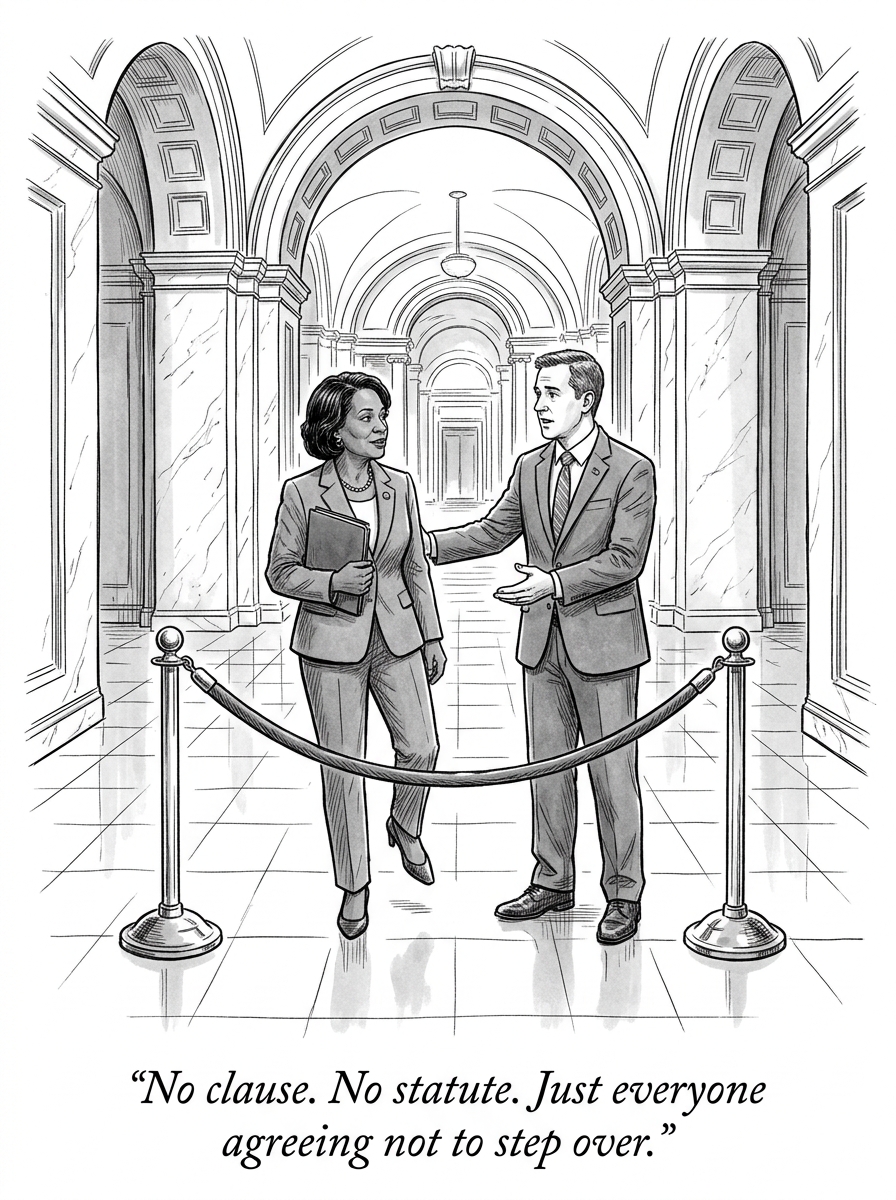
The pattern, named plainly. A tradition is not a weaker version of a law. It is a completely different kind of thing wearing the same clothes: something everyone with the power to break it has simply chosen, so far, not to. It survives right up until someone decides the cost of breaking it is lower than the cost of keeping it — and then it's gone, sometimes for years, before anyone bothers writing down what should replace it. The Constitution's actual supermajority requirements are narrow and specific: two-thirds of the Senate to ratify a treaty, two-thirds of both chambers to override a veto, two-thirds of the Senate to convict on impeachment, two-thirds of both chambers plus three-quarters of the states to amend the document itself. That's the whole list. Nothing in it requires a supermajority to pass an ordinary bill, or to confirm a nominee.
A rule the Senate wrote for itself, and already knows how to unwrite
Which is what makes the Senate's own 60-vote threshold different from all three examples above — it was never even close to being unwritten. It's Rule XXII, and the Senate wrote it for itself, under its own Article I, Section 5 authority to set its own procedures. Before 1917 the Senate had no way to force a vote on anything at all; any single senator could talk until the chamber gave up. That changed only after a filibuster killed Woodrow Wilson's proposal to arm merchant ships against German U-boats weeks before the US entered World War I. Wilson's response, on the Senate floor's own record: "a little group of willful men, representing no opinion but their own, have rendered the great Government of the United States helpless and contemptible."[5] Rule XXII passed days later, requiring two-thirds of senators present to end debate. The Senate softened it to three-fifths of the full chamber — 60 of 100 — in 1975, specifically because the two-thirds bar was producing too much gridlock.[6]
Even the number itself has already moved once, by the Senate's own hand, because the Senate found the old number inconvenient. It has never been a constant.
The Senate already answered "is 60 votes really necessary" — twice, on party-line votes
On November 21, 2013, Senate Majority Leader Harry Reid triggered what both sides call the "nuclear option": a simple-majority vote, 52-48, reinterpreting Rule XXII so that executive-branch nominees and federal judicial nominees below the Supreme Court could be confirmed with 51 votes instead of 60. Reid's stated justification was concrete: of 168 filibusters against nominations in the country's entire history, half had happened under one president.[7] On April 6, 2017, Majority Leader Mitch McConnell did the identical thing to confirm Neil Gorsuch to the Supreme Court — another 52-48 party-line vote, extending the same simple-majority rule to the one nomination category Reid had deliberately carved out four years earlier.[8]
Both changes left ordinary legislation completely untouched. A bill still needs 60 votes to survive a cloture motion, the same 60-vote wall a war-funding supplemental is sitting behind in the Senate right now.[10] The chamber that decided 60 votes wasn't load-bearing enough to protect a lifetime Supreme Court appointment continues to treat it as untouchable for a bill — not because the Constitution draws that line anywhere, but because, so far, nobody with the votes to erase it there has wanted to badly enough.
Even the paperwork is a courtesy, not a law
The same year Rule XXII was born, the Senate Judiciary Committee started a second, smaller tradition: the "blue slip," a literal blue piece of paper sent to a judicial nominee's home-state senators for their approval or objection before a nomination proceeds. It has never been a written rule of the Senate or the committee — purely an informal courtesy, which means whoever chairs the Judiciary Committee can honor it, ignore it, or redefine it at will, and different chairs from different parties have done exactly that depending on which party controls the White House.[9] A century-old custom, resting on nothing but whoever happens to hold the gavel choosing to keep observing it.
Which is exactly the mechanism sitting behind a strait 7,000 miles away
None of this is abstract civics trivia. It's the same live mechanism behind the $87 billion Iran-war supplemental currently stuck in the Senate — Democrats withholding the 60 votes needed for cloture, on a bill that also carries $11 billion in farm aid and $1 billion for a New York train station.[10] The 60-vote wall blocking that bill and the 60-vote wall the Senate already dismantled twice for nominees are the exact same rule, held to different standards for different kinds of votes, by choice, not by any text that draws that distinction anywhere.
The honest version of "how the government works" isn't the Constitution plus statute. It's the Constitution, plus statute, plus a much larger and less visible layer of habits nobody has gotten around to breaking yet — or already has, and just hasn't bothered writing the new rule down. Tradition isn't the soft, ceremonial half of government. In practice, it's most of it.
Part of this outlet's ongoing "how government actually works" thread: "Mitch McConnell Blocked a Supreme Court Nominee for 11 Months Because an Election Was Eight Months Away...".
- White House Historical Association, John Tyler and Presidential Succession
- Congress.gov -- Constitution Annotated (Library of Congress), Presidential and Vice-Presidential Vacancies Before the Twenty-Fifth Amendment's Ratification
- History.com, How FDR Became the 1st -- And Only -- President Elected to 4 Terms
- FindLaw, Twenty-Second Amendment: Presidential Term Limits
- National Constitution Center, How to End a Filibuster: World War I and the Origin of the Cloture Rule
- Bipartisan Policy Center, The Senate Filibuster, Explained
- The Washington Post, Reid, Democrats Trigger 'Nuclear' Option; Eliminate Most Filibusters on Nominees
- PBS NewsHour, Senate GOP Invokes the 'Nuclear Option,' Clearing the Way for Supreme Court Nominee Neil Gorsuch
- Ballotpedia, Blue Slip (Federal Judicial Nominations)
- Oluwadi/DoAyni Analysis, An $87 Billion Bill to Fund the Iran War Includes $1 Billion for a New York Train Station. Farmers Are Still Waiting on Theirs.