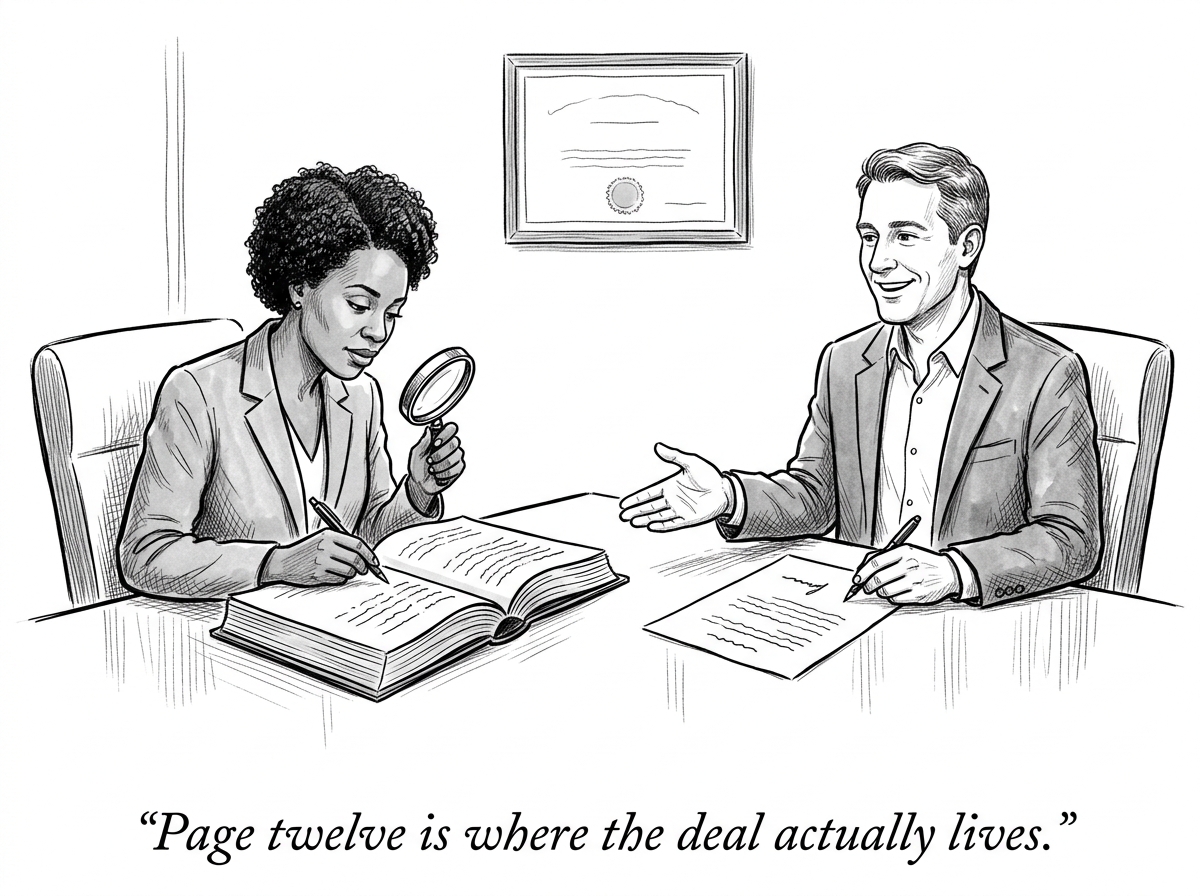
A few months ago we were closing a partnership agreement that read beautifully for the first eleven pages -- roles, responsibilities, a shared vision of the market, all of it accurate, none of it in dispute. Page twelve was where the actual deal lived: what happens if one side stops performing, who eats the cost if a third-party claim shows up, how either party gets out and what they owe on the way. That page had been drafted loosely, on the assumption that a good working relationship wouldn't need it spelled out. We sent it back. A good working relationship is exactly when nobody notices the gap -- it's the one that stops being good where a loose contract actually gets tested.
We read contracts a particular way, and it comes from years of work with government clients before Osparna existed. Government contracts don't leave room for this. Every obligation is written to a specific word: "shall" is binding, "will" is a statement of intent that binds no one, and "must" gets avoided entirely because it invites exactly the argument you're trying to prevent. That discipline exists because the cost of ambiguity in that world is measured in more than money. We apply the same lens to every commercial contract we touch, government client or not, because the underlying question never changes: what is each party actually bound to do, as opposed to what the document merely describes or implies they'll probably do.
That question only bites on one part of the document. The sections describing the partnership working as intended don't need to be binding -- both sides would do those things anyway, contract or not. The entire reason a contract exists is the part everyone skims: termination rights, indemnification, liability caps, dispute resolution, what counts as a breach and what cures it. A contract is, functionally, the same discipline engineers call failure mode and effects analysis, applied to a relationship instead of a piece of hardware -- not "how does this work when everything goes right," but "how, specifically, does this fail, and who bears what when it does." Assume things may go sideways. That assumption is the entire reason the document is worth having.
We run every deal we touch through this lens before capital moves. A representation with no remedy attached isn't a protection, it's a sentence that reads like one. An indemnification clause with a low cap or a short survival period tells you the counterparty priced their own risk, not yours. A termination-for-convenience clause with a long notice period or a steep breakup fee tells you more about how badly the other side wants to lock you in than any pitch deck will. None of this is adversarial -- it's the same builder's instinct we bring to a codebase or a cap table, applied to the one document that's supposed to survive the relationship going wrong. The happy path was never what needed writing down.
Contact us to learn how Osparna approaches contract and legal diligence as part of every deal.