What Analysis isPublished October 31, 2026
You've landed on one piece from Ayni, a site that explains why the place you actually live turned out the way it did — not the country in the abstract. Analysis is Ayni's collection of curated causal chains: real, sourced facts traced back to the specific decisions and people behind them, not a computed data rollup. See the full Analysis index or what Ayni is for more.
A Country Without a Tribe Has to Raise Its Children on Purpose
By Troy M. Pearsall
6 min read
A tribe raises its children without deciding to. The child is born into the relatives, the stories, the same table, the same year's rituals. The next generation gets the identity along with the name. Nobody has to ask what is being handed on, because it is the same thing that was
Last updated October 31, 2026
A tribe raises its children without deciding to. The child is born into the relatives, the stories, the same table, the same year's rituals. The next generation gets the identity along with the name. Nobody has to ask what is being handed on, because it is the same thing that was handed to the people handing it.
A 9-minute narrated version of this piece: the piece's own words over illustrations, read by a synthetic voice.
America is a choice. That is what took the default away, and it was meant to.
The Fourteenth Amendment says who is a citizen: "All persons born or naturalized in the United States, and subject to the jurisdiction thereof." Born, or chose. There is no clause about ancestry, religion or blood.[1] Washington said the same thing in 1796, in the Farewell Address, to a country he still described as sharing "the same religion, manners, habits, and political principles." Even then, in the same passage, he wrote to "citizens, by birth or choice, of a common country."[2]
A country made of birth and choice cannot raise its children the way a tribe does. There is no inherited table to sit them at. If the next generation is going to be raised, someone has to decide to do it.
## Who does it
Whoever is there.
That is the part a tribe never has to learn. In a country like this one, a child is formed by a patchwork of adults who do not coordinate: a parent, a grandparent, a teacher who moves a student into harder math, a bandleader, a coach, a neighbor who notices. None of them was assigned. Each of them looked at one child and decided to act.
The founding generation had its own example of this. Eliza Hamilton, widowed in 1804, co-founded the New York Orphan Asylum Society in 1806, the state's first private orphanage, and led it for twenty-seven years from 1821. The children were not hers. She took responsibility for them anyway.[3]
Whoever is there owes the child a duty of care. When no one performs it, children who will be adults are hurt. Care can look different from one home to the next. One parent puts a child on a bicycle and lets the street teach, because they care. Another puts the child in a cell for a few hours so the child learns what the world will do, because they care. Neither is the test. The test is whether the adult is acting for the person the child will become, and not for the child's comfort today.
## What you hand over
Keep one fact in front of you: you are raising an adult. A person is a child for only a few years and an adult for the rest of life. Judge every choice below by the adult it produces, not by whether the child is comfortable this year.
You cannot hand down an identity, because there is not a single one to hand. What you can hand over is capacity. Four things, in the order they get built.
**Room for consequence.** A child who is never allowed to get it wrong does not learn why it was wrong. Give the risk a size the child can survive, then let it be real. Manage the risk and let the child take it: managing a risk is not the same as removing it. A child can read about a risk, but only a child with a body can take one, and the risk is the parent's as much as the child's: the parent puts the child out and hopes the child comes home. A tribe supplies the guardrails by default. Here someone has to decide where they go, and decide again as the child grows.
**An adult who notices.** Freedom with no one watching closely is only half of a childhood. The decisive moments in most lives are short: one adult sees something in a child before the child can name it, and acts. It cannot be scheduled. It can only be made possible, by leaving enough room in a child's day for an unplanned conversation to happen.
**Practice among strangers.** In a tribe, everyone in the room already knows who you are. In a country like this one, most of the rooms a child will walk into are full of people who do not know the family, the name or the street. A child has to learn to be decent, and to be heard, in a room where none of that carries. Put them in rooms like that early, while the stakes are small, and choose the inconvenient ones: the school across town, the team where no one's parents know yours, the summer program in a place the family has never been. A comfortable room confirms the child. An inconvenient one expands her.
Language is the plainest case. Spanish is all around: it is the most common language other than English spoken in U.S. homes, 62 percent of the nearly 68 million people who spoke a language other than English at home in 2019.[4] A child can use it at the grocery store and on the team. Mandarin is not around, and it is one of the hardest for an English speaker: the State Department's Foreign Service Institute lists Spanish at about 24 weeks, or 600 class hours, and Mandarin at 88 weeks, or 2,200.[5] Nothing in the child's day makes the second one easy. That is the inconvenience, and it is the reason to choose it.
One family chose it anyway, and all of its children now speak Mandarin fluently. One of them went to a boarding school with an international student body, where a group of classmates spoke Mandarin around her and had no idea she could understand them. She could.
Wonder is the teacher. A child in an inconvenient room wonders what is being said, why it sounds that way, who these people are, and the point of the wondering is the learning. The adult's part is to supply the room and let the child wonder in it. That is also how you build a brain: introduce it to hardship early, and help it survive it.
**The whole record.** The creed is only worth teaching if the failures are taught with it. The Fourteenth Amendment was ratified in 1868. The Supreme Court did not strike down state laws against interracial marriage until *Loving v. Virginia* in 1967, ninety-nine years later, and it was unanimous.[6] A child who learns only the creed will take the gap for betrayal. A child who learns both knows what the country has promised itself on paper, and that keeping it is work someone has to do.
## The test
A tribe judges its upbringing by whether the child comes out like the elders. A country made of choosers has to judge it by something harder: whether the child can do what the adults could not. The ones who raised them are not the measure. The measure is whether the child can see something they could not, and act on it. The aim is to build builders: people who can make what the adults could not, and who will build the ones who come after them.
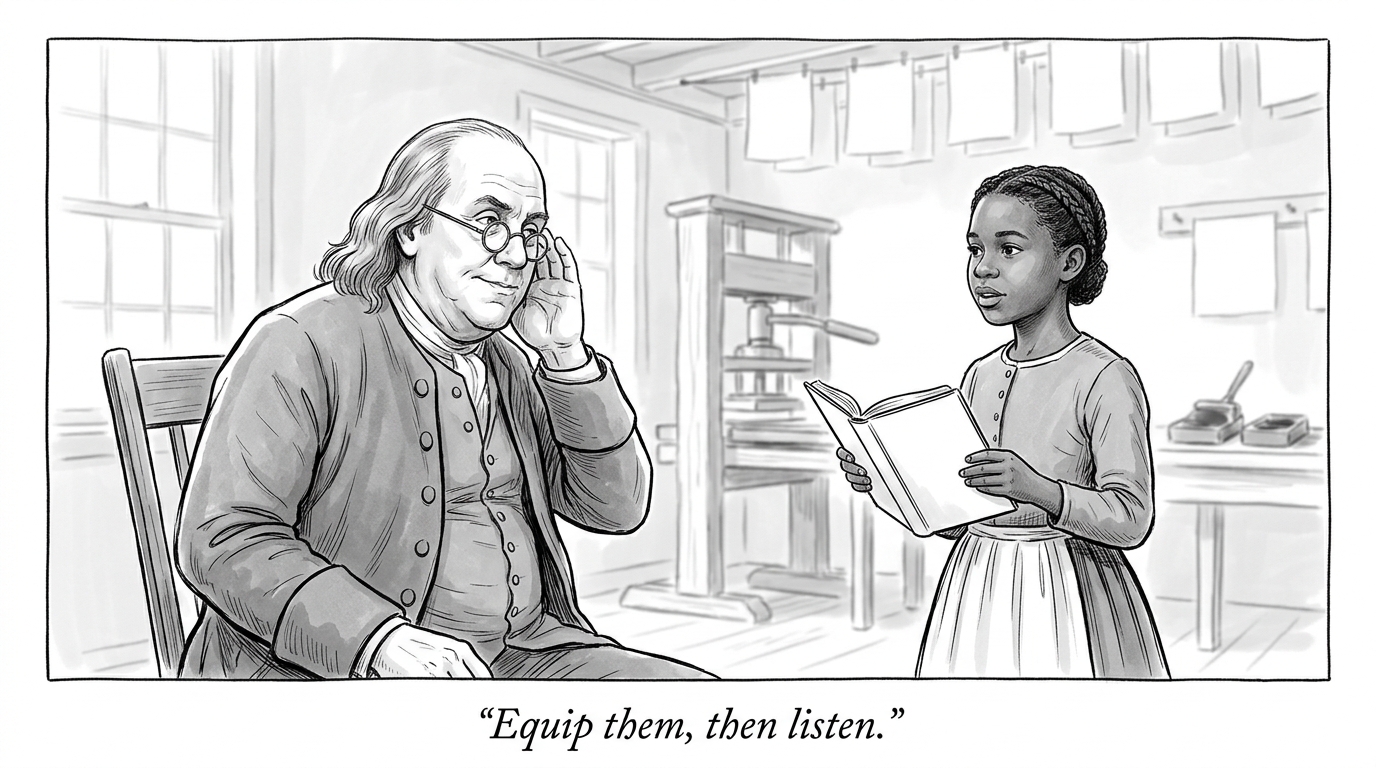
So do not aim for a copy. Aim to equip. The adults in a child's life will get some things wrong and miss some things entirely. A child raised on capacity can carry the correction forward. A child raised on a copy carries the mistakes.
## What to ask
1. **Who is raising the children around you, besides their parents?** Name them. Notice who is missing.
2. **Where do they get to be wrong and survive it?** If the answer is nowhere, that is the first thing to fix.
3. **Which inconvenient room could you put a child in this year, where nobody knows their name?** Pick the harder one. It is the one that expands them.
4. **Which child, not yours, would you notice?**
A tribe raises its own. America is a choice, and it lasts only if each generation builds the builders who come after it.