The Federalist Papers Ran 85 Essays. The Essays Written Against Them Also Ran 85. Almost Nobody Can Name a Single One of the Second Set.
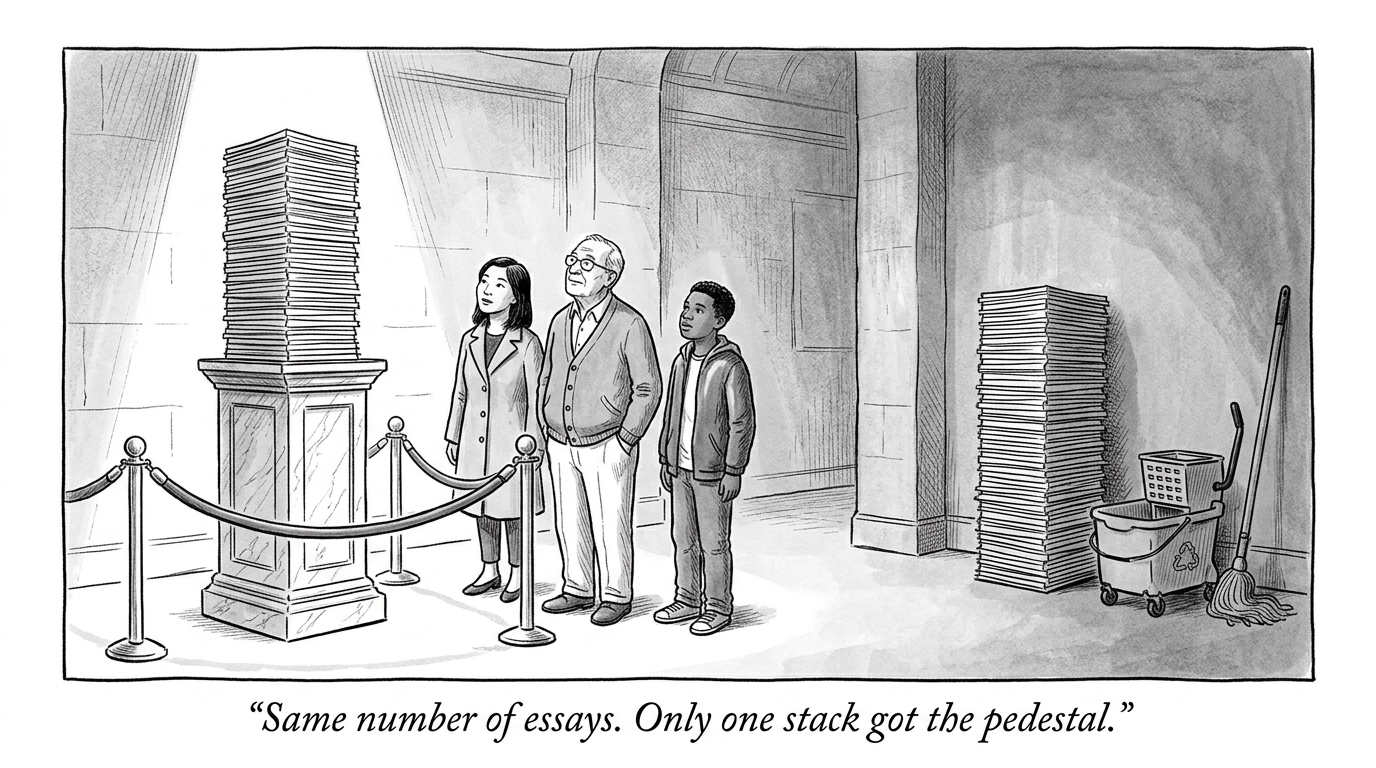
Everybody who has heard of the Federalist Papers has usually never heard there was an equal and opposite reply. While Hamilton, Madison, and Jay wrote 85 essays defending the new Constitution, a separate group of writers -- using fake names of their own -- wrote roughly the same number of essays arguing against it. Historians call the whole body of that opposing writing the Anti-Federalist Papers. Four writers did most of the real work, and each one made a distinct, specific argument -- not just "no."
Brutus -- likely New York judge Robert Yates -- and the fear that size itself would kill accountability
Brutus made the most influential Anti-Federalist argument of all: a republic can only actually protect liberty if it stays small. His reasoning was concrete, not abstract. Representatives can only be held genuinely accountable by people who live close enough to actually watch them. Stretch a government across thirteen states and millions of people, and representation becomes a fiction -- the people voting for someone barely know who that person is, and the government they're voting into power ends up run by whoever actually holds the levers in the capital, regardless of what any single election technically decided.[1]
Brutus warned the new government would need a standing army just to enforce its own laws across that much territory -- and that standing armies "have always proved the destruction of liberty" wherever a free government has kept one. He attacked three specific clauses by name: the Necessary and Proper Clause, the Supremacy Clause, and the federal taxing power, arguing all three were open-ended tools built for exactly one purpose -- letting power consolidate at the center over time, regardless of what limits the rest of the document claimed to place on it.[1]
Cato -- probably New York's own sitting governor -- warning that his own state would lose real power
Cato made close to the identical small-republic argument Brutus did, and historians widely believe Cato was George Clinton, the actual sitting governor of New York at the time -- meaning one of the loudest voices against ratification may have been a powerful state executive with a direct, personal stake in the very state power the new Constitution would reduce.[2] Cato argued a government this large would inevitably separate ordinary people from the actual seat of power, and warned that letting the federal government absorb powers the states already held would open the door to corruption, favoritism for narrow interests, and eventually outright despotism.[2]
Centinel -- Samuel Bryan -- and the sharpest, most cynical argument of all four
Centinel made the boldest claim, and it was aimed directly at Madison's own Federalist No. 51 -- the essay defending checks and balances with the line "ambition must be made to counteract ambition." Centinel called the whole idea a distraction. His argument: real, working checks and balances have historically only functioned in societies built around hereditary orders -- kings, nobles, and commoners checking each other because each held genuinely separate, jealously guarded power. Strip that structure away, Centinel argued, and the new Senate -- small, insulated, elected indirectly rather than by ordinary voters at the time -- would simply run the government in practice, no matter what the document said on paper about three co-equal branches. The only real, effective check that has ever actually worked, in Centinel's own account, is not a clause in a founding document. It is the direct, ongoing attention of ordinary people.[3] Centinel also attacked the Constitution more broadly as a document written to serve what he called the "well-born few" -- an early, blunt version of the argument that a new government's actual beneficiaries and its stated purpose are not always the same thing.[3]
Federal Farmer -- identity still disputed -- and the most methodical, least dramatic case against it
The Federal Farmer wrote the most systematic, least rhetorical critique of the four. Unlike Brutus's urgency or Centinel's bluntness, Federal Farmer worked through the Constitution clause by clause, in a register closer to a legal memo than a call to arms -- historians still dispute whether the author was New York's Melancton Smith or Virginia's Richard Henry Lee, and the identity has never been settled with confidence.[4] That essay is widely considered one of the single most influential pieces of writing produced during the entire ratification fight, on either side, precisely because it read less like an argument and more like a careful audit.
Centinel's specific argument is the one worth checking against what actually happened, because this outlet has already documented a real, current instance of exactly the mechanism he predicted. Centinel said checks and balances would prove to be theater -- that real power would collect somewhere the document's formal structure didn't fully anticipate, regardless of what the text said about three separate, co-equal branches. One Senate majority leader blocking a Supreme Court nomination for eleven months, then filling an identical vacancy in thirty days four years later, using nothing but control of a calendar -- no vote, no rule, no formal power the Constitution names anywhere -- is close to a direct, modern instance of Centinel's two-hundred-and-thirty-five-year-old warning: the formal structure holds on paper, and the actual, decisive power still finds its way to wherever one person happens to be able to hold it.
Losing the vote and still winning something real
None of these four writers stopped ratification. The Constitution passed. But the fight they ran, together with Patrick Henry's floor opposition in Virginia, is the direct reason the Bill of Rights exists at all -- a real, concrete concession, not a symbolic one, won by the side that lost the main vote (covered in full in this outlet's companion piece on all seven founding documents). Reading only the Federalist Papers gives a reader the case for the Constitution as it was actually written. Reading Brutus, Cato, Centinel, and Federal Farmer alongside it gives a reader the specific, real objections that document was written to survive -- and at least one of those two-century-old objections is still worth checking against the news.
Why does this matter? A founding remembered as one side making an airtight case is not history. It is the winning side's highlight reel. The Anti-Federalists lost the vote and were right often enough, specifically enough, that the winning side had to change the actual document to get their votes at all. Reading both sides is not balance for its own sake. It is the only way to actually understand why the Constitution says what it says, instead of only what it says.
Companion piece on this outlet: "Seven Documents Built America. Most People Can Name Two..."
- Fiveable / Teaching American History, Brutus No. 1
- Constitution Center / Founder of the Day, Cato III -- Ceding Power
- Founder of the Day / Wikipedia, The Letters of Centinel -- Samuel Bryan's Anti-Federalism
- Wikipedia, Federal Farmer