Mitch McConnell Blocked a Supreme Court Nominee for 11 Months Because an Election Was Eight Months Away. Four Years Later, He Filled the Next Vacancy in 30 Days -- Eight Days Before an Election.
Justice Antonin Scalia died on February 13, 2016. Within hours -- before President Obama had named anyone to replace him -- Senate Majority Leader Mitch McConnell declared that any nominee the sitting president put forward would be null and void.[1] Obama nominated Merrick Garland on March 16. The Senate never held a hearing. It never held a vote. The blockade ran roughly eleven months, through the rest of Obama's term.[2]
The stated principle, and where it actually came from
McConnell's rationale was that the Senate should not fill a Supreme Court vacancy in a presidential election year -- let the American people decide first, through the ballot box, who gets to make the appointment.[2] He attached a name to it: the "Biden rule," pointing to a 1992 floor speech in which then-Senator Joe Biden, chairing the Judiciary Committee, mused about urging President George H.W. Bush to hold off on a hypothetical nomination until after that year's election.[2] Biden's 1992 remarks were never actually applied to a real nominee -- no vacancy arose that year for the question to be tested. McConnell's invocation in 2016 was the first time anything resembling the idea was actually used to block a sitting president's pick.[3]
Four and a half years later, the same person ran the opposite play
Justice Ruth Bader Ginsburg died September 18, 2020 -- forty-six days before that year's presidential election, a vacancy opening far closer to an election than Scalia's had in 2016.[4] McConnell did not wait. The night Ginsburg died, he issued a statement committing the Senate to fill the seat, and pressed President Trump directly to nominate Amy Coney Barrett.[4] Trump nominated her eight days later, on September 26. The Senate confirmed her October 26 -- thirty days after nomination, the fastest confirmation of any justice since 1975 -- eight days before the election itself.[4]
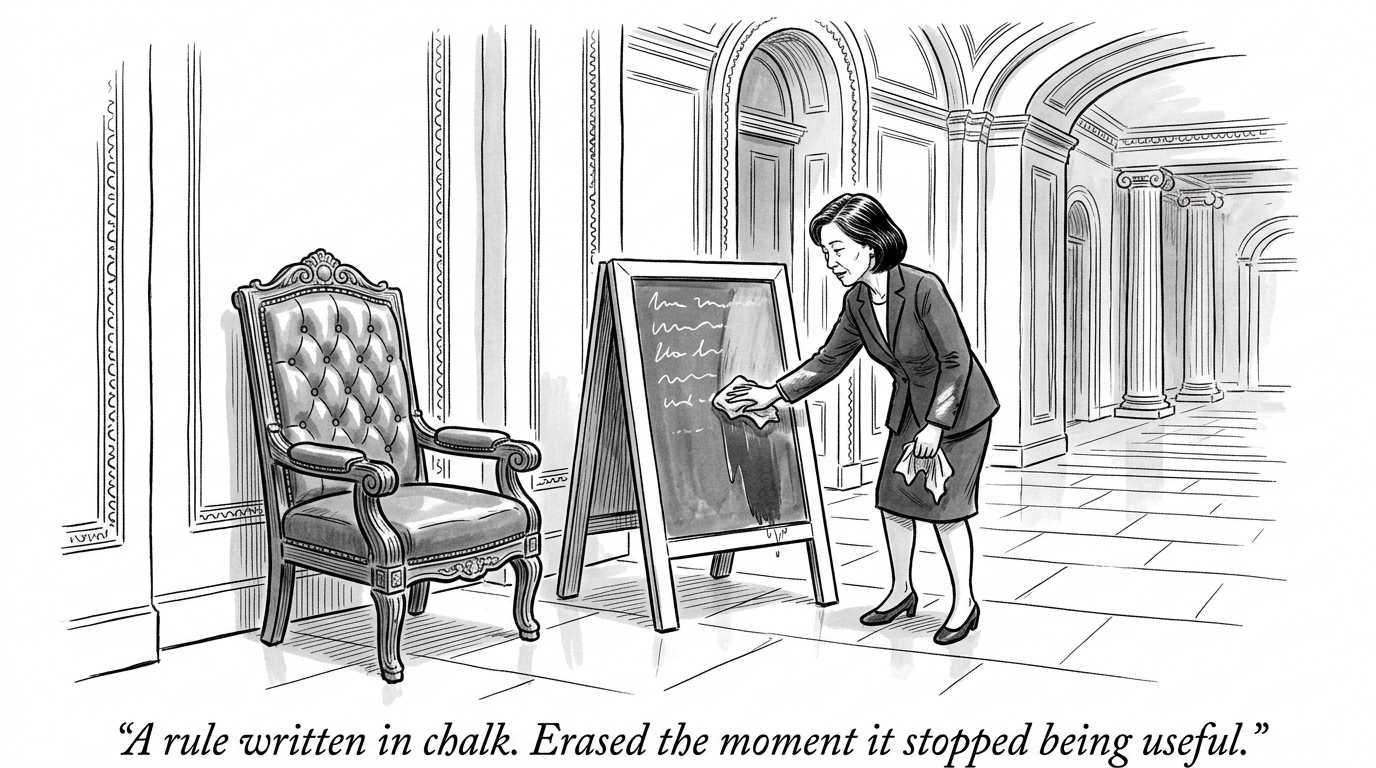
Run the two events side by side and there is no principle left standing, only a lever operated by whoever's hand was on it. In 2016, a vacancy opened roughly eight months before an election, and the stated rule was that voters should decide first -- so the seat stayed empty for eleven months. In 2020, a vacancy opened forty-six days before an election -- objectively closer to the vote than Scalia's death had been -- and the same person filled it in thirty days. If "let the voters decide" were a real, applied principle rather than a name attached after the fact to a decision already made on other grounds, it would have applied at least as strongly the second time. It did not apply at all. McConnell himself later called blocking Garland "the single most consequential decision" of his fifteen years leading Senate Republicans[1] -- a leader naming, in his own words, a procedural choice as his defining act, which is a strange thing to say about the enforcement of a genuine constitutional principle and exactly what you'd expect someone to say about the deliberate use of a real, discretionary lever.
Stated at its most basic: a senator stopped a president. Not the Supreme Court, not a court ruling, not a constitutional bar -- one person controlling the Senate's calendar declined to schedule a hearing, and an enumerated presidential power sat unusable for eleven months as a direct result. That is the actual scale of what a calendar controls.
Why does this matter? Nothing in the Constitution says a Supreme Court vacancy can't be filled in an election year, and nothing says it must be filled quickly either. Both outcomes were entirely legal. What decided which one happened, twice, in the identical circumstance -- a vacancy, a Senate majority, a president of the same party as that majority -- was not a rule anyone was bound by. It was a choice, remade from scratch each time by whoever controlled the calendar, and the "principle" invoked to explain the first choice evaporated the instant it stopped serving the second one. That is not a flaw in how the process is supposed to work. It is how the process actually works, and it has nothing to do with the version taught as civics.
Part of this outlet's ongoing "how government actually works" thread, alongside "Sixty Votes, Tradition Not Law" and "A College Degree's Wage Premium Grows From 27% at Age 25...", which covers the same Court's credential pipeline and a 1993 near-miss nomination from outside it.
- Newsweek, McConnell Says 'Biggest Decision' as Leader Was Blocking Merrick Garland
- CBS News, Here's What Mitch McConnell Said About Not Filling a Supreme Court Vacancy in an Election Year
- NPR, What Happened With Merrick Garland In 2016 And Why It Matters Now
- PBS Frontline, On Night Ginsburg Died, McConnell Pushed Trump to Nominate Amy Coney Barrett