Build the Council Before You Need It
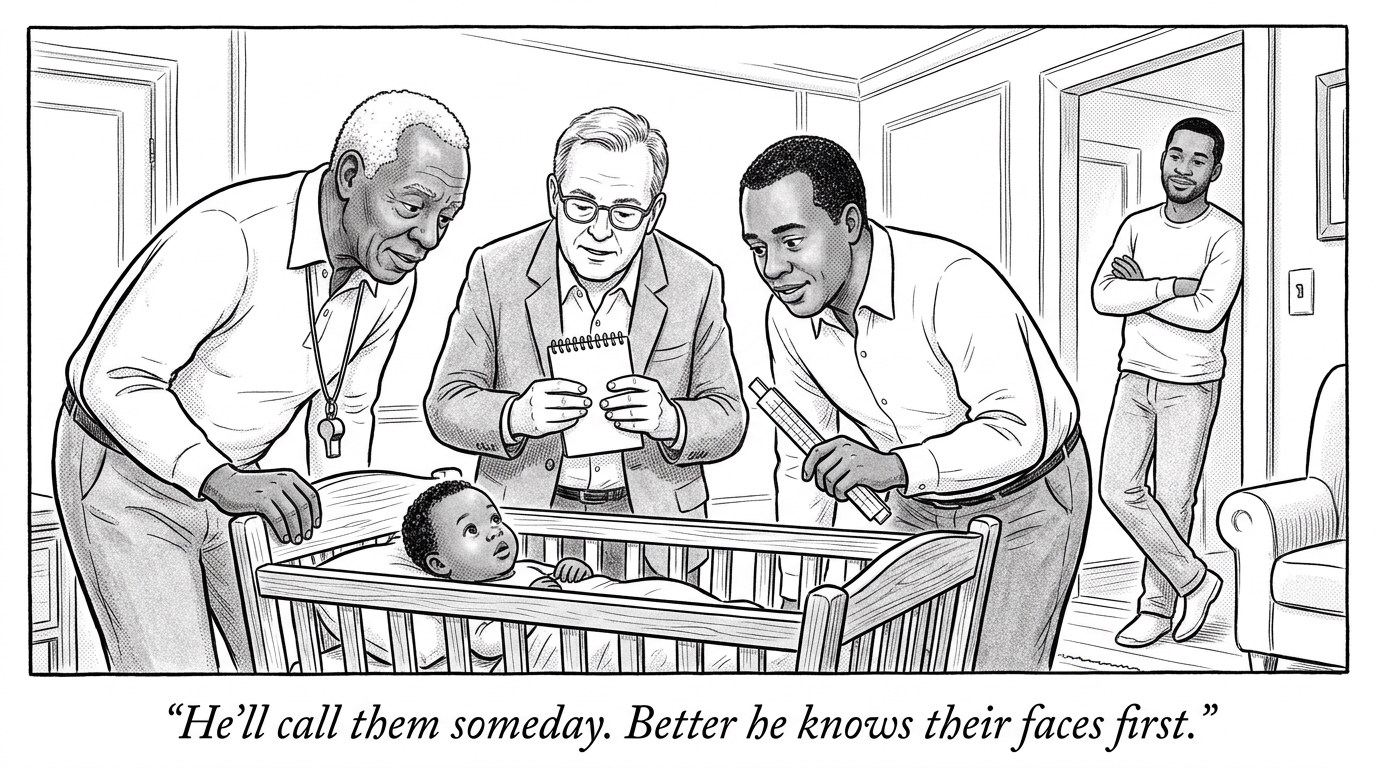
In 2008 the writer Bruce Feiler was diagnosed with cancer. He had young daughters, and he did not know whether he would be there to raise them. So he asked his closest male friends to be present in their lives, to give them guidance, wisdom and love if he could not.[2] He wrote a book about it, The Council of Dads, published in 2010.[2]
I read it, and I agreed with it. Not everyone I respect did. I am not going to speak for them here. I am going to say why I think it is right, and what I would add.
The thesis
A father cannot teach a child everything. That is not a failing. It is arithmetic. There are things other men know that I do not, and a boy, in particular, learns some of them best from a man who is not his father.
This week Scott Galloway wrote about the same thing from the other side. His father was absent while he was growing up, and he says the gap was filled by other people: friends' fathers, his mother's partners, a stockbroker who took an interest in him, fraternity brothers, and bosses who pulled him aside when he was making mistakes.[1] He cites the anthropologist Anna Machin: "all teenagers need a father — whether biological, social, step, or adoptive."[1] He also says those men never saw a return on their time. Their purpose was preparing him for other people.[1]
That is the council, built by accident instead of on purpose. He was lucky. A child should not have to be.
It goes back to the old argument that it takes a village to raise a child. A council is a village built on purpose, with names and phone numbers.
What I did
I have two daughters and a son. My daughters have a strong mother, a strong grandmother and a strong aunt. My uncles are great, but one of them has no children, and my son did not have a line of fathers and sons around him the way my daughters had women.
So I wanted my son to know certain men, before he needed to call them.
One is a friend who coached high-school and pee-wee football for a decade and is an electrical engineer. My son plays football. Another is a friend who is a retired police officer and a politician, and who knows people. A third is my uncle, who knows how to reinvent himself. A fourth is my executive coach and my friend, who came to our house for cookouts and dinners before he moved away to be with his sons; that is how my son knows him, and why he is comfortable calling him. None of them is me, and each of them can give my son something I cannot. My son has their phone numbers. He can call any of them without checking in with me first.
Why before
The order matters. You do not hand a stranger your child the day something goes wrong.
If it is done during duress, it is too late. The parent has their own problems: illness, divorce, job loss, whatever it is. There is no room left to build trust, and no energy left to introduce a child to a man he has never met. If it is done in advance, it feels natural. A boy who has watched a man coach, argue, laugh and fix things for years does not have to be introduced to him later. He already knows the man's face. He already knows what it is like to ask him for something.
Feiler had no choice about the timing; his illness set the clock. I think he is right about the idea. My take is that you do not have to wait for a clock.
The question for a parent
I have written before about what a family hands down: a structure, not just a skill.[3] A council is part of that structure. So here is the question I would ask any parent.
- Who are the adults in your child's life who are not you? Name them.
- Does your child know them well enough to call? Not whether they would pick up. Whether the child would dial. Mine can: he has the numbers, and he does not have to ask me.
- What does each one know that you do not? If the answer is "nothing," you have friends, not a council.
And a harder one, the one DoAyni exists to keep asking: what about the child whose parent cannot build this, because there is no one to call? That is the reader this site is for. A council is a form of access, and not every child is born next to it.
This is the author's account and reading. Where I describe a book or an essay, the source is listed below. Personal details about named people are held back on purpose.
Sources
- Scott Galloway, "Preparing Men for Others," No Mercy / No Malice, October 23, 2026: https://www.profgmedia.com/p/preparing-men-for-others (read in full; his father's absence and the men who filled it; the Machin quotation is as he quotes it, I did not open her writing).
- Kirkus Reviews, review of The Council of Dads: My Daughters, My Illness, and the Men Who Could Be Me by Bruce Feiler, release date May 1, 2010: https://kirkusreviews.com/book-reviews/bruce-feiler/the-council-of-dads/ (read; the 2008 diagnosis and his asking his closest male friends to guide his children).
- Troy M. Pearsall, "What We Hand Down," October 1, 2026: https://doayni.com/analysis/what-we-hand-down (this outlet's earlier piece; the address resolves).