Federal Funding Averages 13% of a Public Radio Station's Budget. For the Only News Source in Northwest Alaska, It Was Up to 50%. The Same Cut Landed Completely Differently Depending on Where a Station Already Stood.
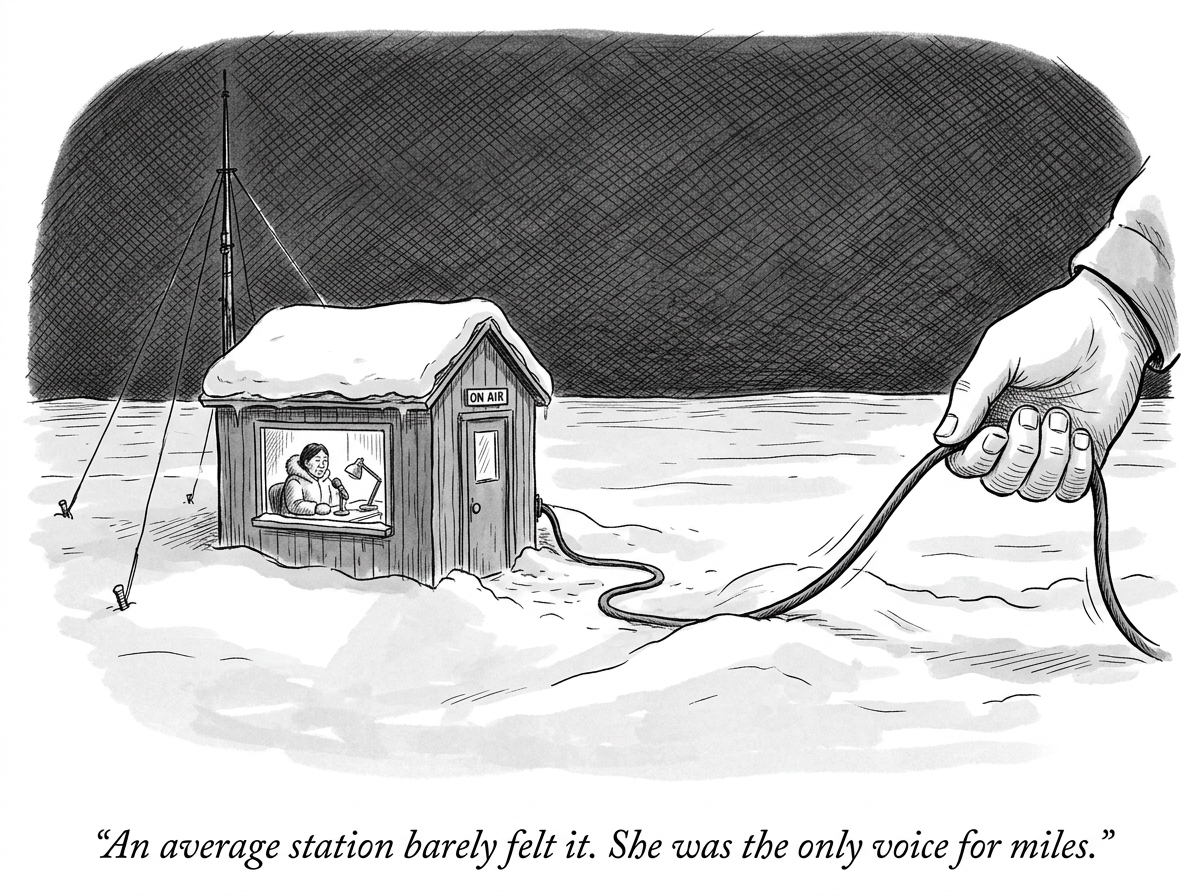
On July 24, 2025, Congress passed the Rescissions Act of 2025, clawing back $9 billion in previously approved federal spending, including $1.1 billion earmarked for the Corporation for Public Broadcasting. On August 1, CPB announced it would shut down entirely -- the first time in its 58-year history it has operated without federal funding -- laying off most of its staff by the end of September and winding down completely by the end of January.[1] CPB's own statement did not describe this as a manageable adjustment: the cut, it said, "will cause irreparable harm, especially to small and rural public media stations."[2]
The average obscures the actual distribution completely
Across public radio and TV stations nationally, CPB funding accounts for roughly 13 percent of the average member station's budget -- real money, but rarely make-or-break for a station with a sizable donor base in a large media market.[2] That average is not what determines whether a specific station survives. Some rural stations depend on CPB for up to 50 percent of their operating budget; stations serving Native communities specifically depend on it for 80 percent or more.[2] CPB distributed funding to 59 Native-serving stations across 20 states before the cut -- for a station like KOTZ, the only local news source across much of northwest Alaska, that funding typically covered 30 to 50 percent of operating costs outright.[3]
What "closure" actually means in specific places, not in aggregate
KUHB, on St. Paul Island in the Bering Sea, and KCUK, in Chevak, Alaska, were both projected to close by summer 2026 without the funding.[3] KNSA in Unalakleet and KSDP in Sand Point were named among the other Alaska stations at direct risk, alongside KGVA in Harlem, Montana.[3] These are not stations competing with a dozen other local news outlets for a shrinking audience. For many of the communities they serve, they are the only source of local news that exists at all -- and, separately and more urgently, they are frequently the only source of emergency warning.
The same shock hitting every station equally doesn't produce an equal outcome -- it sorts, based entirely on what each station already had underneath it before the cut arrived. This outlet has documented the identical mechanism before, in a completely different domain: a single global shock doesn't hit a global average, it sorts based on which side of a line an economy already sat on.[4] The same law runs here. A 13-percent hit is a budget conversation for a station with other revenue. An 80-percent hit is the entire operating model for a station that never had another one. Congress cast one vote. What actually happened next was never going to be uniform, because it was never going to land on a uniform starting point.
The stakes reach further than local news, into the literal infrastructure of emergency warning. The Public Radio Satellite System, which distributes NPR programming to more than 1,300 stations nationally, is the same system used to distribute national emergency alerts.[2] Congress separately appropriated $136 million to FEMA's Next Generation Warning System between 2022 and 2024, built on top of that same public-radio backbone.[2] In a remote Alaska community with no other broadcast signal, defunding the local station doesn't just remove a source of news. It can remove the channel a tsunami, wildfire, or winter-storm warning would have traveled through.
Why does this matter? This outlet has separately documented a pattern of federal actions this year touching the historical record of Black, Native American, and female Americans specifically.[5] The CPB cut is not framed as part of that pattern by anyone who voted for it -- it is framed as a broad, ideologically neutral funding decision, applied equally to every station in the country. But applied equally is not the same as landing equally. The stations facing actual closure over this cut are disproportionately the ones serving Native communities, precisely because those are the stations that never had the donor base to absorb a percentage that reads as minor everywhere else. The vote was general. What it is actually doing, place by place, is specific.
Companion piece on this outlet: "An Automated Filter Flagged the Enola Gay for Deletion Because Its Name Contains 'Gay.' It Also Caught Jackie Robinson, the Navajo Code Talkers, and the Tuskegee Airmen..."
- CNN Business, Corporation for Public Broadcasting Will Shut Down After Trump Funding Cuts
- NPR, Public Media Emergency Alert Funding
- Tribal Business News, 'For Some People, We're It' -- Native-Serving Radio Stations Struggle to Stay on the Air After Loss of Federal Funding
- Ayni Analysis, A Strait 21 Miles Wide Carries a Fifth of the World's Oil...
- Ayni Analysis, An Automated Filter Flagged the Enola Gay for Deletion...