Judgment Isn't a Generic Human Trait Everyone Brings to the Table Equally. It's Built -- and Not Everyone Gets the Same Rooms to Build It In.
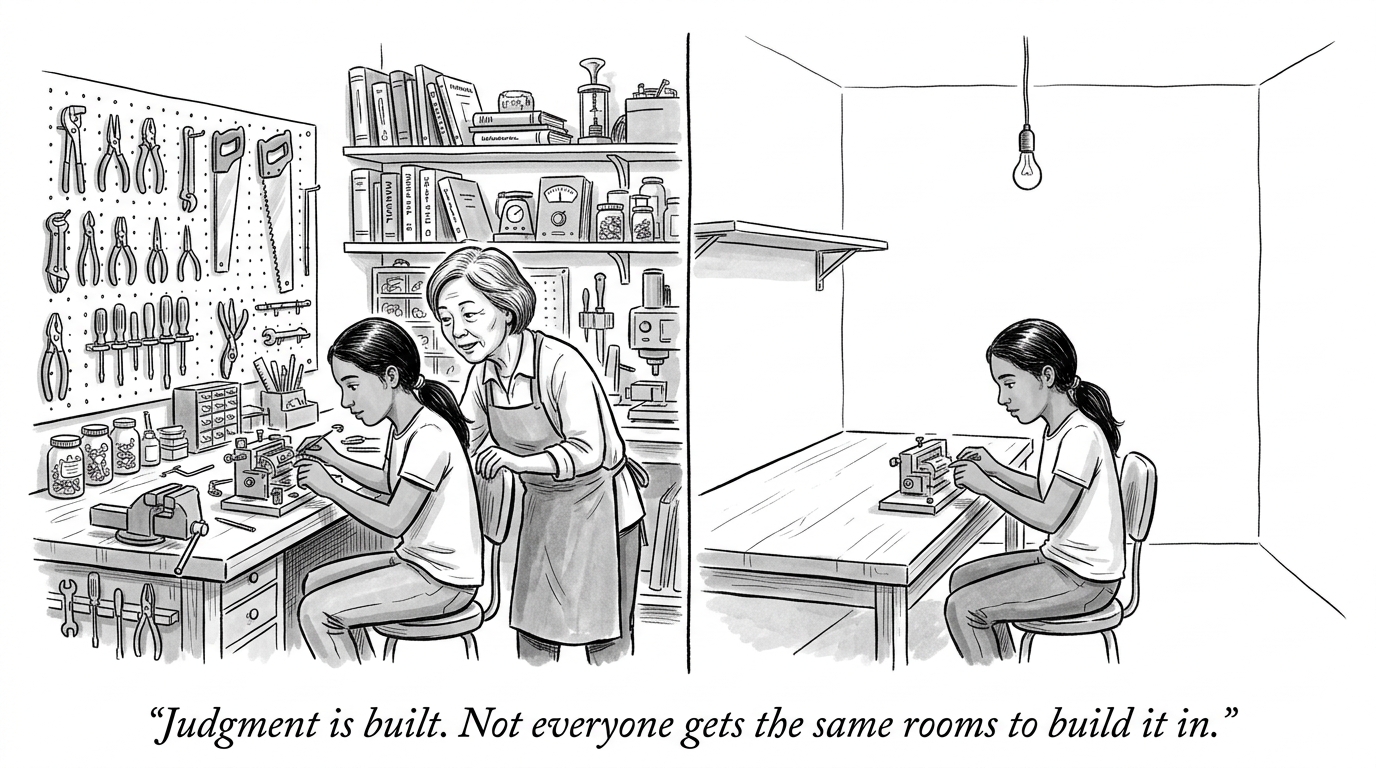
A fast, confident reaction to a new idea -- this is worth pursuing, this claim doesn't hold up, this is the interesting part -- doesn't feel like it was built from anywhere. It feels immediate, almost automatic. Psychologist Daniel Kahneman gave that feeling a name: System 1, the brain's fast, intuitive, low-effort mode, running constantly underneath the slower, deliberate reasoning of System 2.[1] Good judgment mostly lives in System 1 -- the snap read that turns out to be right more often than chance would predict. And System 1 is not a factory default every person is issued in equal working order. It is trained, the same way any fast, automatic skill is trained: by exposure, repetition, and correction, accumulated over years, until the reaction that used to require conscious effort starts arriving instantly.
The training doesn't announce itself, even to the person who has it
Psychologists Richard Nisbett and Timothy Wilson found something uncomfortable about introspection back in 1977: people routinely give confident, coherent explanations for their own judgments and behavior that don't match the actual process that produced them -- not because they're lying, but because there often isn't direct introspective access to the real mechanism at all.[2] A person with sharp, fast judgment in a domain frequently can't fully explain where it came from, because System 1's training happened gradually, absorbed rather than studied, the same way a native speaker can't always state the grammar rule they're following correctly every time. That has a real consequence for anyone trying to pass judgment on to someone else: you can't just hand over the rule, because the person who has the skill often doesn't have full access to the rule either.
What actually built the judgment, in most real cases, wasn't a course or a book -- it was exposure to specific people, places, and situations that most people never get access to at all. A reader's reaction, a snap professional read, a "that doesn't sound right" -- each is downstream of some earlier set of rooms: who taught them, what they were around, what they were allowed to fail at safely and correct. Two people can be equally intelligent and equally well-intentioned and still bring genuinely different-quality judgment to the identical situation, for a reason that has nothing to do with effort in the moment -- one of them spent years in rooms the other never had access to. Saying "AI generates, humans discern" is true, but treating discernment as a flat, equally-available human trait quietly erases this -- and erasing it is not a neutral simplification, it's the exact thing that lets real, unequal formation get read as a character difference instead of an access one.
Admitting this is harder than stating it, and that difficulty is the actual point
Researcher Kathryn Schulz spent a career studying what happens when people confront being wrong, and found that it rarely registers as a small correction -- being shown you were mistaken about something you were sure of tends to land as an identity event, not an information update, because being right feels like proof of who you are.[3][5] Naming that your own judgment came from privileged access -- that it isn't a generic trait you simply have more of than someone else -- runs into the same resistance. It requires giving up a comfortable, flattering account of your own competence in favor of a less flattering, more accurate one: not "I am simply better at this," but "I was given rooms other people weren't, and that's most of the actual difference."
Researcher Brené Brown's two decades of work on vulnerability and shame found the same underlying shape from a different angle: courage doesn't come from certainty or strength, it comes from vulnerability -- the willingness to sit in uncertainty, risk, and real emotional exposure rather than retreat to a safer, more flattering story.[4][6] Saying plainly that your own discernment is a product of access, not just character, is exactly that kind of exposure. It gives up a story that makes you look self-made in exchange for a truer one that makes the unequal distribution of access the actual subject -- which is a harder, more vulnerable thing to say out loud than "I worked hard and it paid off," even when both are true at once.
What this obliges, if it's actually taken seriously
If judgment is built, not issued, then the honest version of "AI can't replace human discernment" comes with a second half that's easy to leave off: discernment is not equally available to replace anything with, for everyone, right now. The reassuring version of the AI-collaboration story stops at "your judgment still matters." The complete version has to add: whose judgment, built where, and who never got the rooms that would have built theirs the same way.
Why does this matter? A claim that flatters the person making it -- your reasoning is what AI can't replace -- is much easier to say than one that implicates the exact access that produced the reasoning in the first place. The second claim is the true one. Saying only the first half isn't wrong, but it's incomplete in a way that quietly protects the person saying it from the harder, more vulnerable, more useful admission underneath.
This piece is one part of a longer argument. The full essay: "How to Build a Mind".
- Kahneman, D., Thinking, Fast and Slow (2011) -- System 1 and System 2
- Nisbett, R. & Wilson, T., Telling More Than We Can Know: Verbal Reports on Mental Processes, Psychological Review (1977)
- Schulz, K., Being Wrong: Adventures in the Margin of Error
- Brown, B., Daring Greatly: How the Courage to Be Vulnerable Transforms the Way We Live, Love, Parent, and Lead
- TED, Kathryn Schulz: On being wrong (2011)
- TED, Brené Brown: The power of vulnerability (2010)