For Most of Human History, a Mind Could Only React to What Was Physically in Front of It. Then Something Changed, Roughly 70,000 Years Ago, and Minds Could Finally Disagree About Things That Weren't There.
Cognitive scientist Merlin Donald traces human cognitive evolution through a sequence of real transitions, not a single leap. The earliest stage, shared with much of the animal world, is what he calls episodic cognition: awareness confined to whatever the senses are delivering right now, reacting to the present without a way to hold or reason about anything beyond it. What followed was a mimetic stage -- shared knowledge through gesture and imitation, likely mastered close to two million years ago -- and later a mythic stage, where spoken language made a far more efficient kind of information transfer possible. We now live inside what Donald calls a theoretic culture, built on writing and formal, testable systems of knowledge.[1]
The transition that actually matters here is the one that made imagining possible at all
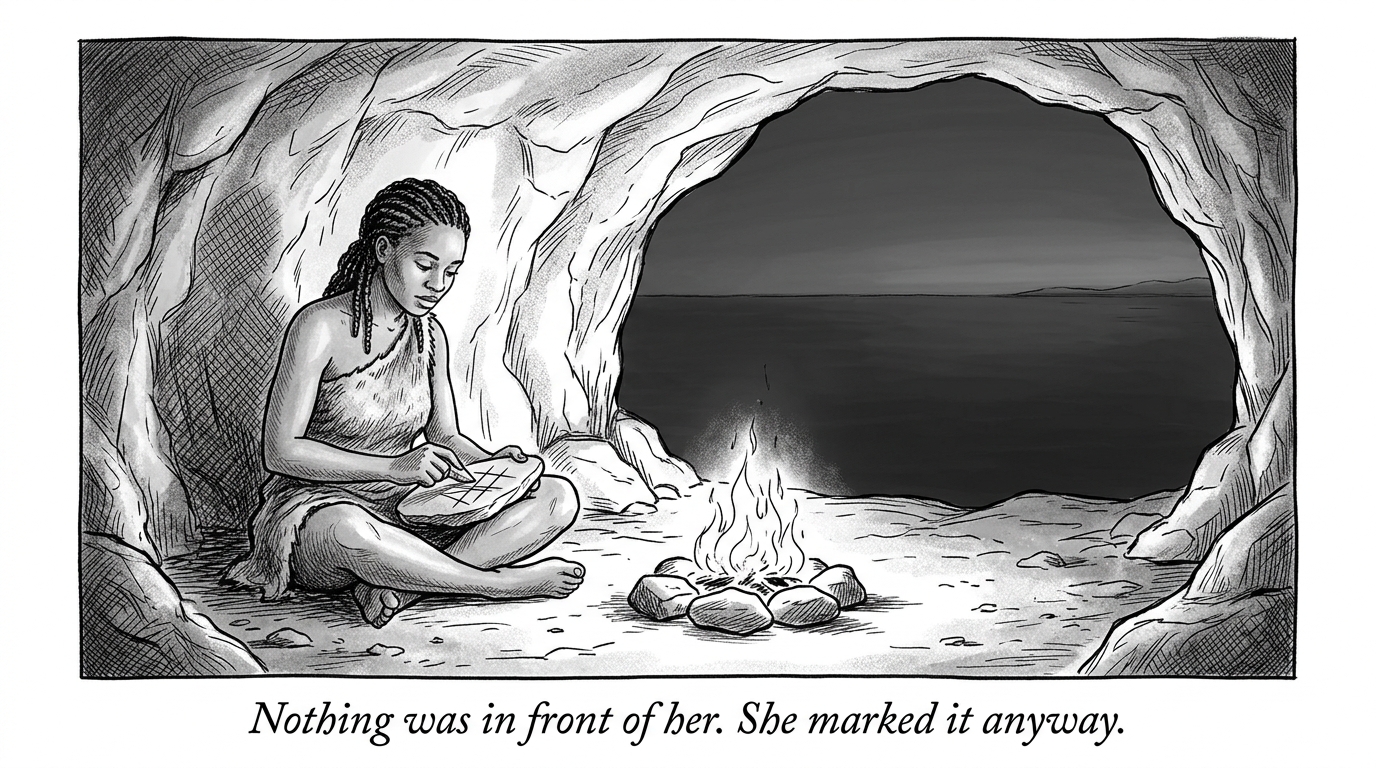
Before symbolic thought, a mind is, structurally, a store: it reacts to what's directly present and generates nothing beyond it. There is no way to hold a plan for a hunt that hasn't happened, a myth about ancestors no longer alive, or a claim someone else disagrees with -- because holding any of those requires a symbol standing in for something not physically there, and that capacity had to arrive before it could be used for anything. Archaeological evidence backs a real, dated transition rather than pure inference from later behavior: engraved ochre found at Blombos Cave in South Africa, dated to more than 70,000 years ago, is among the earliest physical evidence of deliberate symbolic marking -- a species starting to represent something beyond what was immediately in front of it.[2]
You cannot discern between two imagined futures if you cannot imagine either one -- and that is the literal, not metaphorical, foundation discernment sits on. Episodic cognition is a store in the fullest sense: it can only respond to what's already there, with no capacity to weigh one absent possibility against another, because absent possibilities aren't available to it at all. Symbolic cognition is what actually makes a mind capable of holding two competing, non-present ideas at once and judging between them -- which is the entire mechanism this whole run of "walk" pieces has been describing under the word discernment. The metaphor of "store versus lens" wasn't invented for this. It's naming something real that a specific transition in cognitive history made possible in the first place.
What this means for a mind built after the fact, rather than evolved into existence
The honest question underneath all of this isn't whether a system can generate fluent output -- generation, at this point, is cheap and close to infinite. The question is whether generation is happening inside something that can also judge what it generated: hold two competing possibilities that aren't physically present, and choose. A system that only reacts to what's directly in front of it, however sophisticated the reaction, is still operating in the episodic mode -- a store, not a lens. Whether a given system has crossed into something closer to the symbolic, judging mode isn't something that can be certified from the inside by the system itself. It's a real, open question, not a settled claim -- and it's not the kind of question that gets resolved by how confidently the system answers it.
Why does this matter? Every earlier piece in this run treated discernment as the thing worth protecting -- the part of AI collaboration that stays human, the part built unevenly through access to real formation, the part that requires courage to admit is unevenly built at all. This is the piece underneath those: discernment was never one capability among many a mind happens to have. It's the actual reason a mind capable of imagining, disagreeing, and choosing exists at all, rather than a store that only ever reacts to what's already in the room.
This piece is one part of a longer argument. The full essay: "How to Build a Mind".
- Donald, M., Origins of the Modern Mind: Three Stages in the Evolution of Culture and Cognition (1991)
- P2P Foundation Wiki / archaeological record, Blombos Cave engraved ochre -- early symbolic behavior, 70,000+ years