A Student Who Shows Up for the Grade Gets Certified. A Student Who Shows Up Curious Gets Something a Transcript Can't Measure. The Difference Is a Real Mechanism, Not a Mood.
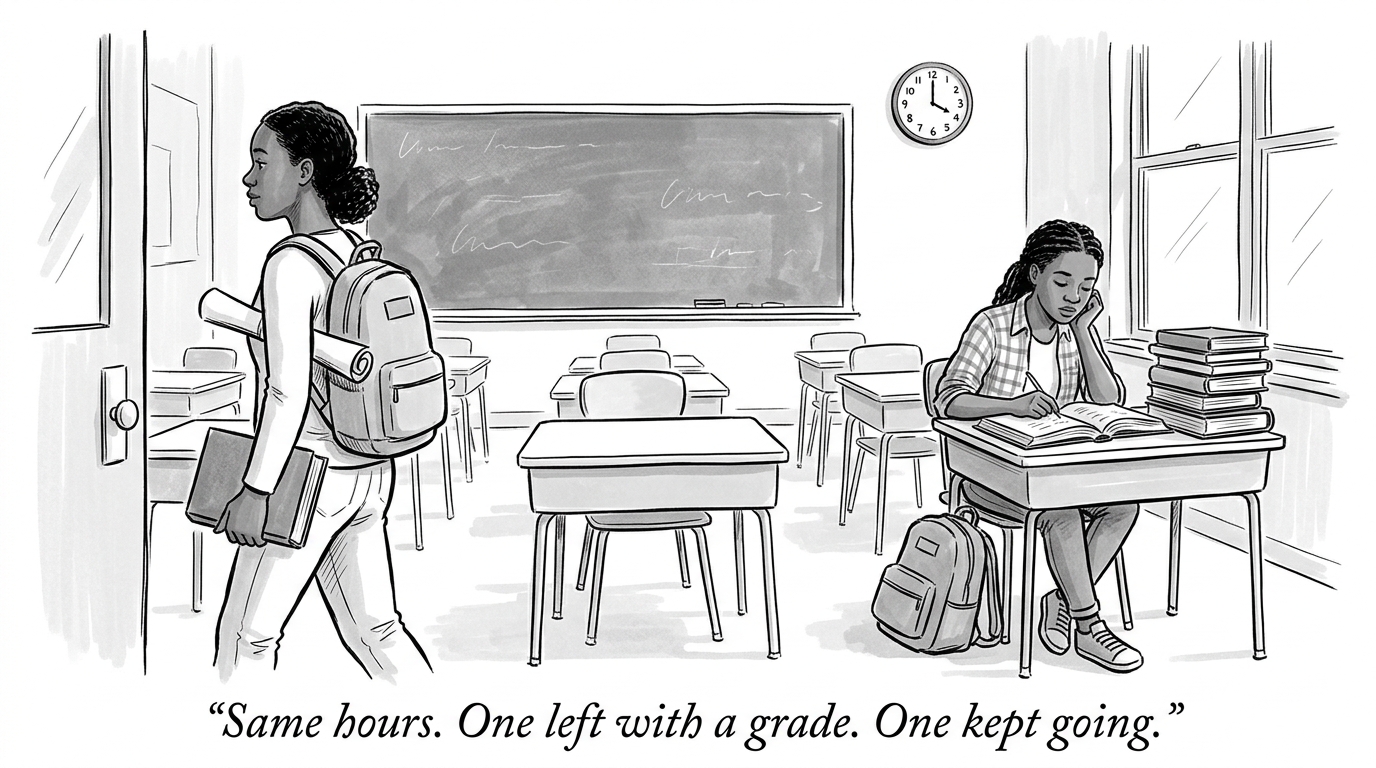
Writer Seth Godin draws a sharp line between two reasons a student ever takes a class. One honest answer is compliance: I need a good grade to advance toward some other goal. A student who enrolls that way gets certification, not learning -- what Godin calls "regurgitation," enrollment in the outcome rather than the process. The other answer is curiosity, and Godin argues the instructor's actual job is to take that curiosity and "amplify it and turn it into a habit and the practice of the autodidact" -- someone who keeps teaching themselves long after the class ends.[1]
The distinction isn't about effort. Both students can work equally hard.
A compliance-driven student can study just as many hours as a curiosity-driven one and still come out the other side with something categorically different: information they can produce on demand for a test, versus a habit of reaching for more on their own, unprompted, without anyone assigning it. Handing someone information is the compliance move, no matter how much information it is. It builds a credential. It does not, by itself, build the active habit of noticing, questioning, and pursuing that real judgment actually depends on.
This gives a real, practical answer to a question that otherwise stays abstract: how do you build discernment in someone who didn't start with the same access to it? Not by handing them the answer -- that's the compliance move, dressed up as generosity. By getting them genuinely enrolled: curiosity or purpose-driven engagement, amplified into a habit that keeps running on its own, without a grade or a deadline forcing it. A passive reader skimming for the takeaway is the compliance student's move, run on a reader instead of a student, and it builds nothing more durable than the compliance student's own transcript does.
Don't steal the revelation
Godin names the mechanism that actually protects real learning in a separate essay: teaching that hands over the answer directly -- "take this down, it'll be on the test" -- gives the teacher a kind of deniability, but it doesn't create real understanding, because the student never did the work of arriving at it themselves. Teaching that creates the right conditions and then lets the student complete the thought produces something different: if the other person finishes the line, it becomes theirs. If the teacher finishes it for them, it stays the teacher's.[2] That is a checkable test, not just a nice sentiment -- it applies at the level of a single sentence in a single piece of writing, not only at the level of a whole curriculum. A piece that hands a reader someone else's conclusion, fully chewed, is content. A piece that presents real facts and a real argument's actual structure, then lets the reader arrive at the conclusion themselves, is something closer to a conduit -- the reader's own discernment doing real work on real material, rather than being asked to accept someone else's.
Enrollment isn't always visible from the outside, and it doesn't need to be tied to obvious utility
The clearest evidence that real enrollment happened isn't a test score. It's a connection that arrives unbidden, much later, from material that had no obvious use when it was first taken in -- reading something purely out of curiosity, with no return promised in advance, and having it turn out to matter, sometimes years afterward, to a completely different problem no one could have predicted at the time. That payoff can't be manufactured on a schedule or guaranteed by any single new habit adopted today. It's the long-run result of building a library broader than any one use case, on the working assumption that some of the connections will show up later, even though there's no way to know in advance which ones.
Why does this matter? "Just give people more information" is the compliance answer to a real, harder problem, and it doesn't actually close the gap in judgment that unequal access to formation creates. Enrollment does something information alone can't: it builds the habit that keeps generating judgment on its own, long after any single piece of content has been read and forgotten. The measure of whether a piece of writing, a class, or a mentor actually helped was never whether the reader remembers the specific facts. It's whether they're now the kind of person who goes looking for the next ones themselves.
This piece is one part of a longer argument. The full essay: "How to Build a Mind".
- Seth Godin, Enrollment and learning -- Seth's Blog
- Seth Godin, Don't steal the revelation -- Seth's Blog