Found Earlier Is Not Yet Saved
On September 23, 2026, an FDA advisory panel voted on Grail's Galleri, a blood test that looks for cancer signals in DNA and is meant for adults 50 and older, as a prescription screening test followed by diagnostic work-up.[1][2] The panel was unanimous, 10 to 0, that the test is safe. On whether it is effective the vote was 6 to 4. On whether the benefits outweigh the risks it was 7 to 2, with one abstention.[1] The FDA is not bound by the vote and is expected to decide in the coming months.[2]
The gap between those numbers is the story. The largest trial, NHS-Galleri, randomized 142,250 people in England aged 50 to 77 to three yearly rounds of testing or usual care.[6] It did not meet its primary goal, which was fewer cancers found at stage III or IV across 12 pre-chosen cancers. Stage IV diagnoses fell 14 percent. Mortality data are not yet available.[3] About half of the participants were women, and about 93 percent were White, which the authors say reflects England's population in that age group; about 1 percent were Black.[3][6] Half of the people the test flagged turned out to have cancer, a 52 percent positive predictive value. It found 54.7 percent of those 12 cancers and 30.7 percent of all cancers, and its false-positive rate was 0.45 percent.[3]
So the claim of this piece is that finding cancer earlier and saving lives are different claims, and only the first has been shown. The test detects. Whether detecting sooner changes who lives is the question the trial has not answered, and the trial's own investigators say it is unknown whether all the cancers it found would ever have caused symptoms.[3] Half of the positives were not cancer, and someone has to pay for, and live through, the follow-up.
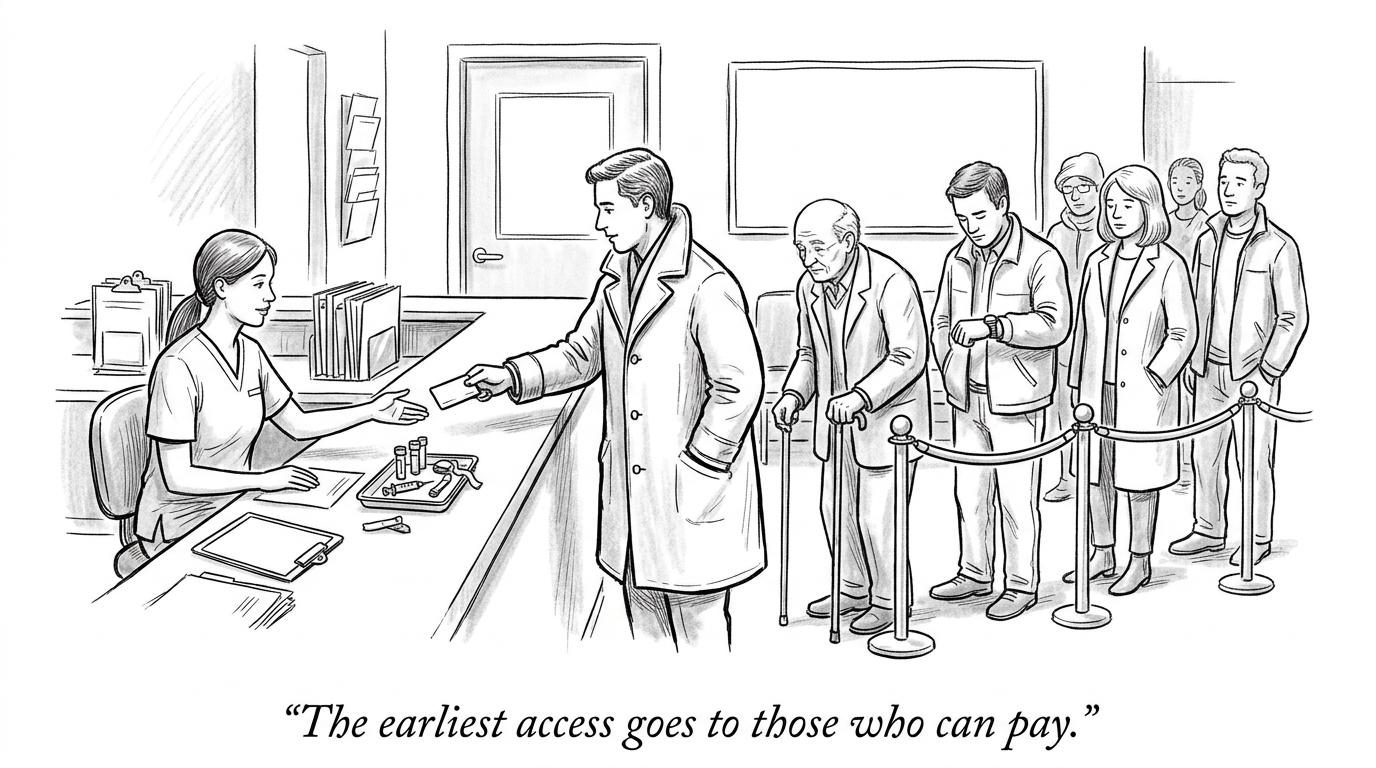
Now the question of who gets it. The standard price is about $900, or $749 at one health system, and most commercial insurers and Medicare do not cover it yet.[4] A federal law signed February 3, 2026 starts Medicare coverage for FDA-approved multi-cancer tests in 2028, and one report describes it as covering tests approved and shown to have clinical benefit.[5] Until then, the people who can find out first are the people who can pay about $900.
In my reading, that makes this a test whose benefit is unproven and whose earliest advantage goes to people with money. That is not a charge against the test; it is the position a new screening starts in, and the sources do not say how it will end.
For an investor, a diagnostics company's revenue waits on three separate decisions: approval, coverage and proof of benefit. Grail shows they can arrive in different years. Ask which one a company's forecast is actually waiting on.
The votes, trial figures, prices and law are as the cited sources report them. The trial's mortality results are not yet available, prices vary by provider, and the Medicare start in 2028 depends on FDA approval and coverage decisions. The reading that the earliest advantage goes to people who can pay is the author's interpretation. This is not medical or investment advice.
The introduction at the top of this page was written by a reviewer, Jalynn Johnson. The reading in the piece is the author's.
- September 23, FDA expert panel endorses Grail's Galleri multi-cancer blood test, STAT, September 23, 2026
- The ASCO Post, FDA Advisory Committee Votes in Favor of Approval of Multi-Cancer Early Detection Test, The ASCO Post, September 2026
- reducing stage IV diagnoses, ASCO 2026: Galleri early detection test may shift timing of cancer detection, reducing stage IV diagnoses, ecancer
- November 18, Multi-cancer early detection: What providers should know about the Galleri blood test, Nebraska Medicine, November 18, 2025
- February 13, Bipartisan support secures MCED coverage in Medicare, AJMC, February 13, 2026
- Nature Medicine, Performance of a multi-cancer early detection test in the randomized controlled NHS-Galleri trial, Neal et al., Nature Medicine, September 22, 2026