A Cattle-Ranch Kid Turned Robotics Engineer Got Quoted a Price for 3D-Printed Parts He Thought Was Absurd. Instead of Paying It, He Built the World's Largest 3D-Printer Farm to Prove the Price Was Wrong.
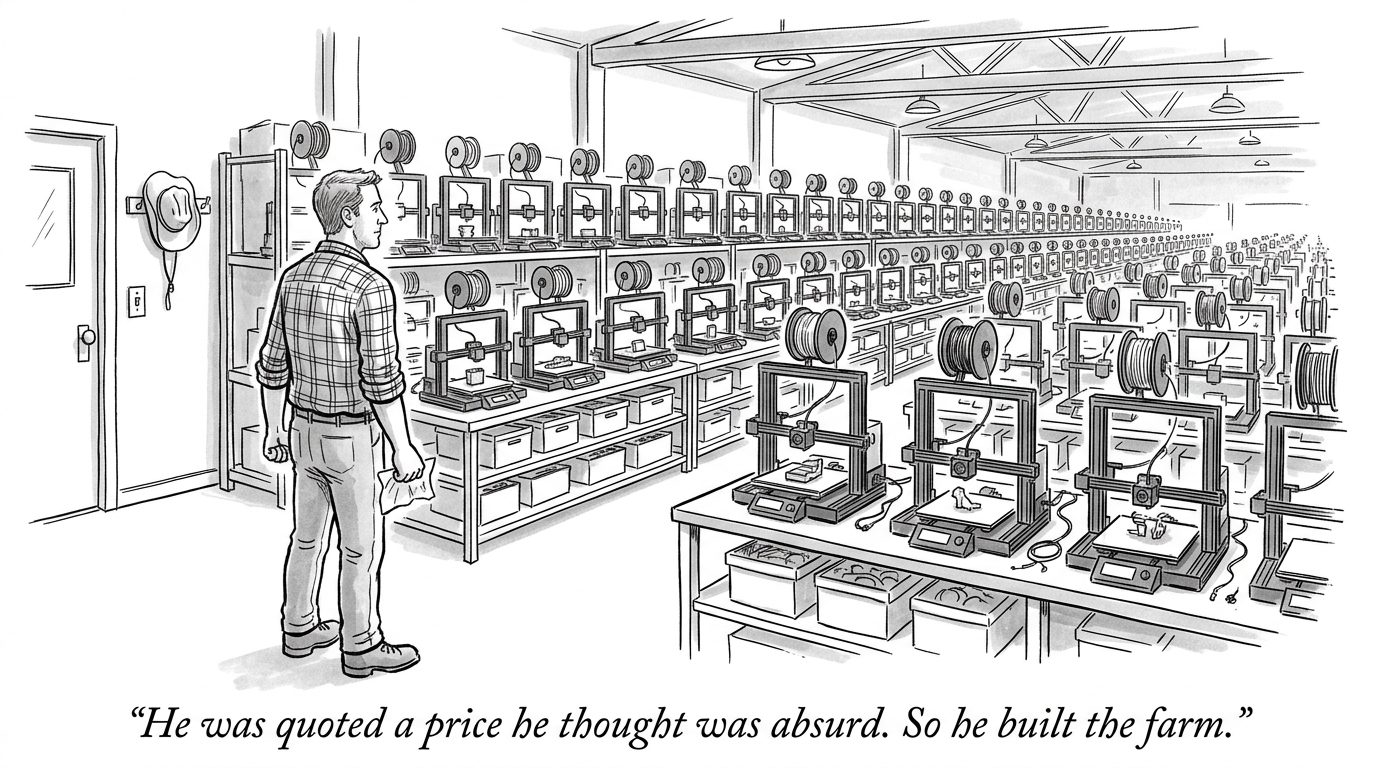
Gabe Bentz grew up on a cattle ranch and trained as a robotics engineer. By his own account, he got into 3D printing against his will -- not as a lifelong passion project, but because a robotic-arm side project he built one weekend led to a product, and the product needed parts made a way that didn't yet cheaply exist.[1] This outlet has already covered what his company, Slant3D, actually does -- the shipping-distance economics that forced a second factory outside Boise, the role it plays alongside Micron in the city's manufacturing reshoring story.[2] Neither piece told the actual, specific decision one person made, and why.
The problem was his own, and the existing market's answer to it was too expensive
Before Slant3D, Bentz ran Slant Concepts, a product design and engineering firm. He wanted 3D-printed parts for his own projects and found existing print-service bureaus priced for one-off prototypes, not real production volume -- too expensive to build an actual product business on.[1] Most people who hit that wall accept it as the price of the technology and either scale down their ambitions or move to a different manufacturing method entirely. Bentz didn't do either. He decided the price itself was the thing that needed to change, and that changing it required owning the manufacturing, not renting time on someone else's printers.
The specific bet: automation at a scale nobody else in the industry was running
In 2022, Slant3D took over a former locomotive-manufacturing building in southeast Boise and filled it with 2,000 printers -- what the company calls the MegaFarm.[2] Bentz's stated goal, in his own words from industry interviews, is blunt: to make physical-product manufacturing as accessible and scalable as digital product creation has become -- "warehouses where the shelves make the product."[1] That is a specific, testable claim about how manufacturing should work, made by one engineer with a ranch background and no manufacturing-industry credential that would have predicted this bet, not a company mission statement written by committee.
This is the shape this outlet's own methodology names directly: an identifiable person's act of will, not a diffuse industry trend, reshaping what a place actually builds. Boise's manufacturing identity around Micron already existed before Slant3D arrived. What Slant3D added wasn't inevitable -- it was one engineer's specific refusal to accept an existing market's pricing as fixed, converted into a 2,000-printer bet inside a building that used to make locomotives. A different person hitting the same pricing wall in 2017 almost certainly does something else with it: pays the higher price, prints less, builds a smaller company. Bentz's specific response is the actual variable that put a MegaFarm in Boise instead of nowhere in particular.
Why does this matter? A company profile answers what Slant3D does. It doesn't answer why it exists in the specific form it takes -- automated at a scale most of the 3D-printing industry has never attempted, built by someone who came to the field sideways, out of his own frustration with what the market was charging him. That specificity is the actual story. Boise's reshoring narrative has real macro drivers -- CHIPS Act incentives, Micron's own history in the city -- already covered on this outlet. It also has this: one person's stubborn, personal refusal to pay what he considered the wrong price for his own project.
Companion pieces on this outlet: "The US Makes 12% of the World's Semiconductors..." and "A 3D-Printing Startup in Boise Is Building a Second Factory in Louisville..."
- Plastics Machinery & Manufacturing, Gabe Bentz Brings 3D Printing Power to the People
- DoAyni, The US Makes 12% of the World's Semiconductors, Down From 37% in 1990...