Replacing a Bad Teacher With Just an Average One Adds $250,000 to a Classroom's Lifetime Earnings. What Actually Turns Access Into a Real Mentor Has Almost Nothing to Do With Asking to Be Mentored.
Start with proof the stakes are real, because "find a good mentor" is usually said as a platitude rather than backed by anything measurable. Economists Raj Chetty, John Friedman, and Jonah Rockoff tracked roughly a million students from elementary school into adulthood using actual tax records, linking which teacher a student had to that student's real adult outcomes.[1] Students assigned a high-value-added teacher were more likely to attend college, attended higher-ranked colleges, earned more as adults, had lower teenage pregnancy rates, and saved more for retirement.[1] The size of the effect is not subtle: replacing a teacher in the bottom 5 percent with just an average one -- not a great one, an average one -- raised the present value of that single classroom's lifetime earnings by roughly $250,000.[1] One person, one year, a quarter million dollars in real, tracked, adult outcomes. That is not a metaphor for why mentorship matters. It is the actual size of it, measured.
What the research gets right, and what it can't tell a working adult
The Chetty research is powerful and it has a real limit worth naming honestly: it studies K-12 classrooms, where a student is assigned a teacher by the system, not chosen by the student. It proves the effect is real. It says almost nothing about the actual, practical question facing an adult who is not going to be assigned a mentor by any institution: given some small amount of access to someone genuinely good, what do you actually do to turn that access into the kind of relationship that changes a career instead of a few pleasant, forgettable conversations?
The specific mechanism, named precisely rather than left as a platitude
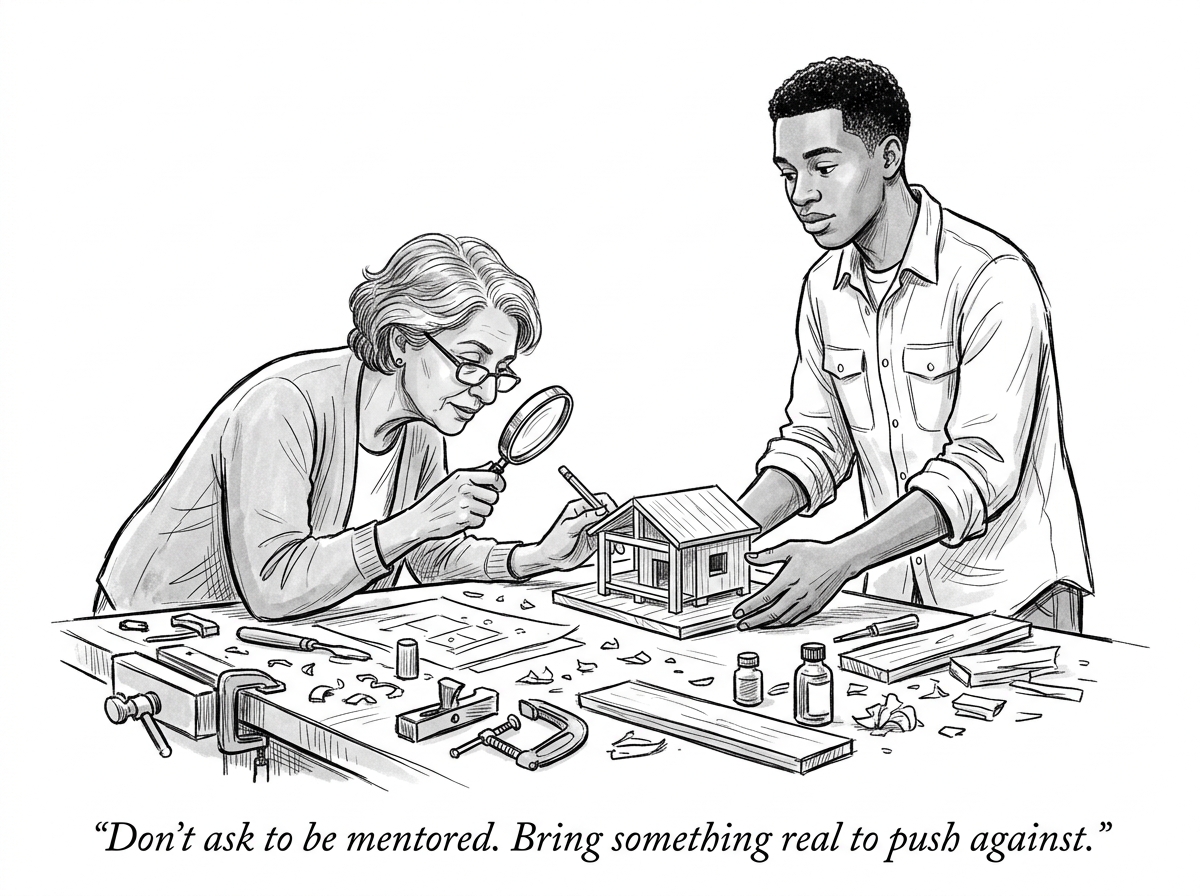
A real, lived example, described in exactly enough detail to be useful rather than inspirational: hundreds of real hours spent with one specific person, not a handful of meetings; being used as a foil -- someone whose evolving arguments got tested and pushed back on directly, not just given advice; and a specific, practical fluency (in this case, the working legal vocabulary embedded in real contracts) picked up because real work together required it, not because anyone taught it as a subject. None of that starts with a request to be mentored. All of it starts with bringing something real -- an actual argument, an actual piece of work -- back to the same person, repeatedly, over real time.
Formal mentorship research backs this up directly, even though it rarely gets stated this plainly. Work on effective mentee behavior, compiled by the National Academies, finds that the mentee's own proactive engagement -- what researchers call "mentoring up": voicing real needs, communicating specifically, driving the relationship rather than waiting to be developed -- is a measured, real competency, not a personality trait some people happen to have and others don't.[2] The same research is direct that mentees have to put in the work themselves and cannot expect a mentor to get them somewhere on their own effort alone.[2] Put plainly: the version of "seeking a mentor" that works is not a request. It is showing up with something real to test, again and again, until the relationship becomes real because of what got built inside it, not because anyone formally agreed to a role.
A second precondition the mentee-behavior research doesn't name: you have to walk in with something real already
"Bring something real to test" only works if there is actually something real to bring. This outlet's own author was not a novice when that specific relationship started -- already an engineer, already responsible for running million-dollar programs, already a CTO at two separate startups by the time the law room formed. The mentor was a lawyer; the relationship was never a senior professional filling an empty junior mind. It was two people with real, substantial, already-formed judgment in different domains, testing each other -- which is a fundamentally different, and harder to arrange, mechanism than "find someone impressive and bring your questions." Being a genuine foil requires having a real position of your own already, built by something -- and the thing that built it, before any mentor relationship began, was a run of ordinary, unglamorous early jobs: the actual programs run, the actual technical decisions made and lived with, the actual responsibility already carried. Early jobs are not just income while waiting for a real mentor to appear. They are what a person actually walks into the room holding, and without holding something real, there is nothing for a foil relationship to test at all.
The same pattern shows up again, outside any mentor relationship at all, which is what makes it a real law rather than one convenient story. This outlet's author is, by his own description, completely monolingual beyond what specific jobs required -- and yet picked up working French because a company's largest customer was based in France, working Spanish because restaurant work made it unavoidable, and the working legal Latin already covered above because contracts required it. Three separate languages, three separate skills, and in every case the actual driver was the same: not formal instruction, necessity created by real work. His own children, by contrast, can all read and write Latin -- taught, formally, in school. Both are real fluency. They arrived by opposite mechanisms. Necessity-driven acquisition and formal instruction are not competing explanations for how someone learns something real -- they are two different, equally valid paths, and knowing which one is actually in front of a person changes what they should be doing next far more than generic advice to "just learn it" ever will.
What this actually means for someone who does not already have access to a mentor like that. The room -- the actual, physical or institutional proximity to someone genuinely good -- is a real precondition, and it is not equally available to everyone; that access gap is its own separate, honestly harder problem this outlet has already documented elsewhere. But once there is any access at all, even a small amount, what determines whether it becomes formative is not gratitude, and it is not asking to be taught. It is bringing something real back, repeatedly: an actual draft, an actual decision, an actual argument that could be wrong, and being willing to have it tested. A single good conversation with someone impressive is not a mentorship. Hundreds of hours of real material, brought back on purpose, is.
Why does this matter? The gap between "I'd like a mentor" and "I have one" is not luck, and it is not charisma. It is a specific, repeatable behavior -- return with something real, let it be tested, come back again -- applied consistently enough, for long enough, that a few conversations become hundreds of hours. The $250,000 figure proves the destination is worth reaching. The actual, harder, and genuinely more useful fact is that the path there was never a request. It was a practice.
Companion pieces on this outlet: "How to Build a Mind", and the law-room material behind this piece, drawn from the same session's work.
- National Bureau of Economic Research, Measuring the Impacts of Teachers II: Teacher Value-Added and Student Outcomes in Adulthood (Chetty, Friedman, Rockoff)
- National Academies Press, Mentorship Behaviors and Education: How Can Effective Mentorship Develop?