IBM Filed More AI Patent Applications in 2023 Than Google or Microsoft. Its Own AI Platform Holds a 0.05 Percent Share of the Market It Spent a Decade Patenting.
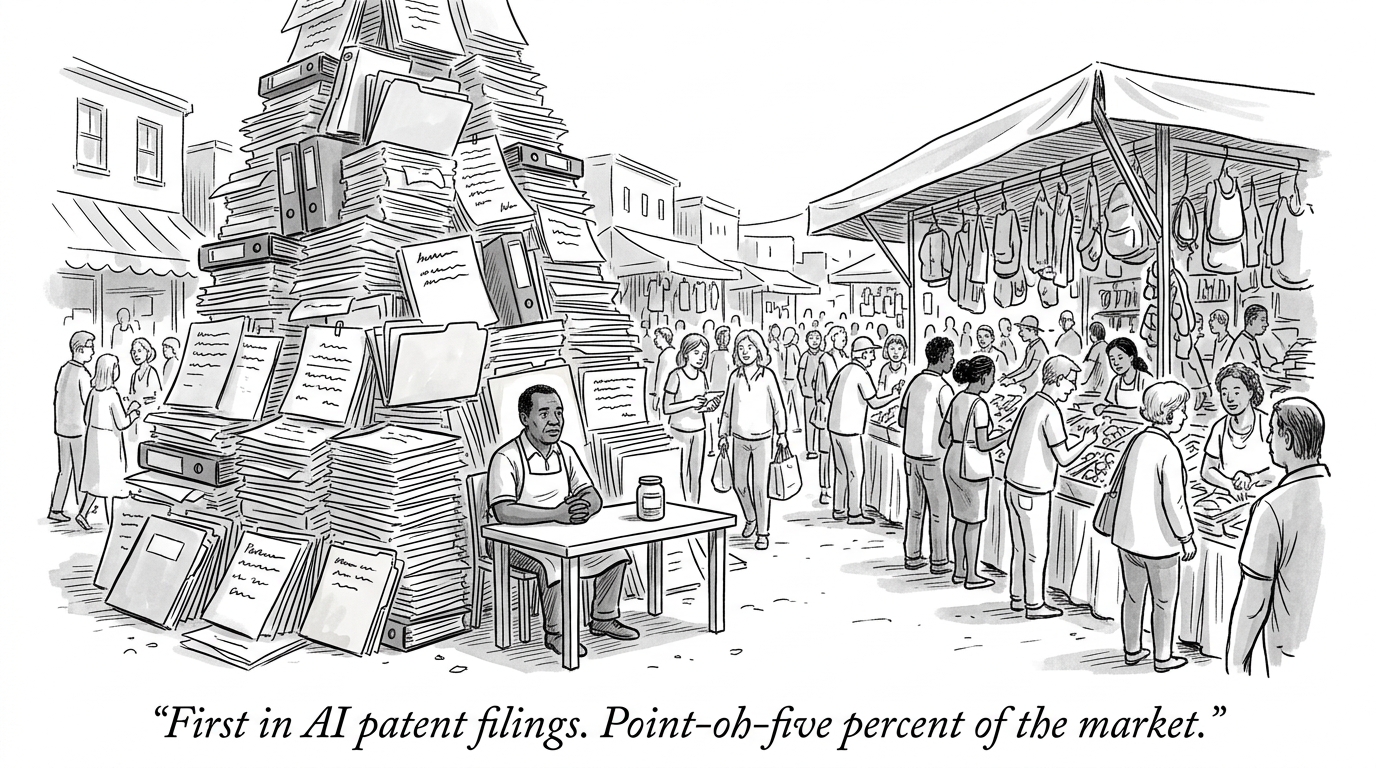
In February 2024, patent analytics firm IFI CLAIMS published a count that ran against a decade of assumptions about who leads artificial intelligence: International Business Machines — not Google, not Microsoft, not any of the companies whose chatbots people actually use — filed more AI-related U.S. patent applications in 2023 than any other company in the world.[1] A newly loaded set of U.S. Patent and Trademark Office filing records confirms the shape of that finding directly, down to individual applications with real filing dates and real patent numbers. What the same records don't show is IBM's own AI platform doing much with any of it in the market those patents describe.
The race IBM stepped out of, and the one it stepped into
IBM topped the annual list of U.S. patent recipients every year from 1993 through 2021 — 29 consecutive years, a streak no other company has matched.[2] In 2022, for the first time since the streak began, IBM didn't hold the top spot; Samsung did. That wasn't a stumble. IBM had already decided, in 2020, to stop competing on raw patent count at all. Darío Gil, IBM's Senior Vice President and Director of Research, later summarized the reasoning in one word: "focus." IBM shifted to what it called a "more selective approach to patenting," directing its filings toward a short list of priority areas — hybrid cloud, data and AI, automation, security, semiconductors, and quantum computing — rather than defending a volume title.[2]
AI was one of the areas IBM chose to keep pushing hard on. By IFI CLAIMS' count, IBM filed more than 1,500 AI-related patent applications in 2023 alone — about a third more than second-place Google, and more than double Microsoft's total.[1] IFI CLAIMS CEO Ronald Kratz framed the significance of the count plainly: "With any powerful, emerging technology, patents are a strong indicator of which companies will dominate the space down the road."[1] Whether that indicator is actually pointing where he thinks is the open question underneath this piece.
What the filings actually describe
The newly available USPTO application records make it possible to look at exactly what IBM was filing, not just how much. In the final ten days of December 2020 alone, IBM filed at least 18 separate applications with "machine learning," "neural network," or "artificial intelligence" in the title — a burst that includes "Automated End-to-End Machine Learning Model Optimization," "Interaction Neural Network for Providing Feedback Between Separate Neural Networks," and "Using a Machine Learning Module to Perform Destages of Tracks with Holes in a Storage System," all filed within the same nine-day window.
One from that batch, filed December 29, 2020 and titled "Customization of Recurrent Neural Network Transducers for Speech Recognition," went on to grant as US Patent 11,908,458.[4] Its claims describe a method for adapting a speech-recognition model to a new domain by synthesizing training audio from text and updating the model's internal encoder — a technique aimed at enterprise speech systems, not a consumer product with IBM's name on it. That's representative of the pattern across the batch: storage-system optimization, model training infrastructure, domain adaptation. Enterprise plumbing, filed at industrial scale, years before "generative AI" was a phrase anyone outside a research lab used regularly.
The market the patents point at
IBM does have a commercial AI product built on some of this research: watsonx.ai, its enterprise generative-AI platform. Martech intelligence firm 6sense, which tracks the technologies companies actually run by scanning their websites and infrastructure, estimates watsonx.ai's share of the AI-platform market it competes in at roughly 0.05 percent — good for 68th place among the tools it tracks in the category, with 229 customer companies identified. In the same tracking, OpenAI's ChatGPT and API products alone account for more than a quarter of the category between them, with Grok, Google Gemini, GitHub Copilot, and Microsoft's own Azure AI products each holding a larger measured share than watsonx.ai.[3]
The company that filed more AI patents than Google filed in 2023 is not, on this measure, fielding the AI product enterprises are actually adopting — not Google's, not Microsoft's, and not even, by a wide margin, its own.
Two different kinds of leading
Those two facts don't resolve into one story; they sit next to each other. A patent is a claim on a method, filed years before anyone knows whether the market built on that method will look anything like what the applicant imagined — the storage-destaging patent and the speech-customization patent were both filed in December 2020, before ChatGPT existed as a product at all. A platform's market share is a count of who is paying, today, for a finished thing. IBM's patent strategy, on Gil's own account, was built for the first kind of leadership deliberately, at the cost of the second: a "more selective," patient bet on owning pieces of the underlying methods other companies' products may eventually run on, rather than a bid to own the product layer itself.[2] Whether that bet pays off depends on whether the companies building the AI products people actually use ever need to license what IBM already filed — and that isn't a question this data, or any patent count, can answer yet.
[2] IBM Research, "IBM is no longer the U.S. patent leader," 2022
- Digital Science / IFI CLAIMS, IBM leads Google and Microsoft as race to next generation AI heats up
- IBM Research, IBM is no longer the U.S. patent leader
- 6sense, IBM Watsonx.ai — Market Share, Competitor Insights in Artificial Intelligence
- Google Patents, US11908458B2 — Customization of recurrent neural network transducers for speech recognition