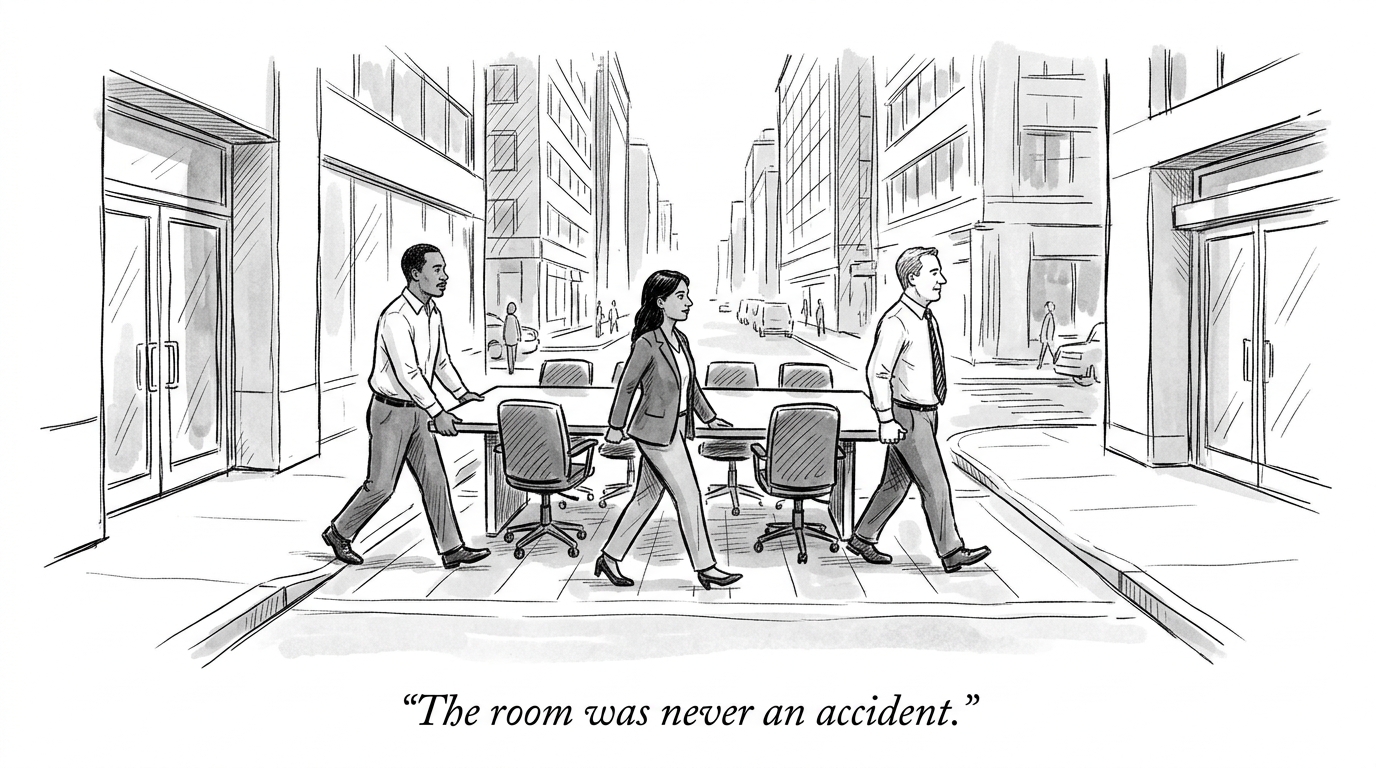
Mo Islam Did Technical Diligence for the CIA at In-Q-Tel. T.J. Rylander Ran Its ICT Practice for a Decade. Three More Colleagues Left Together, Founded a Company, Sold It, and Landed at the Same VC Firm. The Room Was Never an Accident.
Twelve years ago, Mo Islam helped seed Zoox while working in venture alongside a technical background built at In-Q-Tel, the CIA's own strategic investment arm, where he did technical diligence work on the agency's behalf. Zoox is now running Level 4 commercial robotaxi service in the US, and Islam -- now a partner at Obvious Ventures, after six years at Threshold Ventures and four at DFJ -- just published his own public read on the autonomous-driving inflection point: proprietary post-training data loops, world-model simulation, safety validation and compliance, and vertically-integrated hardware are where he's placing the firm's next bets.[1]
He isn't the only one who ended up here
T.J. Rylander spent ten years at In-Q-Tel, rising to Managing Partner and co-heading its ICT investing practice, leading bets on companies that included FireEye, Cloudera, Pure Storage, Cloudant, and Platfora. He's now a General Partner at Next47, the independent venture firm backed by Siemens, focused on connected devices, industrial systems, security, and robotics -- adjacent frontier-hardware territory to where Islam is now investing, reached by a different route through the same institution.[2]
A smaller, sharper version of the same pattern: Mark McGovern spent more than nine years as VP of Technology at In-Q-Tel. Michael Graninger worked the investment track there alongside him. Both left together with a third colleague, Will Radosevich, to co-found Mobile System 7 -- which CA Technologies acquired in April 2016. McGovern is now a Partner at Sands Capital. Graninger is Managing Partner there, running its Global Ventures practice in AI and cybersecurity. Three people who worked the same institution's investment track didn't just each independently land in venture capital -- they left in the same group, built and sold a company together, and re-formed at the same firm afterward.[3]
The specific technical bench In-Q-Tel's own CIO, the author of this piece, built and managed directly scattered the same way -- into almost exactly the lane each person's old deal book already pointed toward. One, a computational linguist and former NIST standards author, ran In-Q-Tel's NLP/AI deal book. Another covered semiconductors, microelectronics, batteries, and power electronics; he's now the founder of TeraContext and Joshua8.AI, doing AI-testing work -- local inference, GPU benchmarking, LLM evaluation. A VP of Technical Staff from 2007 to 2016 founded Acme Logic Works, doing technical due diligence in deep tech, AI, and defense. An SVP and Chief Architect from 2007 to 2016 moved through Capital One Ventures and now runs NextEra Energy Investments as Managing Partner -- energy and grid investing, the exact constraint now deciding how fast AI infrastructure itself can scale. The head of In-Q-Tel's physical and biological technologies practice is now a director at Lockheed Martin's Advanced Technology Laboratories and founder of Omega Advanced Systems. None of them landed in a lane unrelated to what they were already doing. Every one of them kept doing the same kind of work, just outside the one institution that had trained them to do it first.
That freedom wasn't informal or accidental. The technical team could simply decide -- backed by management prepared to stand behind that decision -- because return on capital was never the outcome In-Q-Tel measured its own people against. The actual question was simpler than that, and harder to fake: did this move the mission forward. A standard VC firm, and even a corporate venture arm answering to its own parent company's P&L, doesn't carry that same latitude: a bet has to clear a return threshold before it clears a decision-maker. In-Q-Tel's bets only ever had to clear one bar -- would this actually matter to the mission -- which is the specific, structural reason a technical staffer's own conviction about exoskeletons, or NLP, or semiconductors, could become a real position instead of a memo nobody acted on.
What the institution was actually built to do
In-Q-Tel exists specifically to find dual-use, national-security-relevant technology before the broader market prices it -- that's the entire stated reason the CIA created an investment arm at all. Spend years doing that professionally, evaluating frontier hardware and software against a national-security lens before anyone else is looking at it that way, and the pattern-recognition doesn't turn off the day someone leaves. It shows up again, on someone else's balance sheet, years later, credited to instinct or timing instead of to where that instinct actually got built.
Why does this matter? The easy version of this story is "well-connected people know each other." The actual mechanism is sharper than that: this isn't a favor network trading on who owes whom. It's a training effect -- years spent professionally identifying which frontier technology matters before the market has decided, at the one kind of institution built specifically to do that. Zoox getting seeded, McGovern and Graninger and Radosevich exiting Mobile System 7 together, Smith building an AI-testing company out of a semiconductors-and-batteries deal book -- none of it required anyone to be first, or lucky, or connected in the sense the word usually means. It required having already spent years in the one room built to teach exactly that kind of looking.
- Threshold Ventures, Mohammad (Mo) Islam -- team bio
- Venture5, Mo Islam joins Obvious Ventures
- SiliconANGLE, Amazon acquires autonomous vehicle startup Zoox in reported $1.2B deal
- N47, T.J. Rylander -- General Partner