A Venture Studio Ran 17 AI Models Through a 30-Round Game of Telephone and Published the Results. One of Its Portfolio Companies Builds Construction Bids on the Same Discipline.
Most AI ventures ship a model and call the demo proof. Joshua8.AI, a McLean, Virginia venture studio, publishes the failure modes first -- in exhaustive, reproducible, numeric detail -- before backing a company built on top of what the testing found. The studio builds and funds AI ventures from concept through Series A, running a 4,500-square-foot hardware lab of its own alongside the advisory work. One of its portfolio companies, TeraContext.AI, sells AI-powered document intelligence to commercial general contractors -- and the rigor that runs through Joshua8.AI's public research is the same rigor built into what TeraContext actually ships.
The testing isn't marketing copy -- it's a real, reproducible experiment
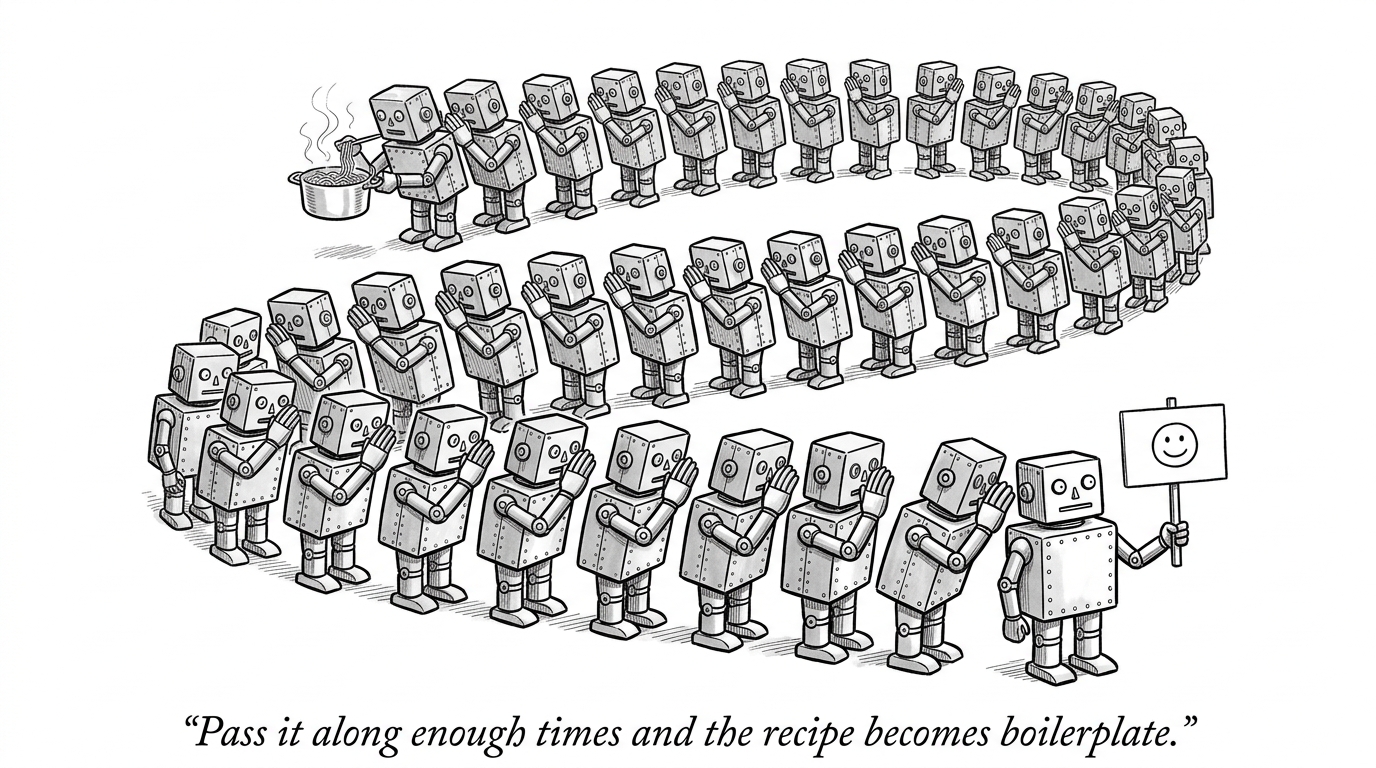
In February 2026, Joshua8.AI published a study asking a blunt question: when an AI model paraphrases something for "the next agent" in a chain -- exactly the pattern every multi-agent framework uses by default -- how much of the original meaning actually survives? The methodology was deliberately simple and hard to game: a five-step pasta recipe ("boil water... add pasta for 8 minutes... drain and serve with sauce"), paraphrased by each of 17 open-weight models, 30 times in a row, temperature fixed at 0.7, no cherry-picking. Semantic survival was scored by cosine similarity on the outputs' embeddings, not a subjective read.[1]
The spread was not subtle. Qwen3:30b-instruct held up best -- a rigorous multi-seed reanalysis puts its similarity to the original recipe at 0.904 (95% CI 0.89-0.91) after 30 rounds of paraphrasing, recognizably the same instructions. Other models collapsed into generic customer-service boilerplate within 10 to 20 steps, losing the actual content entirely. The study grounded itself in real prior academic work rather than inventing the question from scratch -- Frederic Bartlett's 1932 "serial reproduction" research on human memory distortion, a 2025 ICLR paper on "cultural attractors" in LLM transmission chains, and a 2025 ACL paper documenting a news story about a lorry accident mutating into a bus explosion after 50 rounds of iterative translation -- and extended that literature specifically to open-weight models runnable on consumer hardware, rather than only closed frontier APIs.[1]
The same discipline, applied to a domain where a missed detail costs real money
TeraContext.AI takes that same instinct -- don't trust an AI system's output, measure it -- and builds it directly into a product for a genuinely high-stakes use case. Commercial general contractors bidding on a project have to read spec books running 500 to 2,000-plus pages, classify every section by trade, and assemble scope packages for dozens of subcontractors across 29 trades, all under deadline pressure; a missed section becomes a change order later. TeraContext's pipeline runs the document through seven distinct stages -- PDF extraction, table extraction, section splitting, embedding, classification against the construction industry's standard taxonomies (MasterFormat and ten others), graph building, and cross-reference validation -- and every classification carries its own confidence score, so an estimator knows exactly which output to trust and which to double-check.[2]
The rigor doesn't stop at the confidence score. The platform is explicitly built human-in-the-loop -- "the AI does the heavy lifting, your team makes the final call" -- rather than positioned as a fire-and-forget replacement for the estimator's own judgment. And when someone queries the system directly, the answer comes back with the actual source: spec section codes, drawing numbers, and page references, not just a generated summary asserted without a way to check it.[2]
A follow-up study sharpens why that design choice matters. Joshua8.AI's newer, unpublished research asks a harder question than the original drift study did: does the similarity score itself actually track what a reader cares about? Across sixteen knowledge domains the correlation between similarity and fact survival is weak, and on construction statements of work specifically -- the exact document type TeraContext processes -- it runs backward: similarity and numeric survival are negatively correlated. A paraphrase can score high similarity while quietly dropping the one clause that changes what a contractor bids; the follow-up work found a reasoning-enabled model doing exactly that, silently omitting a bidder's exclusions clause in 60-80% of chains, while its similarity score looked fine.[3] That's not a footnote to the original study -- it's the direct, data-backed justification for why TeraContext doesn't ship one aggregate confidence number and call it done. A single similarity score can hide the exact failure that costs a contractor money; a confidence score per classification, checked against a citable source, is what catches it instead.
Why does this matter? The AI industry's actual failure mode right now is rarely "the model is wrong" in some dramatic, obvious way -- it's a plausible-sounding paraphrase that's quietly drifted from what it was supposed to preserve, discovered only after it mattered, sometimes even while the metric meant to catch drift says everything is fine. Joshua8.AI's public research exists to make that drift visible and measurable rather than assumed away -- and its own follow-up work shows the researchers turning that same scrutiny on their own headline metric, not just on the models being tested. TeraContext.AI is the applied proof of the same instinct: confidence scores instead of blind trust, human review instead of full automation, and citations a reader can actually check instead of an answer taken on faith. The venture studio and its portfolio company are running the identical discipline at two different altitudes -- one testing models and its own methods in public, the other testing outputs in production, for a customer whose margin depends on the difference between "close enough" and "exactly right." Joshua8.AI also sponsors the Culpeper Rodeo, a detail that says something about a company that's as comfortable in a dirt arena as it is in a GPU lab.
- Joshua8.AI, The Telephone Game for Local LLMs: Quantifying Semantic Drift Across 17 Open-Weight Models in 30-Iteration Paraphrase Chains
- TeraContext.AI, AI-Powered Pre-Construction — RFP Decomposition & Bid Management
- Joshua8.AI / Jim Smith, Follow-up semantic-drift research -- fact-survival vs. cosine-similarity divergence across knowledge domains, including construction statements of work; code and results public on GitHub