The Moon's Most Valuable Real Estate Has Been Completely Dark for Billions of Years, and No Solar-Powered Rover Can Enter It. A $250,000 University Project Is Trying to Get In With an Inflatable Ball.
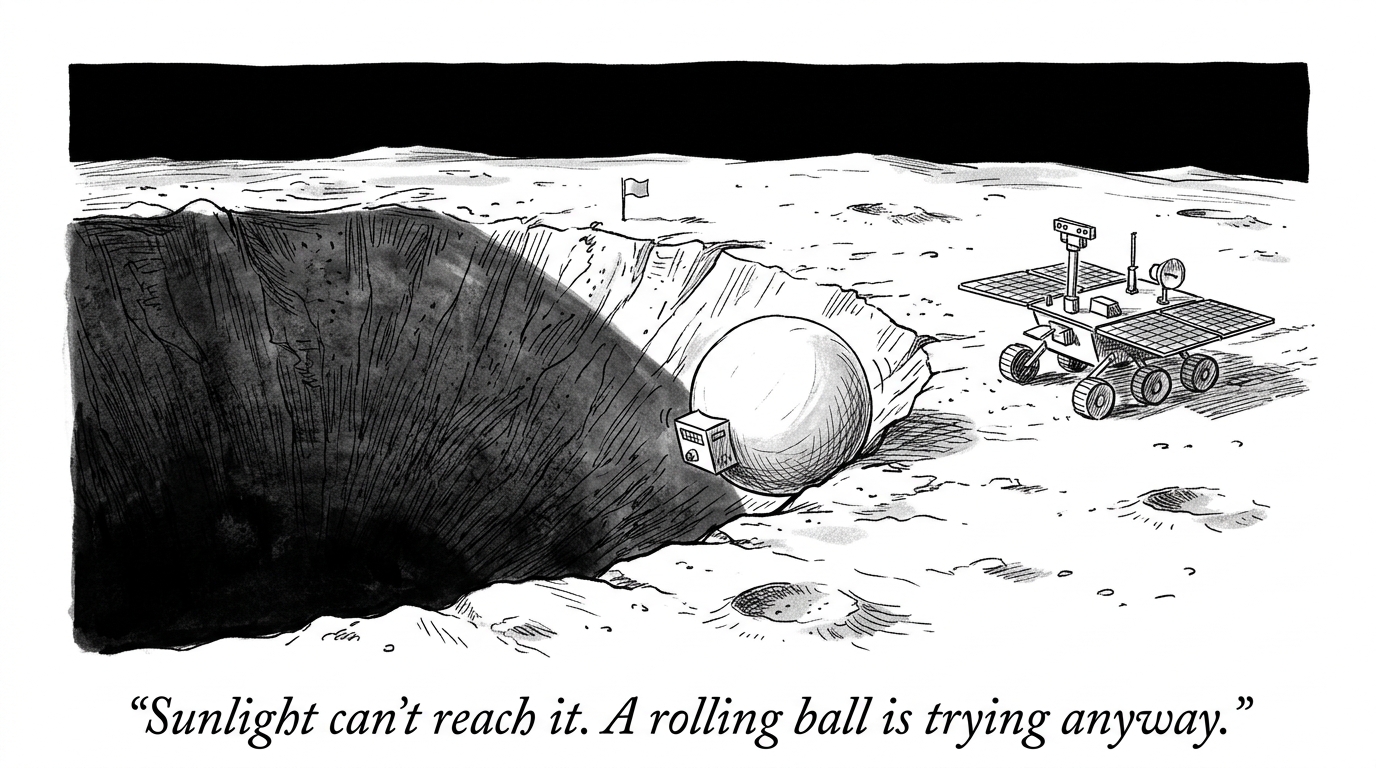
Rishi Jangale, a mechanical engineering PhD candidate at Texas A&M, is building a robot that looks nothing like a rover: RoboBall, an inflatable sphere 1.8 meters wide and 150 kilograms, that moves by shifting an internal pendulum to roll itself across terrain -- climbing 20-degree slopes, absorbing small obstacles by bouncing over them, and shrugging off temperature swings from -240°C to 93°C behind an insulated shell. The design traces back to 2003, conceived by Jangale's advisor Robert Ambrose, a former NASA robotics engineer. At roughly $250,000 for the current version, it carries a carry-on-luggage-sized instrument bay and can fire small rockets to launch samples back out. Its target is Shackleton crater, a 21-kilometer-wide, 4-kilometer-deep feature at the lunar south pole that has not seen direct sunlight in an estimated billions of years.[1]
Why anyone is spending money to get into a crater that's been dark since before complex life existed
NASA's LCROSS impactor (2009) and India's Chandrayaan-1 (2008-2009) confirmed water ice inside the moon's permanently shadowed polar craters, and that single finding turned those craters from a scientific curiosity into the most strategically valuable resource off Earth. Water can be split into hydrogen and oxygen -- rocket propellant, produced on-site, without the enormous cost of launching every gallon of fuel from Earth's own gravity well. The same water supports astronaut life support, and hydrogen nuclei are unusually effective at absorbing the cosmic radiation and solar particles that make long lunar stays dangerous without it. Water is the single resource on the moon that pays for itself three separate ways at once: fuel, life support, and shielding.[2]
The actual engineering problem is mundane: nothing that runs on sunlight works where sunlight never arrives
A permanently shadowed region is exactly what it sounds like -- crater walls angled so steeply relative to the sun that direct light never reaches the floor, in some cases for longer than the moon has had a crater there to shadow. A standard solar-powered rover simply cannot operate inside one; there is no light to convert to power. That single physical constraint is why the actual competition here isn't about who wants the ice most. It's about who solves the power-and-locomotion problem for a machine that has to work in total, permanent darkness, in extreme cold, on terrain steep and broken enough that conventional wheels struggle even in daylight.
At least three genuinely different engineering bets are running at once, and none of them has won yet. Texas A&M's RoboBall rolls in on stored power behind an insulated shell. Intuitive Machines is building "Grace," a hopping robot that uses a series of five thruster-powered jumps at different altitudes to leap directly into a permanently shadowed crater rather than drive in. Astrobotic's Griffin lander is set to deliver NASA's VIPER rover -- the Volatiles Investigating Polar Exploration Rover -- built for multi-day traverses into shadowed terrain using onboard power reserves rather than solar panels. A nuclear-powered rover concept is also under NASA discussion specifically because a radioisotope power source, unlike solar, doesn't care whether the sun ever reaches the crater floor at all.[3] The instinct to reach for nuclear power in space is not new -- physicist Freeman Dyson spent 1958 to 1963 at General Atomics working on Project Orion, a real, funded feasibility study for a spacecraft propelled by a series of small nuclear explosions detonated behind it. Nuclear power was, at the time, simply the most energy-dense source available for a problem this demanding; the same logic -- nothing else packs as much usable energy into as little mass -- is what still makes it the fallback answer whenever solar power isn't an option, on a lunar crater floor as much as a 1950s spacecraft design.[5] Three different machines, three different physical solutions to the identical constraint -- and the constraint itself, not ambition or funding, is what's actually been slowing this down.
Two national programs are racing for the same physical location
NASA's Artemis program has centered its planned lunar base near the south pole specifically because of the ice. China's own International Lunar Research Station -- built with Russia as a named partner -- targets the identical region. China's Chang'e 7 mission, delayed to 2027, is built specifically to hunt for that same water ice, deploying a lander, rover, and a hopping probe capable of jumping up to 15 kilometers at a time into the surrounding permanently shadowed craters, with China targeting a first crewed landing by 2030.[4] Two separate national programs are not just both interested in the moon in the abstract. They are both building hardware aimed at the same physical craters, for the same resource, on two competing timelines.
Why does this matter? A $250,000 university PhD project and a national space program chasing the same physical target sounds like a mismatch of scale, but the actual constraint -- sunlight cannot reach where sunlight has never reached -- doesn't care about a program's budget. Whoever actually solves reliable access to a permanently shadowed crater first, at any scale, has solved the load-bearing problem underneath every larger plan that depends on lunar water: the fuel depot, the life-support system, the radiation-shielded base. The hardware that gets there first may not be the best-funded. It may just be whichever bet on rolling, hopping, driving, or something not yet tried actually works in the dark.
- IEEE Spectrum, RoboBall -- Texas A&M's Inflatable Rolling Robot for Lunar Crater Exploration
- New Space Economy / Scientific American, Why is Artemis Focused on the Lunar South Pole? / Can NASA's Artemis Moon Missions Count on Using Lunar Water Ice?
- Gizmodo / NASA CLPS, Meet Grace, the Hopping Robot That Will Dive Into the Moon's Darkest Craters; Astrobotic Griffin/VIPER mission
- Scientific American, China's Chang'e 7 Moonshot Will Seek Water Ice at the Lunar South Pole
- Stanford University / Astronautix, Project Orion -- Freeman Dyson, Ted Taylor, and General Atomics' 1958-1963 nuclear pulse propulsion feasibility study