She Made $1.50 a Day Washing Other People's Clothes. She Built a Company That Trained 20,000 Women to Earn $5 to $15 a Day Instead. The Building She Built With That Money Is Still Standing in Indianapolis.
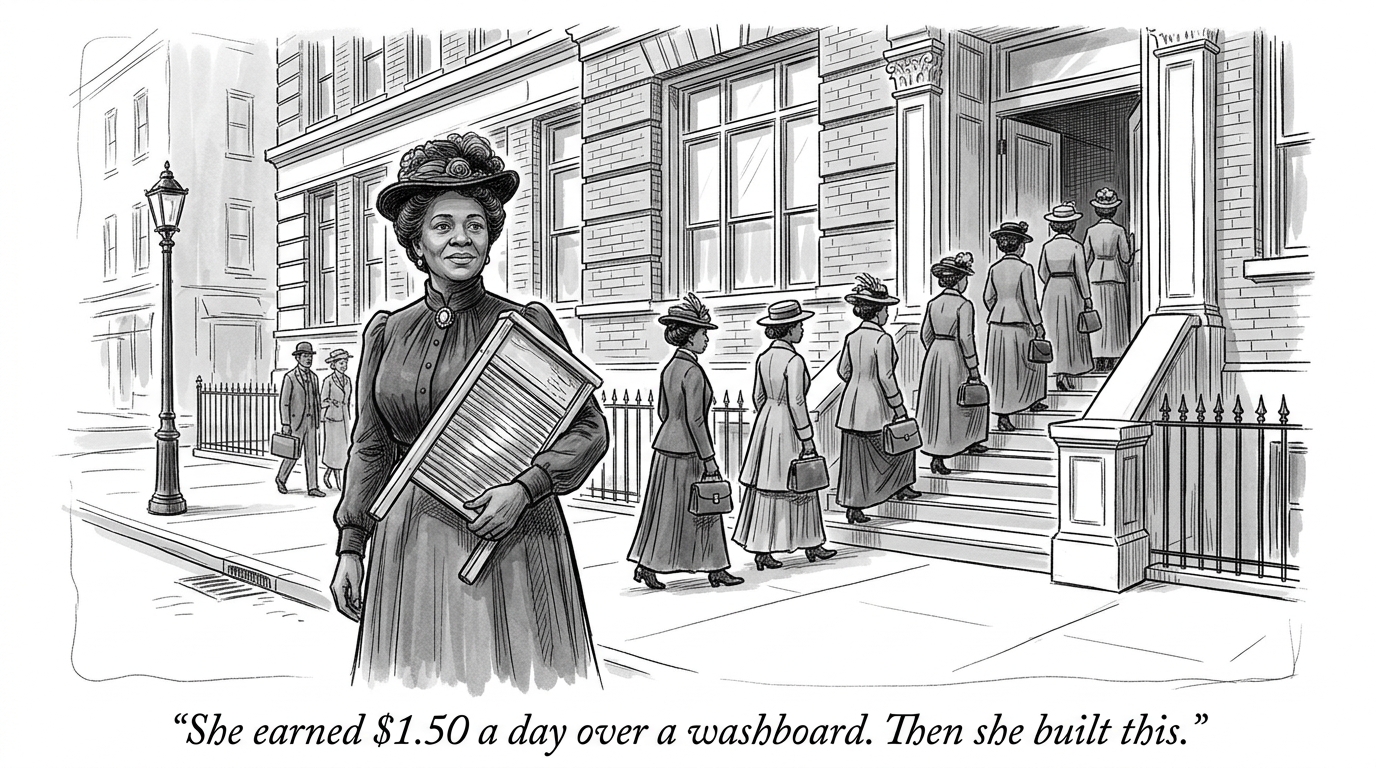
Sarah Breedlove was born in 1867 in Delta, Louisiana, to parents who had been enslaved. Orphaned at seven, married at fourteen, widowed at twenty, she supported her daughter by working as a washerwoman, earning roughly $1.50 a day.[1] By the time she died in 1919, she had built a company that trained more than 20,000 women to earn $5 to $15 a day -- more in a single day than she had once made in a week -- and the building she built with that fortune is still standing, in Indianapolis, right now.[2]
The product, then the deliberate choice of where to build the company
Breedlove developed a scalp treatment and hair-growth formula for Black women, first selling it door to door in St. Louis under the name Madam C.J. Walker, taken from her third husband. The formula was the product. The company came from something more deliberate: in 1910, she chose to move her manufacturing headquarters specifically to Indianapolis, for its position as a national rail hub -- letting her ship product anywhere in the country -- and its large, established Black community to draw both customers and a workforce from.[1] The city wasn't incidental to the business. It was a deliberate distribution decision, the same way this outlet has traced other companies choosing a place for exactly what that place offered.
The business model: she didn't just sell a product, she built the sales force
The company's actual mechanism was the sales force, not the formula alone. Walker trained saleswomen -- "Walker Agents" -- in the Walker Method at schools she built for exactly that purpose, and by 1917 the company had trained more than 20,000 of them, earning $5 to $15 a day at a time when many Black women's only available work paid a small fraction of that.[2] Walker is widely credited as the first self-made female millionaire in America, of any race -- a claim resting specifically on "self-made": she built the fortune from a $1.50-a-day starting point, not from inherited money or a husband's estate.[3]
The real mechanism wasn't the hair product. It was converting a skill 20,000 women already had into an income multiple times higher than the work available to them otherwise. Walker didn't invent a market that wasn't there -- Black women were already doing this work informally, for whoever would pay them. What she built was the structure that let 20,000 of them do it as a real business, trained and organized, at four to ten times the daily wage they'd have earned washing clothes. The company was the delivery mechanism for that wage gap closing, at scale.
What's still standing, and what it means for the city itself
The Madam C.J. Walker Manufacturing Company Building opened in 1927 on Indiana Avenue, eventually holding a drugstore, a beauty school, a 4,800-square-foot ballroom, and a 1,500-seat theater -- a full commercial and cultural complex, not just a factory.[2] Indiana Avenue was, at the time, the center of Indianapolis's Black business and cultural life. Nearly every other landmark on that stretch is gone. The Walker Building is the last of them still standing, designated a National Historic Landmark in 1991, still operating today as the Madam Walker Legacy Center.[4]
Why does this matter? Indianapolis is Indiana's capital and its largest city, and this outlet's only piece touching Indiana had been about South Bend -- a real, distinct city 140 miles away, with its own separate story about Studebaker's 1963 shutdown. That left the actual capital without a dedicated piece of its own. Madam Walker's story is not a footnote to that gap. It's a full, self-contained one: a washerwoman who built a national company by training tens of thousands of other women into a wage multiple times higher than what was available to them, and left behind a building still doing exactly the kind of community work it was built for, a century later.
Related pieces on this outlet: Nobody bailed out South Bend, so the law changed instead (this outlet's existing Indiana piece, correctly a different city's story).
- HISTORY, Madam C. J. Walker - Products, Hair & Facts
- Wikipedia, Madam Walker Legacy Center
- National Women's History Museum, Madam C.J. Walker
- Encyclopedia of Indianapolis, Madam Walker Legacy Center