Math Is Not a Ladder
Sailing means reading a chart, with its shoals, and the tide changes the landscape under you. Off Atlantic City there are several piers, and the bottom shifts. The inlets there have unmapped landmass running into the channel, and it changes from season to season. In Barnegat Bay there is an island that appears and then disappears. It is only local knowledge. If you do not know it, you can run aground and stay there until the tide shifts. Sometimes even the official marks cannot keep up. In 2015 the New Jersey State Police and the Coast Guard warned of significant shoaling in the channel that leads to Barnegat Inlet, and the Coast Guard moved buoys to mark the hazard.[13] In 2017, farther south, it pulled six of the seven buoys at Little Egg Inlet.[14] The chart is the map. The shape that matters keeps moving.
I did not learn to think about that in a math class. I learned it on a boat, and years later it turned out to have a name: topology. This is how I am built, and it is the reason for this piece. Math is not a ladder. It is a set of branches, and the useful skill is knowing which one you are standing in.
One ladder, many branches. The official classification of mathematics, maintained jointly by Mathematical Reviews and zbMATH, has 63 top-level areas.[1] A student in an American high school meets a sequence: Algebra I, geometry, Algebra II, precalculus, calculus. That is five courses, or six where trigonometry is its own course, which in my experience comes right after geometry. High school is four years, so a student starts in eighth grade or doubles up. In 2011 about 47 percent of eighth graders reported taking Algebra I or higher.[2] My computer science teacher, whose class I largely taught, told me to double up: Algebra II and geometry in the same year. That is why calculus was open to me. About 85 percent of 2019 graduates earned credit in Algebra II. Sixteen percent earned credit in calculus.[3]
The branches I know, and what each one is for.
Calculus is the language of continuous change, and physics runs on it. Physics is where a student who cannot do the math finds the subject much harder. In a national survey of 8,474 students at 63 randomly selected four-year colleges, the students with the most rigorous high-school math preparation did significantly better in college biology, chemistry and physics, and other high-school science courses showed little link to how students did in the other sciences.[4] At one selective university, prior college math coursework did not predict the final exam in the first calculus-based physics course.[5] That is the early math this piece is about.
Ratios and algebra are the language of chemistry. The coefficients in a balanced equation give the ratios, in moles, between the substances. Students often find chemistry hard until they see that the ratio is in moles and not in mass.[6] That is proportional reasoning, which is algebra.
Geometry and trigonometry are the math of space. In my view, trigonometry flows from geometry and unifies it with the algebraic branches.
Topology is the math of shapes that change. That one I got from sailing, and sailing also taught me not to trust it. The math is correct. The bottom does not care.
Discrete math is counting, graphs and routes. The traveling salesman problem lives here. Its cost grows in a way that surprises people, and a later section shows how.
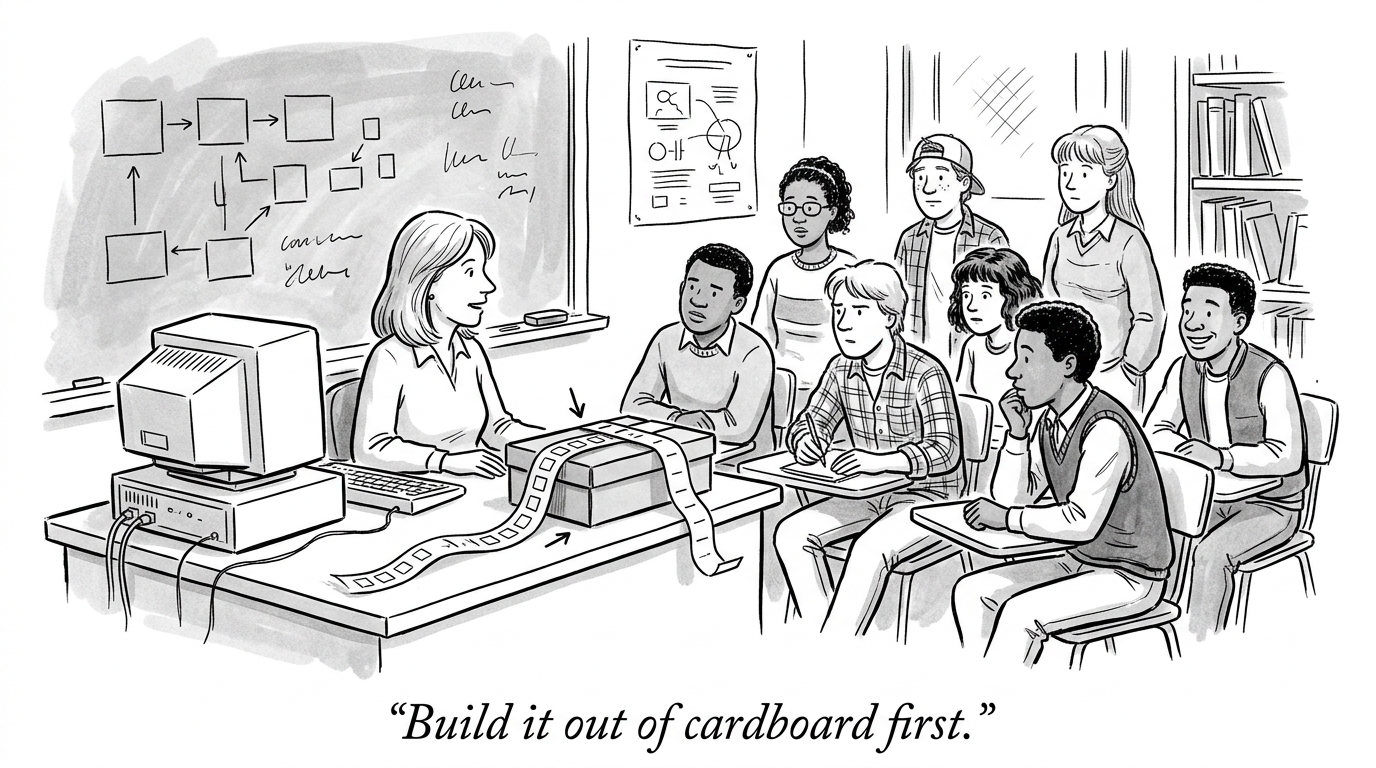
Formal languages are computer science. Shannon, Pascal, Fortran. A formal language is how you build a machine. A turnstile has two states, locked and unlocked, and two inputs, a coin and a push. Write down the states, the inputs and what each input does in each state, and you have built a state machine. The inputs it accepts form what is called a regular language.[7] Give a machine a stack and it handles nested structure like balanced parentheses; give it unlimited tape and it handles the most general languages. A generation of accountants and other finance professionals learned how a stack works on an HP calculator, without ever hearing the word.[16] Developers reached the same device by another route. Two groups with nothing in common came to the same idea through two separate mechanisms. That ladder of language classes matched to machine types is the Chomsky hierarchy.[7] And the open question this piece orbits, P versus NP, is written in that vocabulary: classes of languages decided by machines in a bounded number of steps.[8]
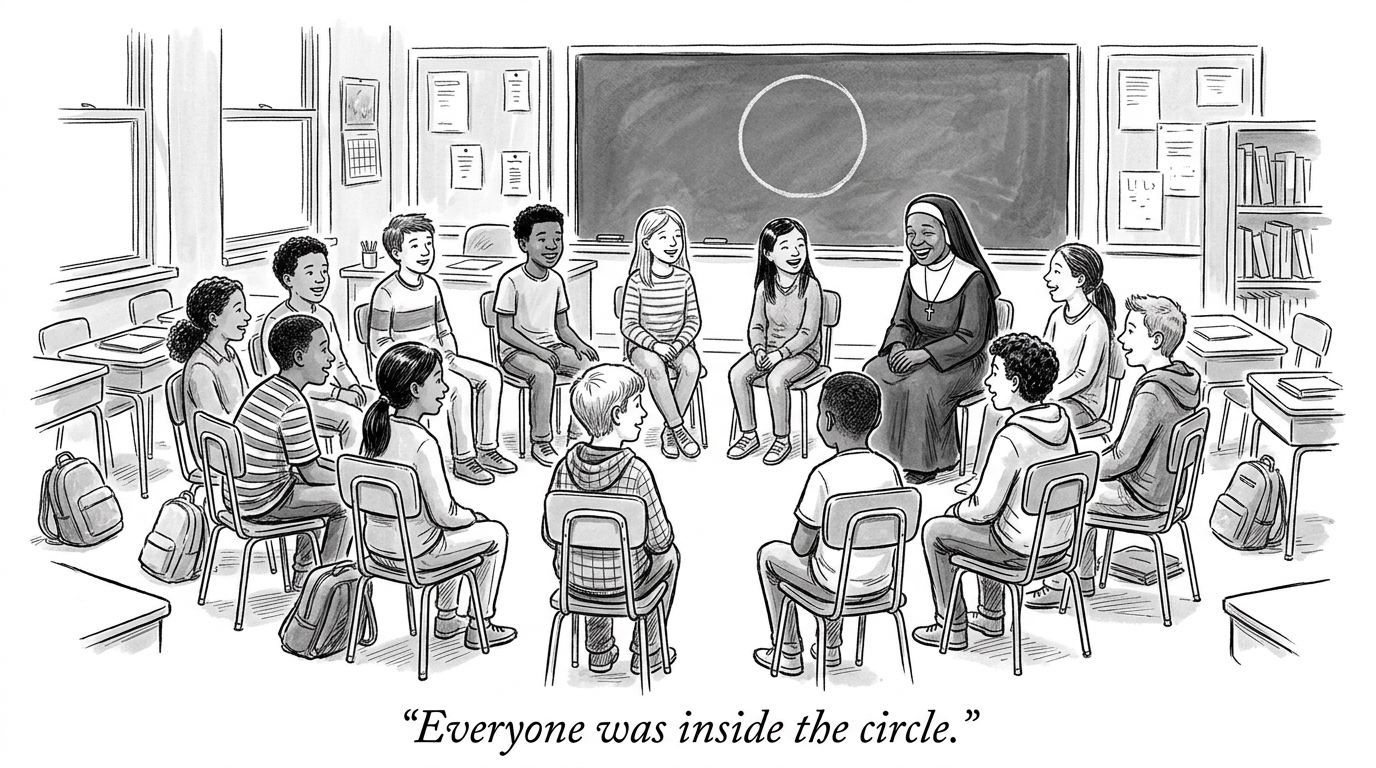
How I am built. I have a computer engineering degree and a minor in math, which came to something like fifteen college-level math courses, differential equations and graduate-level proofs among them. My father taught physics and chemistry at a college, and he taught me to sail, offshore and not on a lake. My mother was a teacher. My family knows how to teach. So physics, chemistry and the chart were in the house before they were courses. Two teachers bent my arc years apart, and they never knew each other. One was a nun in eighth grade. She was not a subject. She was a way of life, what meaning meant, a feeling of belonging; her order was about caring. I am not Catholic, and she still lives in my head more than forty years later. The other was my computer science teacher in high school. I hated geometry and trigonometry, and I cannot see in three dimensions. Calculus and linear algebra were a breeze, and I took calculus young. In my view that is not an accident: linear algebra is space written as algebra. I know the branches. Some are just easier. Algebra came first, as I recall. An uncle about five years older taught me the math he was learning, which would have been Algebra II when I was nine or ten. I started writing software at thirteen. Software, with its variables, taught me abstraction, so symbolic math made sense. Courses are how a school sorts math. The thinking underneath them is what carries over, and it does not always follow the order the courses come in.
Up close: the discrete branch. Add one stop to a delivery route and the driver's day gets a little longer. Add one stop to the planning of the route and, depending on the problem, the planning gets a little longer, or doubles, or multiplies by the number of stops. Those are three shapes.
A straight line, with a bend. Put sixty stops in order from nearest to farthest. A computer compares each stop against the others, about 60 times 60, or 3,600 steps. A thousand stops is about a million steps, which a laptop does in a thousandth of a second. Double the stops and the work roughly quadruples. Problems with this shape stay easy as they grow.
Doubling. Ask for the shortest route that visits every stop and returns home. That is the traveling salesman problem. The best exact method known, worked out in 1962, needs about 2 multiplied by itself once per stop, times the number of stops squared.[9]
Multiplying by the count. Trying every order is worse. Ten stops have 3,628,800 orders. Twenty have about 2.4 quintillion.
At a billion steps a second (idealized, one step per route or table entry):
| Stops | Straight line: sort by distance | Doubling: the 1962 method | Multiplying: try every order |
|---|---|---|---|
| 10 | instant | 0.0001 seconds | 0.004 seconds |
| 20 | instant | 0.4 seconds | 77 years |
| 40 | instant | 20 days | 3 × 10^31 years |
| 60 | instant | 131,500 years | 3 × 10^63 years |
Read down the middle column. Doubling feels fine for a long time and then it does not. From 20 stops to 60, the stops triple and the work grows by a factor of ten trillion. Faster computers do not fix a shape.
Easy to check, hard to find. Hand me a finished tour and ask whether it is shorter than 5,000 miles, and I add up the distances. That check is fast. Finding the shortest tour is the hard part. Problems whose answers are easy to check form the class called NP, and whether every such problem is also easy to find is one of the seven Millennium Prize Problems, unsolved.[8] Routing, scheduling and packing look nothing alike and sit in the same family: Karp's 1972 list of 21 such problems includes the Hamilton circuit, job sequencing, knapsack and set packing, and a fast method for any one of them would give a fast method for all.[10]
Knowing the difference. When someone says software will "optimize" a school-bus system, a hospital schedule, a freight network or a portfolio, the first question is not whether it is clever. It is which branch the problem belongs to, and which shape it has inside that branch. A calculus problem and a counting problem fail in different ways. An answer that is right on a chart can still put you aground until the tide shifts.
Where the ladder fails readers. Completing a course is not the same as being shown what it is for: in 2024, 45 percent of twelfth graders scored below the "Basic" level on the national math assessment, and about a third of the class of 2024 was estimated ready for college-level math.[11] The national teaching standards of 1989 recommended that grades 9 to 12 include topics from discrete mathematics.[12] In my view, schools give discrete math and the other branches little room, and an engineer who arrives without high-school calculus starts behind. In my view, the country does not produce much analysis of this kind, and even the people trained for it, the quants, are focused on Wall Street.
Some problems have no branch. Practicing software developers use another word: wicked. The idea comes from planning, not computing. Horst Rittel and Melvin Webber described wicked problems in 1973: no definitive formulation, no stopping rule, and answers that are better or worse and not true or false. Software borrowed the term in 1990.[15] A wicked problem is not hard the way a routing problem is hard. A routing problem can be written down exactly, and its answer can be checked. A wicked problem is not understood until someone has tried a solution. In my practice, a wicked problem is basically unsolvable in the traditional sense. You guess and iterate. Wicked problems are the only ones that make you not sleep. Everything else is engineering.
This is the author's account and is not investment advice.
- Mathematical Reviews and zbMATH, Mathematics Subject Classification 2020 (MSC2020): 63 two-digit classes, 529 three-digit, 6,022 five-digit
- Education Week, Study: middle school algebra push yields minimal performance gains (Brookings Brown Center report on NAEP course-taking)
- NCES, High School Mathematics and Science Course Completion, Condition of Education 2022
- ScienceDaily, Sadler and Tai, national survey of 8,474 college science students at 63 colleges, as reported by ScienceDaily, July 29, 2007
- American Physical Society, Burkholder, Murillo-Gonzalez and Wieman, Importance of math prerequisites for performance in introductory physics, PRPER 17, 010108 (2021)
- University of Northern Iowa, Goldsmith and Jaschen, A Balancing Act: Helping Students Understand the Mole Relationship for Balancing Equations, Iowa Science Teachers Journal 37(3), 2010
- Wikipedia, Chomsky hierarchy (secondary source; confirm against a standard automata text)
- Clay Mathematics Institute, P vs NP, Clay Mathematics Institute; Cook's formal statement as quoted by The Register, August 11, 2010
- arXiv, Held and Karp, J. SIAM, 1962, as described in Stoian, TSP Escapes the O(2^n n^2) Curse
- Wikipedia, Karp's 21 NP-complete problems; NP-completeness
- Nation's Report Card; Chalkbeat, 2024 NAEP Mathematics Grade 12 results; Chalkbeat, September 9, 2025
- NCTM, NCTM Curriculum and Evaluation Standards (1989), as described in an ICME-8 working group paper
- WHYY, Significant shoaling impacting Oyster Creek Channel, authorities warn, April 4, 2015
- Philadelphia Inquirer, Coast Guard signals popular Shore inlet no longer safe for boaters (Little Egg Inlet, 2017)
- Wikipedia, Wicked problem (Churchman 1967; Rittel and Webber 1973; DeGrace and Stahl 1990)
- Wikipedia, HP-12C (introduced 1981; classical RPN, four-level stack; de facto standard among financial professionals)