You Have Probably Owned One of Their Chairs, Lamps, or Sculptures Without Knowing Their Names. Three of America's Most Recognizable Postwar Designers Learned Their Craft, or Made Their Defining Work, Inside a WWII Incarceration Camp.
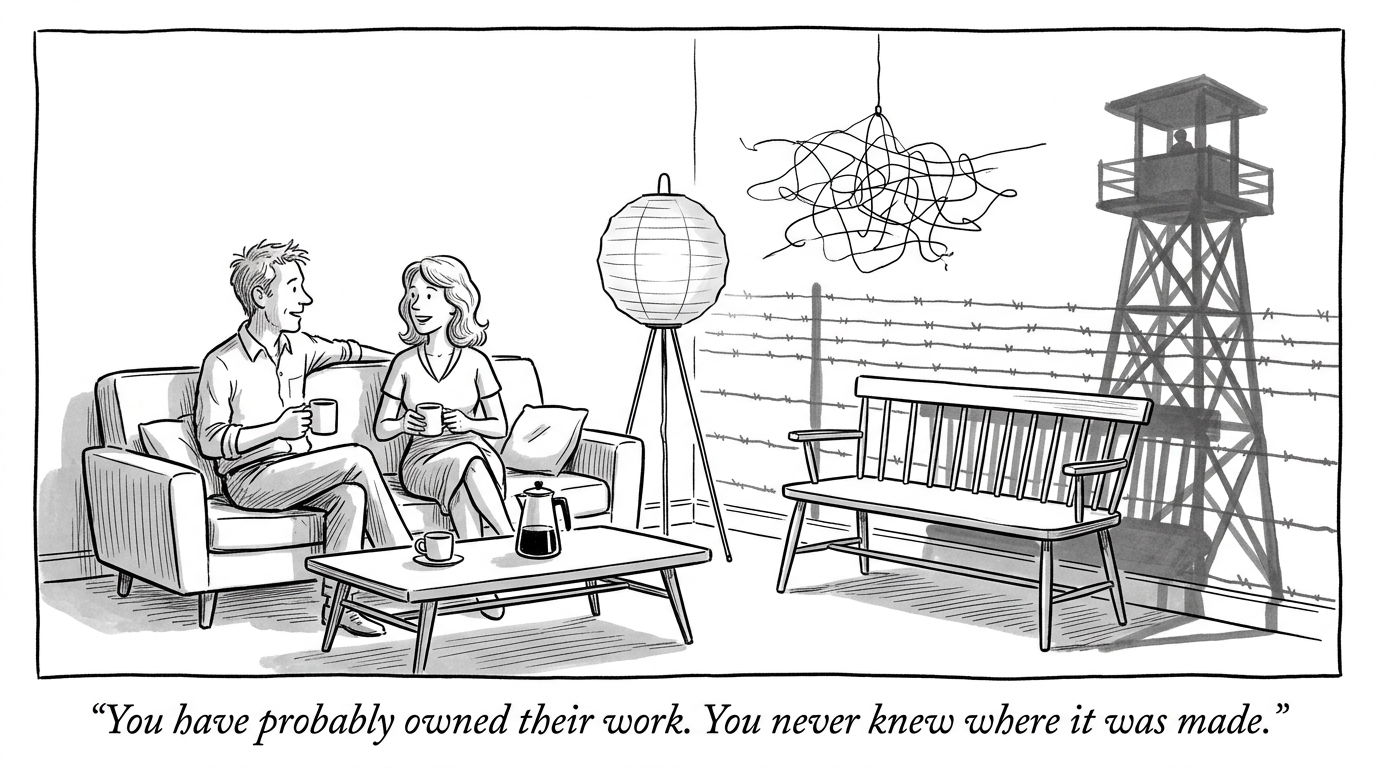
Isamu Noguchi's paper lantern, George Nakashima's wood furniture, and Ruth Asawa's wire sculptures shaped what a generation of Americans pictured as modern design -- objects that ended up in living rooms across the country with almost nobody knowing the names behind them, let alone what those three people had just survived when they made the work. All three were incarcerated, alongside roughly 120,000 other Japanese Americans, under the same 1942 executive order this outlet has already covered as a constitutional failure -- Korematsu v. United States, the case where the Supreme Court upheld the incarceration 6-3 and wasn't formally repudiated for 74 years.[1] This is the same history, showing up in a room nobody expects to find it.
Noguchi went in voluntarily -- and found the camp wouldn't let him build what he came to build
Isamu Noguchi was exempt from incarceration; as a New York resident, the order didn't apply to him. He went to Poston, Arizona anyway, in May 1942, carrying art supplies and real plans -- to establish craft guilds, redesign the camp's parks and recreation grounds, and make the place more livable for the people who had no choice about being there.[2] The camp administration let almost none of it happen. Poston stayed a prison. What Noguchi actually carried out of it was personal: abstract sculptural work like "My Arizona" (1943), a direct artistic record of the incarceration itself, made by a man who had walked in of his own free will and found out, from the inside, that free will wasn't actually on offer once he had.
Nakashima learned the joinery that built his whole career from a fellow prisoner
George Nakashima was incarcerated at Minidoka, Idaho, where he met Gentaro Hikogawa, a traditionally trained Japanese carpenter also imprisoned there.[3] Hikogawa taught him traditional Japanese joinery -- the specific woodworking technique that became the foundation of Nakashima's entire later career, and the reason his furniture still sells for real money and sits in museum collections today. The architect Antonin Raymond petitioned for Nakashima's release in 1943; Nakashima opened his own woodworking business in 1945. The single most defining technical skill of his career was not something he brought into the camp. It's something the camp, despite itself, is where he actually learned it.
Asawa's actual wire technique came later -- the honest, uncollapsed version
Ruth Asawa and her family were held first at the Santa Anita racetrack, where she and her siblings lived in horse stalls for five months, then at Rohwer War Relocation Center in Arkansas for the rest of the war.[4] Her actual first access to formal art instruction happened at Santa Anita -- taught by Japanese American animators who had worked at Walt Disney Studios, also incarcerated there, who gave her real, sustained drawing training.[4] It would be a cleaner story to say the wire sculptures came from the camps too. They didn't: the specific looped-wire basket technique she became famous for came later, from basket-makers she studied with in Toluca, Mexico, while she was a student at Black Mountain College.[4] The camps gave her the discipline and the first real teachers. They did not give her the technique -- and the honest version of her story keeps both facts, rather than flattening them into one clean line.
This outlet has already traced Korematsu as a legal failure: a court that had the Constitution directly in front of it, during the actual harm, and ruled the wrong way. This is the same history read from a completely different room. The legal record shows a government win that stood unrepudiated for 74 years. The living-room record shows three of the objects that shaped how postwar Americans actually decorated their homes, made or learned by people the government had just told, formally and with a Supreme Court ruling behind it, that they could not be trusted to be free. Both records are true at once, and neither one is the whole of what happened.
Why does this matter? A chair, a paper lantern, and a wire sculpture don't come with the maker's biography attached. Six Japanese American artists and designers -- Noguchi, Nakashima, Asawa, and three others -- are getting a joint show at the Barnes Foundation this fall specifically because that gap between the object and its story is real and worth closing.[5] The objects were never separate from the incarceration. The incarceration is where two of these three careers actually started.
Companion piece on this outlet: "The Supreme Court Had a Chance to Apply the Constitution to 120,000 People..."
- DoAyni, The Supreme Court Had a Chance to Apply the Constitution to 120,000 People...
- PBS SoCal, Isamu Noguchi: A Voluntary Stay at the Japanese American Internment Camp
- Minidoka National Historic Site, Listening to Trees: George Nakashima, Woodworker
- Densho, Visionary Sculptor Ruth Asawa
- Barnes Foundation, Noguchi to Asawa: Designing Postwar America