The Supreme Court Had a Chance to Apply the Constitution to 120,000 People Locked Up for Their Ancestry. It Ruled 6-3 That the Government Was Right to Do It. That Ruling Sat as Good Law for 74 Years.
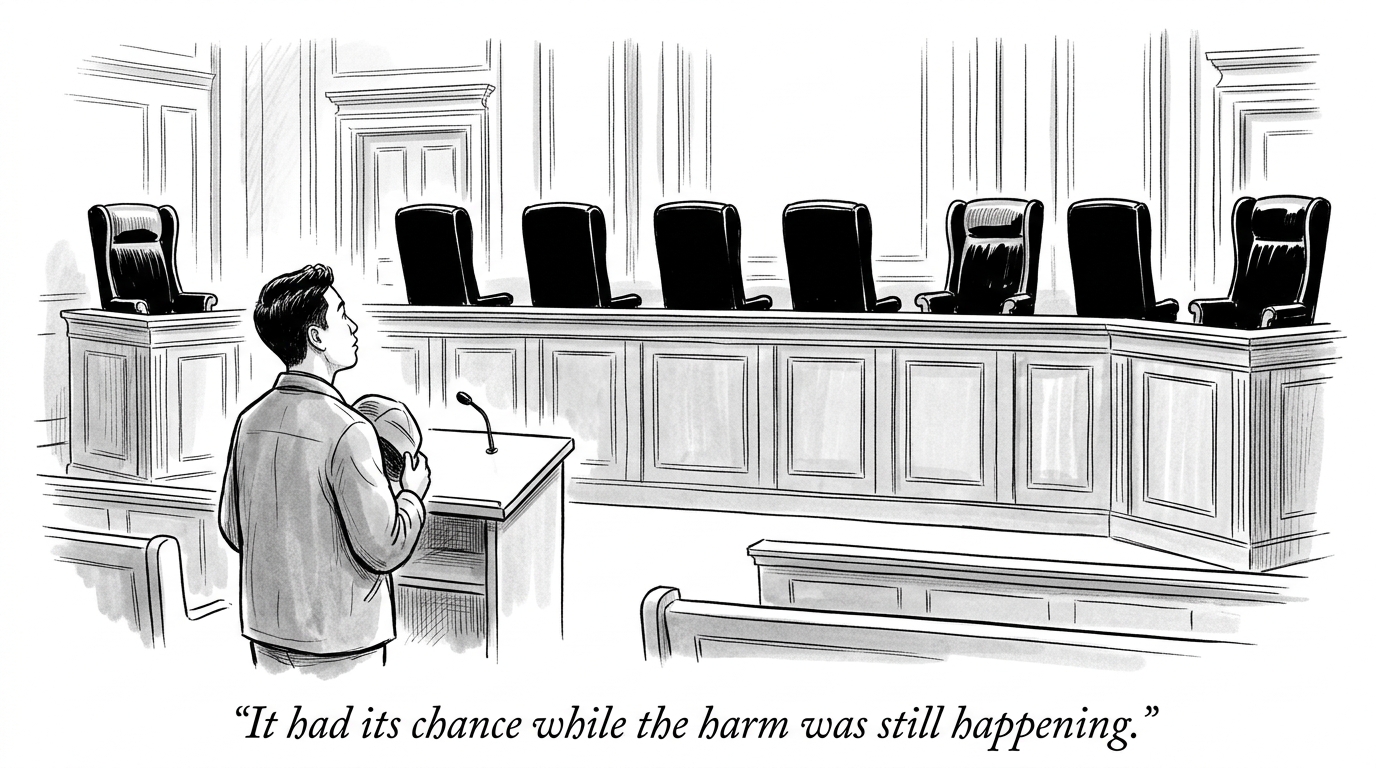
On February 19, 1942, President Franklin Roosevelt signed Executive Order 9066, authorizing the military to remove and confine any group it designated a security threat. Roughly 120,000 people of Japanese ancestry, most of them living on the West Coast, two-thirds of them US citizens by birth, were forced from their homes and held in camps for up to three years -- convicted of nothing, charged with nothing.[1] This thread has covered several cases where the Supreme Court finally applied a constitutional right after decades of leaving it unenforced. This is the case where the Court had its chance immediately, while the harm was still happening, and ruled the other way.
Fred Korematsu refused to go, and the Court sided with the order
Fred Korematsu, a 23-year-old Japanese American welder born in Oakland, stayed in California rather than report for removal, was arrested, and challenged the order's constitutionality all the way to the Supreme Court. On December 18, 1944, the Court ruled 6-3 that the incarceration was constitutional, accepting the government's framing that it was a "military necessity" rather than a decision based on ancestry.[2] Justice Robert Jackson dissented directly: once a court validates a racial-exclusion order as lawful, he warned, it becomes "a loaded weapon" available to any future government that wants to use it again.[2] The majority disagreed, and their ruling, not the dissent, was the law.
This is the inverse of Loving v. Virginia, already covered on this outlet. Loving is the case where a constitutional clause sat unused for 99 years until the Court finally applied it correctly.[3] Korematsu is the case where the Court had the clause -- the Fifth Amendment's guarantee of due process -- directly in front of it, while the harm was actively happening to living people, and ruled that the government's justification was good enough. Not every constitutional failure gets corrected once the facts are clear. Sometimes the Court gets the chance immediately and still gets it wrong.
Accountability came from Congress and a President, not from the Court
Korematsu was never formally overturned through the normal process -- no later case directly reversed it on the same legal question. What actually happened was slower and came from a different branch entirely. On August 10, 1988, President Reagan signed the Civil Liberties Act, granting a formal government apology and a $20,000 payment to every surviving person incarcerated under the order -- 44 years after the ruling, and only after a federal commission spent years documenting the decision as driven by "race prejudice, war hysteria, and a failure of political leadership," not military necessity.[4] The correction, when it came, came from the political branches admitting the Court had been wrong -- not from the Court admitting it to itself.
The Court eventually said something close to that itself, but not directly, and not cleanly. In 2018, deciding an unrelated case upholding a travel ban, Chief Justice Roberts wrote that Korematsu "was gravely wrong the day it was decided" and "has no place in law under the Constitution" -- 74 years after the ruling.[5] Justice Sotomayor's dissent in the same case pointed out the irony directly: the majority was repudiating a decision built on unquestioning deference to the government's stated national-security rationale, in the same opinion that extended exactly that kind of deference to a different government policy.[5] Even the repudiation carries an open argument about whether the underlying mechanism was actually retired or just renamed.
Why does this matter? This thread has spent several pieces showing that a written right does not enforce itself -- someone has to force the confrontation that makes a court apply it. Korematsu is the reminder that forcing the confrontation is not a guarantee. Fred Korematsu did everything the mechanism asks: he refused to comply, he was arrested, he took it all the way to the Supreme Court. The Court still ruled against him, and that ruling stood as valid law for nearly three-quarters of a century before anyone with the authority to say otherwise actually said so -- and even then, not through the front door.
Companion pieces on this outlet: "A Sheriff Walked Into Their Bedroom at 2 A.M....", "The Declaration Said 'All Men Are Created Equal' in 1776...", and "The Supreme Court Struck Down School Segregation, Unanimously, in 1954...", and "You Have Probably Owned One of Their Chairs, Lamps, or Sculptures..."
- National WWII Museum, Korematsu v. United States: 80 Years Later
- Wikipedia, Korematsu v. United States
- DoAyni, A Sheriff Walked Into Their Bedroom at 2 A.M. and Arrested Them for Being Married
- Densho Encyclopedia, Civil Liberties Act of 1988
- National Constitution Center, Did the Supreme Court Just Overrule the Korematsu Decision?