A Sheriff Walked Into Their Bedroom at 2 A.M. and Arrested Them for Being Married. The Judge Cited "Almighty God." It Took the Supreme Court 9-0 to Undo It -- 99 Years After the Amendment That Made the Case Possible.
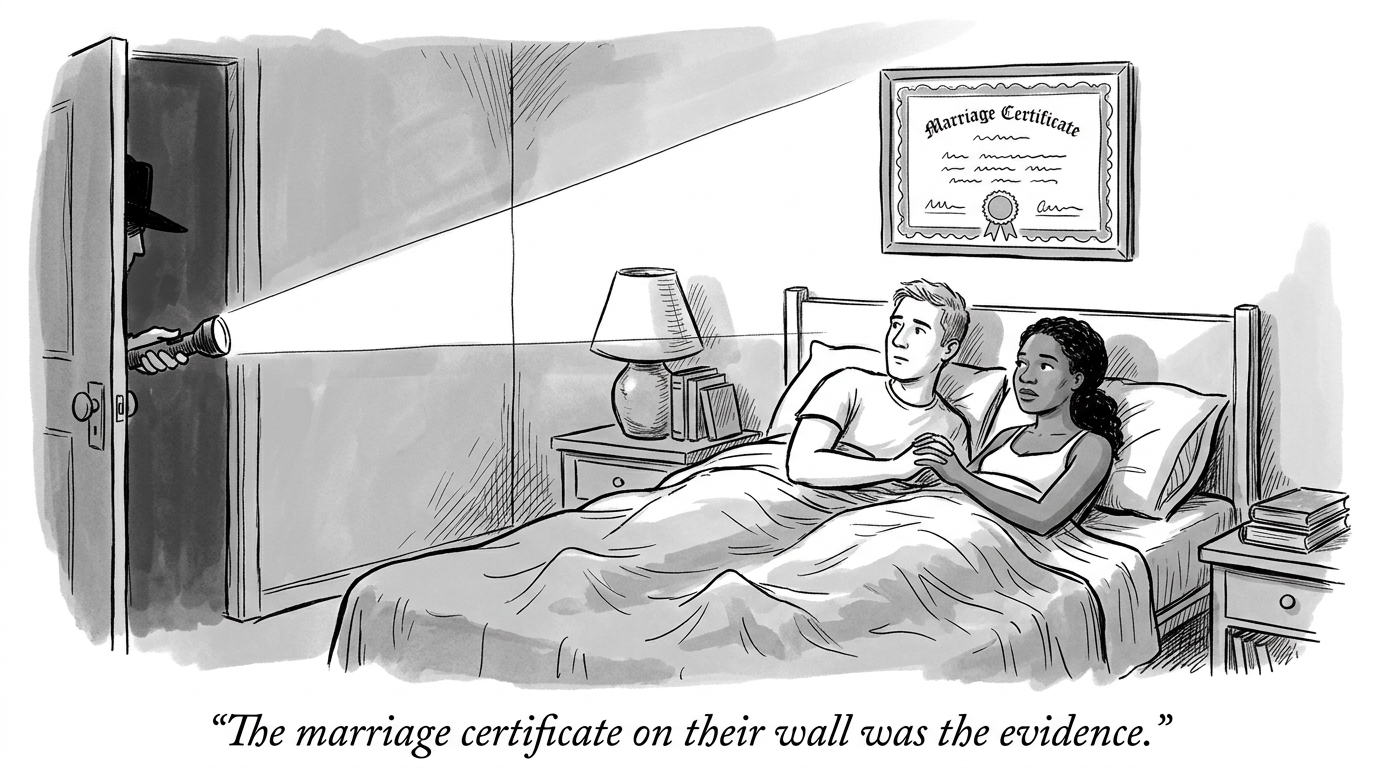
On July 11, 1958, a sheriff walked into a bedroom in Central Point, Virginia, at roughly 2 a.m. and arrested the two people sleeping in it. Their crime, on the books in Virginia at the time, was being married to each other.
The arrest
Richard Loving, who was white, and Mildred Jeter, who was Black and Rappahannock, had gotten married five weeks earlier in Washington, D.C., where the marriage was legal, then come home to Virginia, where it was not.[1] Virginia's law banned interracial marriage outright -- one of sixteen states that still had such a law on the books in 1958.[3] Sheriff Garnett Brooks found the Lovings' D.C. marriage certificate hanging on their bedroom wall and used it as the evidence to arrest them in their own bed.[1]
The judge
The Lovings pleaded guilty rather than face a jury trial. Judge Leon Bazile sentenced them to one year in prison, suspended on the condition that they leave Virginia and not return together, as a couple, for 25 years.[1] When the Lovings later asked him to vacate the conviction, Bazile refused and put his actual reasoning in writing: "Almighty God created the races white, black, yellow, malay and red, and he placed them on separate continents. And but for the interference with his arrangement there would be no cause for such marriages. The fact that he separated the races shows that he did not intend for the races to mix."[2] That is not a paraphrase or a hostile summary of his position. It is the sitting judge's own written opinion, on the record, justifying a criminal conviction.
The ruling
The Lovings moved to Washington, D.C., and, with the ACLU, appealed all the way to the U.S. Supreme Court. On June 12, 1967, the Court ruled 9-0 that Virginia's law -- and the other fifteen states' identical laws -- violated the Equal Protection and Due Process Clauses of the 14th Amendment. Chief Justice Earl Warren wrote the opinion himself: "The freedom to marry has long been recognized as one of the vital personal rights essential to the orderly pursuit of happiness by free men."[3] Every remaining state ban on interracial marriage fell the same day, in every state that still had one.
The 14th Amendment was ratified in 1868. This ruling came in 1967 -- 99 years later. The Equal Protection and Due Process Clauses did not change in that time. What changed was whether the Court would actually apply them to this specific harm. This is the same mechanism already documented on this outlet: a constitutional amendment is the shape a later case operates inside, not a guarantee that operates itself. The clause sat on the books, doing nothing for this specific harm, for nearly a century, until a sheriff, a bedroom, and a judge's own written words gave the Court something concrete to rule on.
Where the ruling went next
Loving did not stay confined to its own facts. In 2015, the Supreme Court decided Obergefell v. Hodges, recognizing a constitutional right to same-sex marriage nationwide -- and the majority opinion leaned directly on Loving's own language, that the freedom to marry is a fundamental right the state cannot restrict along lines the Constitution has already ruled illegitimate.[4] Mildred Loving herself said as much eight years before Obergefell was decided, in a rare public statement issued for the case's 40th anniversary in 2007: "I believe all Americans, no matter their race, no matter their sex, no matter their sexual orientation, should have that same freedom to marry... I support the freedom to marry for all."[5] The woman whose own arrest built the precedent lived to explicitly extend it, in her own words, before the Court did the same thing formally.
Why does this matter? Loving v. Virginia has appeared in three other pieces on this outlet, each time as one line in a longer list of Reconstruction-era cases.[6] It earns more than a line. It is a specific, documented instance of the exact mechanism this thread keeps tracing: a right written into the Constitution decades earlier, sitting unenforced against a real, named harm, until a case forces the question -- and once decided, that same reasoning becomes the foundation later cases stand on, not a closed, one-time ruling. The 14th Amendment did not marry the Lovings. A sheriff in their bedroom, a judge's written words, and nine justices applying a clause that had already existed for 99 years did.
Companion pieces on this outlet: "The Constitution Is 4,543 Words Long...", "Seven Documents Built America...", "The Declaration Said 'All Men Are Created Equal' in 1776...", and "The Supreme Court Had a Chance to Apply the Constitution to 120,000 People..." (this thread's inverse case -- the one time the Court had the chance immediately and got it wrong), and "The Supreme Court Struck Down School Segregation, Unanimously, in 1954..."
- Encyclopedia Virginia, Loving v. Virginia (1967)
- Library of Virginia, Judge Leon M. Bazile, Indictment for Felony
- Britannica, Loving v. Virginia | Summary, Date, Ruling, Facts, & Significance
- Cato Institute, Interracial Marriage as a Precedent for a Gay Marriage Decision
- qSaltLake, Mildred Loving's speech prepared for 40th anniversary of Loving v. Virginia
- DoAyni, The Constitution Is 4,543 Words Long...