The Supreme Court Struck Down School Segregation, Unanimously, in 1954. Ten Years Later, 2% of Black Students in the South Attended a Majority-White School. One Virginia County Just Closed Its Schools Instead, for Five Years.
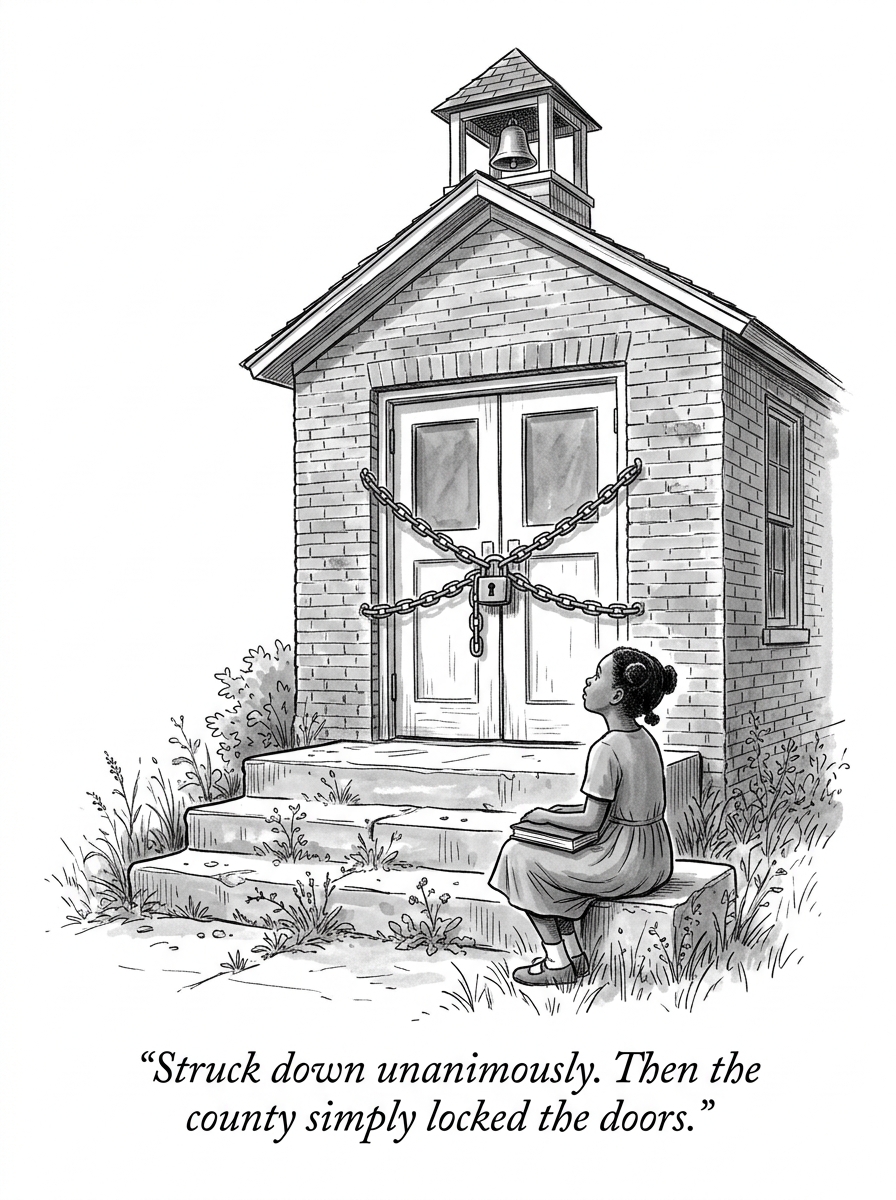
On May 17, 1954, the Supreme Court ruled unanimously, 9-0, that segregated public schools were unconstitutional, overturning the "separate but equal" doctrine that had stood since 1896. Most people know that date and stop there, as if the ruling and the result were the same event. This thread has now traced that exact gap three times -- Loving, Korematsu, and now the case most people would assume closed fastest of all.
The Court wrote its own delay into the second ruling
Brown v. Board did not order immediate desegregation. A year later, in "Brown II" (1955), the Court instructed school districts to desegregate "with all deliberate speed" -- a phrase Chief Justice Warren left deliberately undefined, with no actual deadline attached, and directed enforcement down to local federal courts rather than setting a national timeline itself.[1] Supporters read the phrase as "immediately." Opponents read it as permission to take as long as they wanted. Both readings were available because the Court had written a phrase that meant either one.
One Virginia county's answer: close the schools entirely
Prince Edward County, Virginia gave the plainest possible answer to "with all deliberate speed." In June 1959, rather than desegregate, the county board simply stopped funding its public schools -- closing every one of them.[2] White families used new state tuition grants to send their children to a newly formed private school, Prince Edward Academy, built specifically to keep white students educated while Black students had nowhere to go at all. Roughly 1,700 Black and lower-income white students went without formal schooling, some for the entire five years the schools stayed closed.[2] The county's public schools did not reopen on an integrated basis until 1964, and only then because the Supreme Court struck down Virginia's tuition-grant program in a separate ruling.[2]
The number that actually shows what "with all deliberate speed" produced: in 1964, ten years after Brown, only 2% of Black students in the South attended a majority-white school.[3] Ninety-eight percent of Black students in the South were still in all-Black schools a decade after the ruling that supposedly ended that arrangement. This is the same shape as Loving's 99-year gap and Korematsu's 74-year one, already covered on this outlet -- a right stated by the Court on paper, doing close to nothing on the ground, until something more specific forced it.
What actually closed the gap -- and it took two different branches, not one ruling
Two things changed the number, arriving close together. The 1964 Civil Rights Act gave the federal government a lever the courts alone hadn't had: Title VI let Washington cut off federal funding from school districts that stayed segregated, turning desegregation from a legal obligation into a financial one. Then, in 1968, the Supreme Court's Green v. County School Board of New Kent County ruled 9-0 that the "freedom of choice" plans most Southern districts had adopted -- letting Black families "choose" to enroll in white schools, which almost none dared to do under continued social and economic pressure -- did not satisfy Brown at all. The Court placed an "affirmative duty" on districts to actually integrate, not just remove the legal bar and wait.[4] By 1970, six years after Congress and sixteen years after Brown itself, the same measure had moved from 2% to 33%.[3]
Why does this matter? Brown v. Board is taught as the moment school segregation ended. The actual record shows a ruling that stated a right clearly, wrote its own enforcement deadline out of the decision, and then needed a second Supreme Court ruling and an act of Congress -- fourteen and ten years later, respectively -- before the number on the ground moved past a rounding error. This thread keeps finding the identical structure in different rooms: Loving's 14th Amendment sitting unused for 99 years, Korematsu's wrong ruling standing for 74, and now Brown's own "speed" turning out to mean over a decade for the first real movement. A ruling is a stated right. It is never, on its own, the result.
Companion pieces on this outlet: "A Sheriff Walked Into Their Bedroom at 2 A.M...." and "The Supreme Court Had a Chance to Apply the Constitution to 120,000 People..."
- ADL, With All Deliberate Speed
- Virginia Museum of History & Culture, The Closing of Prince Edward County's Schools
- The Fulcrum, 70 Years After Brown v. Board of Ed., Public Schools Still Segregated
- Encyclopedia Virginia, Green, Charles C. et al. v. County School Board of New Kent County, Virginia