The Declaration Said "All Men Are Created Equal" in 1776. Frederick Douglass Asked What That Meant to a Slave in 1852. It Took Four More People, Over 112 More Years, Forcing the Same Question, to Get an Honest Answer.
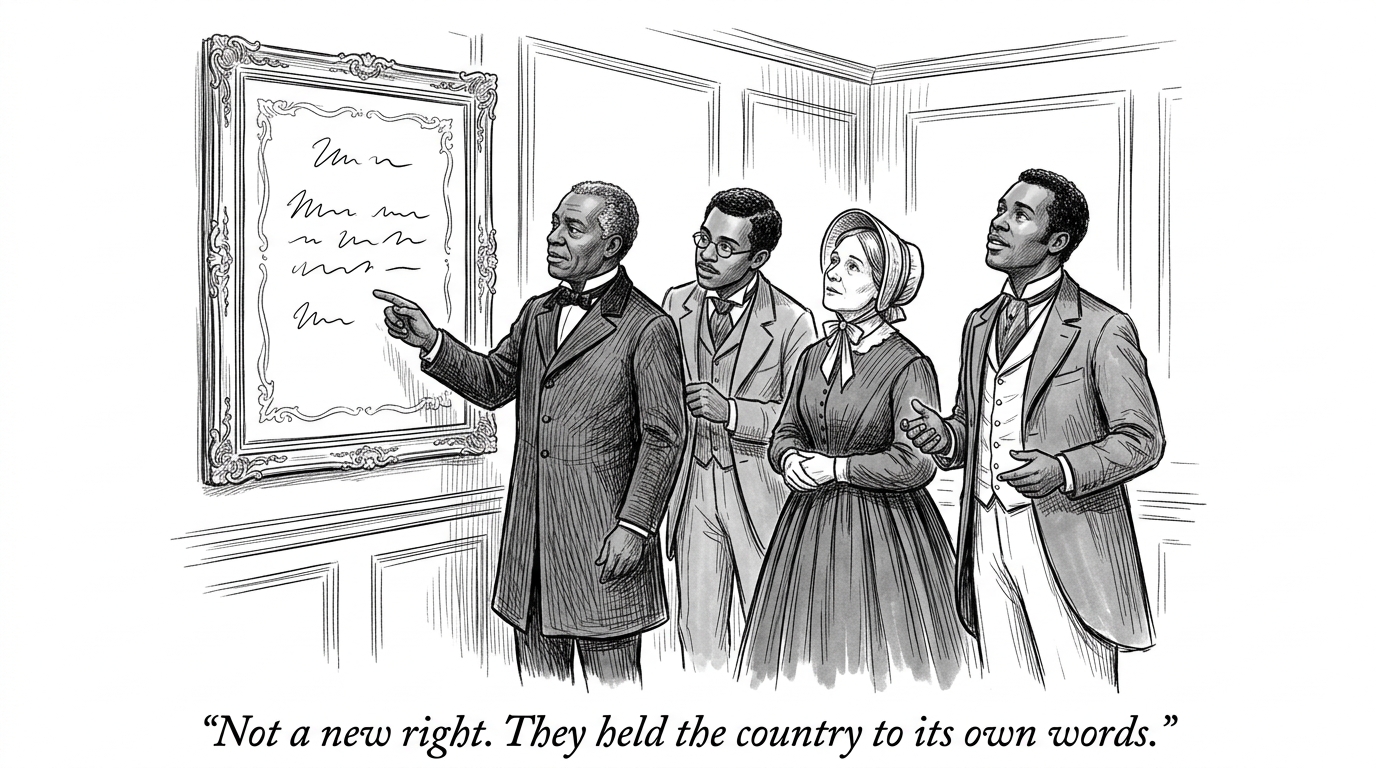
This outlet just published a case where a constitutional clause sat unused for 99 years until a sheriff, a bedroom, and nine justices gave it something to apply to.[6] That is not a one-case coincidence. Four people, across more than a century, made the same underlying move: holding the country accountable to words it had already put on the record about itself -- the Declaration, an amendment, a court ruling -- and refusing to let the gap between the word and the practice go unnamed. They did not always agree on how to do it.
Frederick Douglass, 1852 -- one of the most famous speeches in American oratory, and it is an indictment
Seventy-six years after the Declaration of Independence said "all men are created equal," Frederick Douglass, a man who had escaped slavery himself, stood in Rochester, New York, and asked a Fourth of July audience what that sentence actually meant to someone still enslaved. The speech is not a minor entry on a list -- "What to the Slave Is the Fourth of July?" is on its own terms one of the most studied and anthologized orations in American history, still taught, still read aloud every year at its own commemorations.[1] Its power was holding the country to its own stated word, not asking for something new: "Your prayers and hymns, your sermons and thanksgivings, with all your religious parade and solemnity, are, to him, mere bombast, fraud, deception, impiety, and hypocrisy -- a thin veil to cover up crimes which would disgrace a nation of savages."[1] There was no 14th Amendment yet for Douglass to invoke -- it would not exist for another sixteen years. His target was the founding promise itself, and the country's own failure to live up to words it had already chosen to write down.
Susan B. Anthony, 1872 -- using the exact clause Loving would later use, 95 years early
Four years after the 14th Amendment was ratified, Susan B. Anthony walked into a polling place in Rochester, New York, and voted -- deliberately testing the amendment's own language: "No State shall make or enforce any law which shall abridge the privileges or immunities of citizens of the United States." She and fourteen other women were arrested. At her 1873 trial, Anthony argued directly from that clause: as a citizen, she had the right to vote. The judge instructed the jury to return a guilty verdict without deliberation, and fined her $100 -- which she refused to pay.[2] Anthony was not asking the country for a new right. She was holding it to the exact words it had ratified four years earlier -- the identical Equal Protection language Loving v. Virginia would use 95 years later -- and the country, through its own judge, refused to be held.
Martin Luther King Jr., 1963 -- accountability as a discipline, not just a demand
Writing from a Birmingham jail cell, King laid out a direct framework: a just law is one a majority would also bind itself to; an unjust law is one a majority imposes on a minority while exempting itself.[3] Segregation law, he argued, was unjust by that test, and the duty was to break it openly rather than wait, in his words, potentially forever for justice to arrive through the courts on its own.[3] King was not rejecting the courts. He was holding the country to the same 14th Amendment Anthony had invoked ninety years earlier, on the position that a right already written down does not enforce itself without someone making the country answer for the gap.
Malcolm X, 1964 -- holding the country accountable for not enforcing its own ruling
A year later, Malcolm X went further, and broke with the other three on the actual mechanism. In "The Ballot or the Bullet," he argued that taking the fight to the government's own courts meant asking the same government that had allowed the harm to also correct it -- and pointed specifically at the Supreme Court's 1954 school-desegregation ruling in Brown v. Board of Education, still unenforced in large parts of the country a full decade later, as his own proof that the country had not lived up to a promise it had already made to itself, in its own highest court.[4] He was not making Douglass', Anthony's, or King's argument. He was making the argument underneath all three of theirs: that even a won ruling, an actual formal victory, could sit unenforced for years -- and that trusting the same mechanism indefinitely was itself a risk, not a neutral, safe default.
These four did not agree, and that disagreement is the actual point, not a flaw in the pattern. Their pivot, in every case, was accountability -- holding the country to something it had already said about itself, in its own words, rather than asking for something new. Douglass held the Declaration's promise up against slavery's reality, before any amendment existed to enforce it. Anthony held the 14th Amendment's own text up against her own arrest. King held the country to its own Constitution through public, deliberate confrontation rather than waiting on it. Malcolm X held the Supreme Court to its own 1954 ruling, a decade after the Court itself had already decided the question. Every one of them was answering the same underlying fact this outlet just documented in Loving v. Virginia: a right written into the Constitution does not apply itself, and the country does not hold itself accountable by default. It took a sheriff's arrest to make the 14th Amendment mean something for interracial marriage in 1967. It took a forced vote, a forced arrest, and a decade of public accountability to make the same amendment mean something for citizenship, for legal equality, and for the actual, physical presence of Black students in previously all-white schools.
Why does this matter? "The law already says this" and "this right already exists" are not the same claim as "this right is being enforced." Four people, arguing across more than a century and sometimes arguing directly against each other's strategy, all converged on the same underlying diagnosis: a written right is a claim on the future, not a guarantee about the present, and the country does not hold itself to its own word without someone making it answer. Someone still has to do the holding -- and reasonable people, including these four, have disagreed sharply about how.
Companion pieces on this outlet: "A Sheriff Walked Into Their Bedroom at 2 A.M...." and "They Won the Only Successful Slave Revolution in History..."
- Teaching American History, What to the Slave Is the Fourth of July? (1852)
- Smithsonian Magazine, In 1872, Susan B. Anthony Was Arrested for Voting 'Unlawfully'
- The Martin Luther King, Jr. Research and Education Institute, Letter from Birmingham Jail
- Teaching American History, The Ballot or the Bullet (1964)
- DoAyni, A Sheriff Walked Into Their Bedroom at 2 A.M. and Arrested Them for Being Married