They Won the Only Successful Slave Revolution in History and Declared Independence in 1804. France Sent Warships and Made Them Pay for Their Own Freedom -- Until 1947. The US Didn't Recognize Them for 58 Years.
In August 1791, enslaved people in the French colony of Saint-Domingue rose up. By January 1, 1804, they had defeated the French army, declared independence, and renamed the country Haiti. It remains the only successful slave-led revolution in world history to end in an independent nation.[1] Every other piece in this thread has been about someone forcing a country to live up to a right it already claimed to hold. This is the one time it was not a petition, a lawsuit, or a protest. It was won outright, on the battlefield -- and losing did not stop France, or the United States, from finding other ways to make Haiti pay for it.
The revolution
Toussaint Louverture, formerly enslaved himself, rose to lead the revolution by 1794 and became the colony's de facto ruler by 1801. Napoleon sent an army to restore French control and re-enslave the population; French forces captured Toussaint in 1802 and shipped him to a French prison, where he died the same year.[1] The revolution did not die with him. Jean-Jacques Dessalines took command, defeated the remaining French army at the Battle of Vertières in November 1803, and declared Haiti's independence on January 1, 1804.[1] An enslaved population had defeated a European empire and built a sovereign nation from the win. Nothing else in this thread required more than that -- and nothing else in this thread was punished for its success more directly.
France's price for acknowledging what had already happened
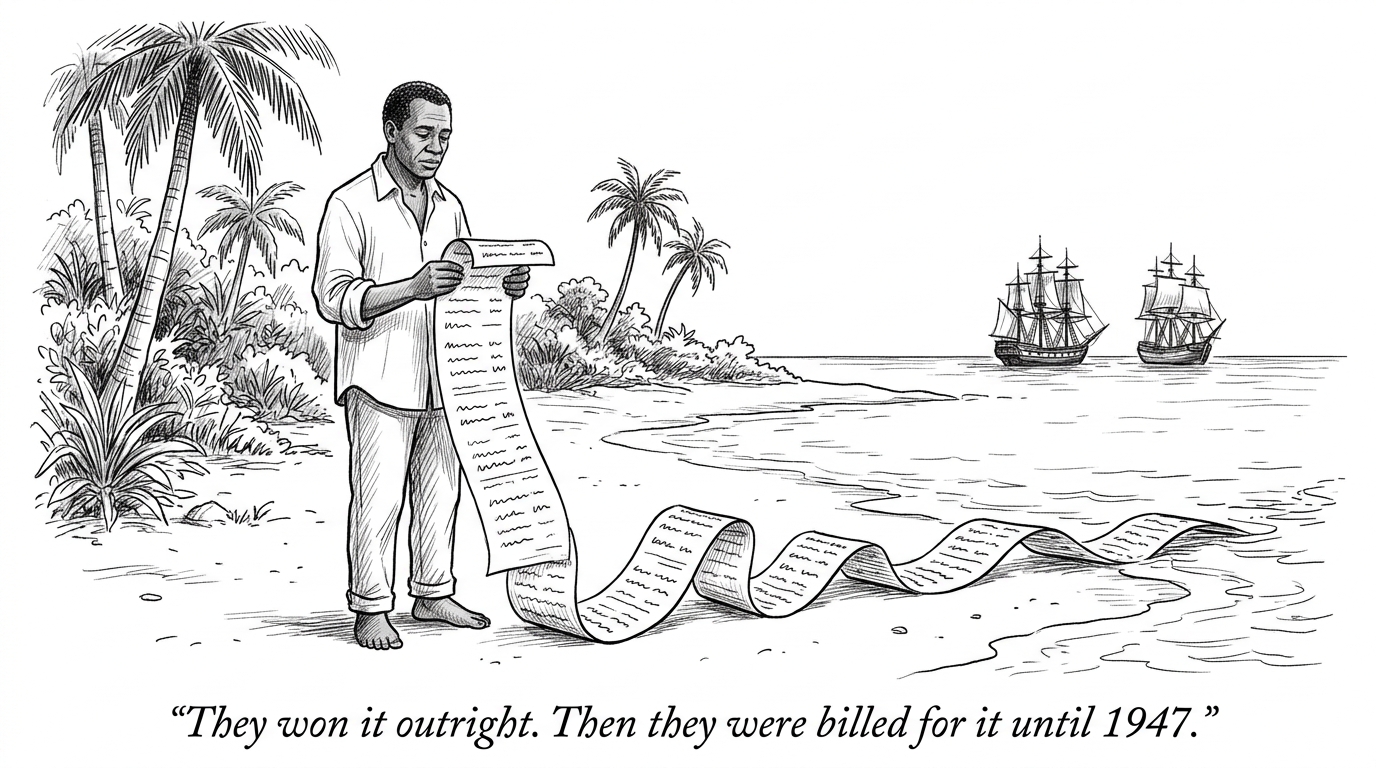
Haiti had already won. France's recognition changed nothing about the military outcome -- but France used it as leverage anyway. In July 1825, King Charles X sent an armed flotilla to Haiti with a demand: pay 150 million francs in compensation to former French slaveholders for the loss of their human property, or face renewed military action.[2] Haiti agreed, and took out loans from French banks to make the first payment. In 1838 France reduced the remaining balance to 60 million francs, payable over 30 years; the original indemnity itself was paid off by 1883. But the loans Haiti had taken out to cover those payments carried their own interest, and by a 2022 New York Times investigation's accounting, Haiti did not finish paying off that secondary, compounding debt -- what the investigation called the "double debt" -- until 1947. The Times estimated Haiti paid roughly 112 million francs in today's terms, equivalent to about $560 million.[2] A nation that had already won its independence by force spent the next 122 years paying for the privilege of having it acknowledged.
The United States withheld recognition for 58 years -- and said exactly why
The US did not formally recognize Haiti's independence until July 5, 1862 -- 58 years after Haiti declared it.[3] The delay was not a bureaucratic oversight. Southern representatives in Congress blocked recognition for decades specifically because an independent Black nation, founded on a successful slave uprising, was a threat they did not want their own enslaved population to see acknowledged as real by the US government.[3] Recognition only became possible once the Southern states seceded and their representatives left Congress -- Lincoln recognized Haiti in the middle of the Civil War, once the specific votes that had been blocking it for six decades were no longer in the room.[3]
The occupation: when withholding recognition stopped being enough
Recognition, once granted, did not end the pattern. In December 1914, US Marines landed in Haiti and physically removed $500,000 in gold from the Haitian National Bank, shipping it to the vaults of the National City Bank of New York -- the same bank that had just taken effective control of Haiti's finances.[6] In July 1915, the US invaded outright and occupied Haiti for nineteen years, running its finances, rewriting its constitution to permit foreign land ownership Haiti had banned since 1804, and reviving forced labor -- a corvée system -- to build roads with Haitian workers who resisted it by force for most of the occupation's length. In December 1929, US Marines opened fire on roughly 1,500 unarmed protesters in Les Cayes, killing at least 24.[6] The occupation did not end until 1934. A country that had already won its independence outright in 1804, already paid France's price for having that independence acknowledged, and already waited 58 years for the US to admit it existed, spent nineteen more years under direct foreign military and financial control -- 130 years after the win, not immediately after it.
None of this -- France's indemnity, America's 58-year non-recognition, the 1915-1934 occupation -- was ever about whether Haiti was real. Haiti had won its independence outright in 1804; there was no factual dispute left to resolve, at any of the three points where outside power was applied again. Each was a political choice, made by people who had the power to make it, to extract something further from a settled win because doing so served their own interests -- slaveholder compensation for France, the political optics of a free Black nation for the antebellum US, US banking and strategic interests in the Caribbean by 1915. Haiti did not just win once and get punished once. It was punished by outside powers, at three separate points across more than a century, for the same original fact: it had won, and stayed won, when the rest of the hemisphere had not let that happen anywhere else.
The same pattern, closing its latest chapter in 2026
This is not a live story this outlet is tracking -- it is two settled, dated events, already closed. In September 2021, roughly 15,000 Haitian migrants gathered under the international bridge at Del Rio, Texas; images of Border Patrol agents on horseback grabbing at them became a national controversy, DHS suspended horse patrols, and by September 24 the camp was cleared -- about 2,000 people sent back to Haiti, about 8,000 returned to Mexico.[7] Separately, Haiti's Temporary Protected Status -- the legal protection that had let roughly 352,000 Haitians live and work in the US -- went through a two-year legal fight: terminated by the administration in 2025, stayed by a federal court in February 2026, and finally ordered into effect by the Supreme Court on June 25, 2026, taking effect July 27, 2026.[8] Both are closed, dated facts, not a status this outlet promises to keep updating. What they show is that the mechanism this piece traces -- an outside power, for its own domestic reasons, choosing to withdraw or withhold something from Haiti that had already been settled -- is not confined to 1825 or 1915. It closed another chapter in 2026, 222 years after 1804.
The split still on the map today
Haiti and the Dominican Republic share one landmass, Hispaniola, divided by a colonial border that has nothing to do with either nation's own choices. France and Spain split the island between them by the 1697 Treaty of Ryswick -- France took the smaller western third (Saint-Domingue, later Haiti), Spain kept the larger eastern two-thirds (Santo Domingo, later the Dominican Republic).[4] After Haiti's revolution, Haitian forces under Jean-Pierre Boyer invaded and unified the entire island under Haitian rule in 1822. Dominicans broke away and declared their own independence in 1844 -- not from Spain, but from Haiti.[4] Two countries, one island, two languages (Kreyòl and French on one side, Spanish on the other), and a border that traces back to a European truce neither side had any say in.
The economic gap on either side of that line has widened sharply and recently. In 1990, the Dominican Republic's GDP per capita was roughly twice Haiti's. By 2022 it was seven times higher.[5] As of 2024, the Dominican Republic's GDP per capita stands at $10,876 against Haiti's $2,143 -- and 99.6% of Dominicans have access to electricity against 51.3% of Haitians.[5] Same island, same starting geography, same hurricane paths -- a gap that opened almost entirely inside the last three decades, not from any difference laid down in 1697.
Why does this matter? This thread has spent several pieces on people forcing a country to honor a right already on paper. Haiti is the case where the right was never granted on paper at all -- it was taken, completely, by force, in 1804. The shape of what came after is the actual thesis: Haiti threw off its slaveholders outright, and the Western powers around it spent more than a century finding new ways to make it pay for that -- an indemnity backed by warships, six decades of a neighboring superpower pretending the win had not happened, then nineteen years of direct military and financial control starting in 1915. A revolution that succeeded outright turned out not to be the end of the fight. It was the start of a longer one, and the island next door -- never occupied, never indemnified for its own independence -- shows what a different, uninterrupted set of decades can look like by comparison. That longer fight is not confined to history. It is still closing chapters -- most recently in 2026.
Companion pieces on this outlet: "The Declaration Said 'All Men Are Created Equal' in 1776...", "Same Trade, Different Ratios -- Why the US, Brazil, and Haiti Look Nothing Alike Today", and "Haiti Won Its Freedom Once, in 1804, and Never Lost It Again..."
- Britannica, Haitian Revolution | Causes, Summary, & Facts
- The New York Times / UN, How Haiti Paid for Its Freedom -- Twice Over
- Face2Face Africa, Why the U.S. Never Recognized Haiti as a Nation Until 1862
- CUNY Academic Works, The Difficult Relationship Between Haiti and the Dominican Republic
- Our World in Data, Haiti and Dominican Republic: One Island, Two Diverging Economies
- Wikipedia, United States occupation of Haiti
- The Texas Tribune, Thousands of Haitian Migrants Arrive at Texas Border City Del Rio's Bridge
- Congressional Research Service / Library of Congress, Mullin v. Doe: Supreme Court Allows Termination of Temporary Protected Status for Haiti and Syria