Pick What Fits and Holds
Companies that last have come up here before. Brands that last are a different thing, and what they hold is people. A brand is a place to belong, and the belonging looks like loyalty. It invites the wrong question, which is who has the most devoted members. The better question is who kept the place open when the owner changed.
Three places
Shelton belongs to three places: the Corvette, the Harley, and the bands. We sail, and we are both Buffett fans. None of the three is a product. Each is a room with a name on the door, and the people in it recognize each other.
The ladder
The first Porsche I wanted was a 914, in the mid-1980s. It was not a 911. It was a mid-engine car built by Volkswagen and Porsche together, shown in 1969, with a Volkswagen engine in the four-cylinder version and a Porsche flat-six in the other.[1] By the time I wanted one it was a used car a kid could picture owning. I wanted it as a Porsche. A brand that lasts has a rung a young person can reach, and the name on it is the same name as the top.
The line
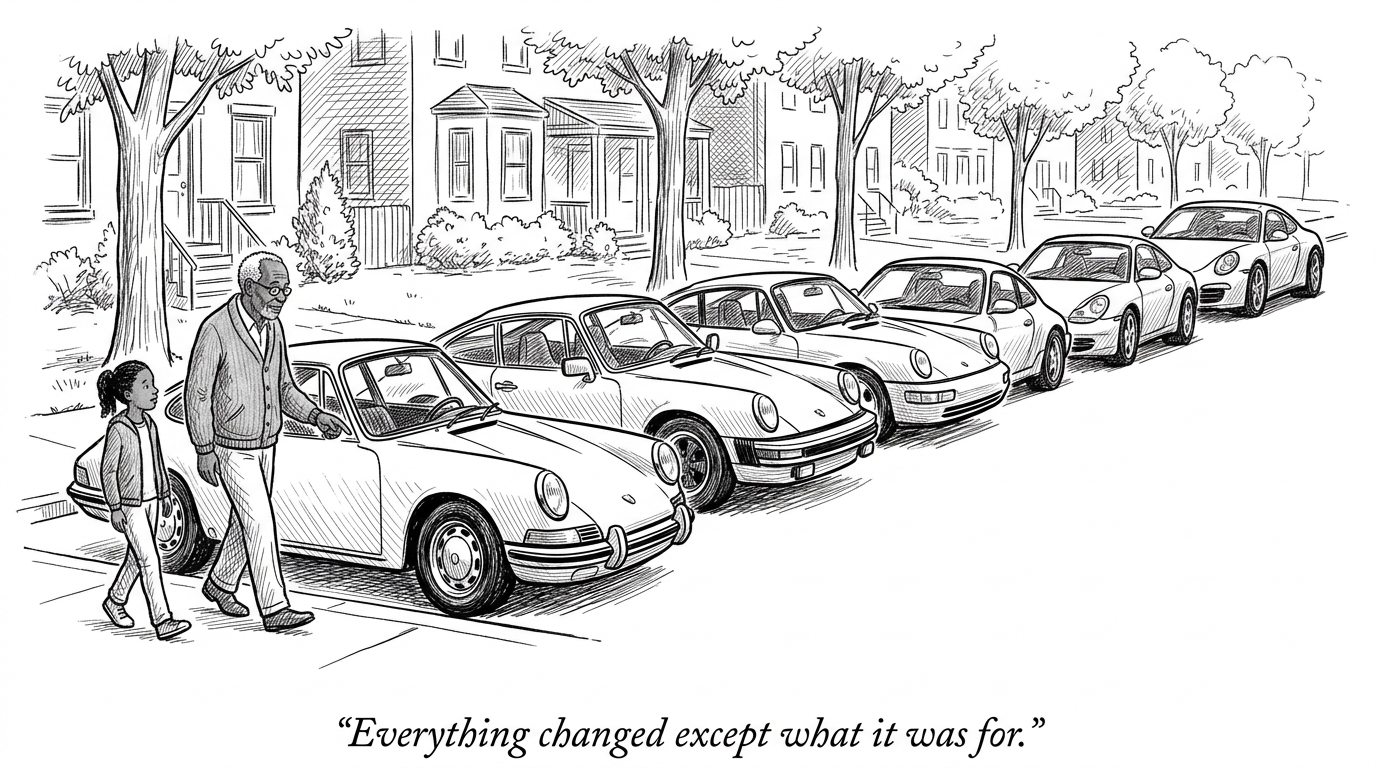
Porsche showed the 911 at the Frankfurt motor show on 12 September 1963 and began building it in 1964.[2] The Corvette debuted in 1953.[3] An owner of either is buying into a named line with a kept shape and a kept promise, not a model. That is the point of a line. It lets someone who wanted the car at sixteen buy it at forty and be buying the same thing, and it is how Shelton's Corvette and my 911 sit in the same garage of the mind.
The break that fixed what the line was blamed for
A line also has to survive being changed. The nickname "widowmaker" belongs to the 911 Turbo of the 1970s: the engine hangs out beyond the rear axle, little happens low in the rev range and then power arrives sharply, and a driver who arrives at a corner too hot and lifts off is in trouble.[4] In 1998 Porsche made the 911 water-cooled for the first time, in a car that by most accounts carried over almost nothing from the one it replaced, and purists pushed back before the first one was built.[5]
I own the water-cooled one, a 2002 with all-wheel drive. I drove the air-cooled cars and chose mine because it felt better. It corners as if it were on rails, it will save a bad driver and reward a good one, and it is not the car that name once meant. That is my judgment, not a measurement, and the people who prefer the older cars have a case worth stating at full strength. But the change repaired the one thing the line was most blamed for and kept what it was for.
Chevrolet made the equivalent move in 2020 with the first mid-engine Corvette, an idea Zora Arkus-Duntov had advocated since the 1950s and tried out in the CERV I in 1962 and the CERV II in 1964.[3]
The brand that was nearly lost, and how it came back
Harley-Davidson shows the other side. It was sold to AMF in 1969, and quality suffered.[6] Some hardcore riders refused to accept Harleys built after 1969 and called them only "AMFs."[7] In June 1981 thirteen executives led by Vaughn Beals bought the company back from AMF for $81.5 million.[6] In 1983 it formed the Harley Owners Group. The first event was a three-day tour of 250 members in Colorado, and membership cards one and two went to Willie G. Davidson and Nancy Davidson.[8] The group now has more than a million members.[9] It was not a marketing add-on. It was how the brand rebuilt the room.
What outlives the founder
Shelton was a Deadhead. After Jerry Garcia died we went to see the Other Ones, the band's surviving members, at the Spectrum in Philadelphia in 2002.[10] We had meant to go earlier. The band had encouraged its fans to record and trade its shows, and when it briefly stopped free downloads it reversed after the fans objected.[11] Pollstar counted 889 shows in the 1980s and 1990s that moved more than 16 million tickets for $346 million.[12]
Jimmy Buffett died in 2023, and the business that carries his name had $2.2 billion in gross annual revenue in 2022, most of it licensing and franchising, according to the Baltimore Sun.[13] Neither of those is explained by a product, because the product ended. What lasted was the room, and the rituals in it.
The test: who kept the room open
Belonging is not enough, and the cleanest evidence is the brand that had it and still did not last. Saturn was founded in 1985. In 1994 it held a Homecoming at its plant in Spring Hill, Tennessee, and about 44,000 people came.[14] GM said in 2009 it would close the brand after a sale to Penske fell through, and its last franchises ended in October 2010.[15] By one account it never made money,[16] and in its last years it was left to almost fully badge-engineer products from other GM divisions.[15]
Saab and Volvo are the other two cases, and they are the useful pair. Both are Swedish brands whose identities came before their marketing: Saab from aviation engineering, Volvo from safety. Both passed through American owners. Saab went bankrupt in December 2011 after years under GM and then a short stretch under Spyker.[17] Volvo was bought by Ford in 1999 for about $6.45 billion and by Geely in 2010 for $1.8 billion, and it is still Volvo.[18][19] In 1959 it patented the three-point seat belt and made the patent available to every other car maker.[20] A brand that gives away its best invention is not defending a product. It is keeping a standard.
The difference between Saab and Volvo is not lineage and it is not loyalty. They had both. It is whether the owner who came next kept the room open.
Why does this matter?
Members are the evidence of a brand, not the cause of it. People belong to a brand the way they belong to a team or a town, and the belonging is real. But it is held by someone, and when the brand is bought the thing worth asking is what it was for and whether the next owner will keep it, because belonging is the first asset a new owner is tempted to spend. Saturn's owners were as loyal as owners get, and it made no difference. The ones who bought a Volvo or a 911 or a Harley were buying a place that someone kept. Pick what fits. Then ask whether it holds, because the people who keep it are not always the people who love it.
Part of a longer argument about what lasts. See also DoAyni's piece on Nikon and Apple keeping faith with the people already on their platforms.
- Wikipedia, Porsche 914
- Porsche AG, A brief history of the Porsche 911
- SlashGear, Why (and when) did Corvettes switch from front-engine to mid-engine?
- Evo, Porsche 911 Turbo (930) review: the original widowmaker, driven again
- Stuttcars, 25 Years of the 996: A Look at Today's "Entry Level" 911
- FundingUniverse, Harley-Davidson, Inc. History
- Cycle World, A message from Milwaukee (Oct 1988)
- Rider Magazine, Harley Owners Group 30th Anniversary Celebration: Riding with a passion
- Wikipedia, Harley Owners Group
- Jambands.com, The Other Ones will tour this fall (Aug 7, 2002)
- CBS News, Grateful Dead OKs downloads again
- Pollstar, 25 years after Jerry's passing, the Dead remain touring legends (Aug 14, 2020)
- The Baltimore Sun, via PressReader, Can Buffett's empire sail on? (Sep 9, 2023)
- NPR, Saturn homecoming (transcript)
- Wikipedia, Saturn Corporation
- Fox News, GM to close Saturn as sale to Penske falls through
- Wikipedia, Bankruptcy of Saab Automobile
- U.S. Securities and Exchange Commission, Form 10-K, Ford Motor Company, fiscal year 1999
- Volvo Cars, Zhejiang Geely Completes Acquisition of Volvo Car Corporation (Aug 2, 2010)
- Volvo Cars, Press release on the three-point safety belt (Aug 2009)