Portland's Tech Industry Started in a Basement, Not a Defense Contract
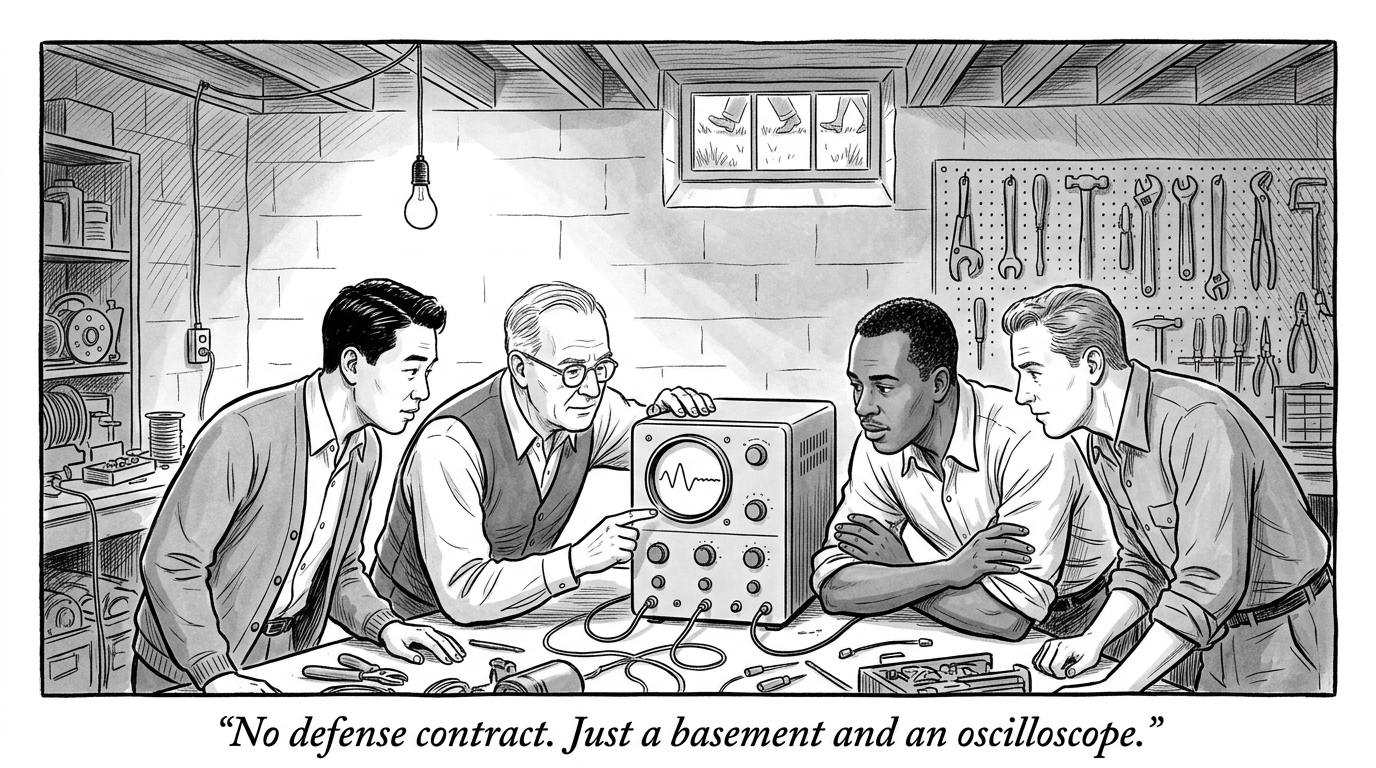
Start with what Portland's tech industry didn't have, because every other region this site has traced did. San Diego had Naval Base San Diego. The DMV had defense and intelligence contracting. Silicon Valley had Lockheed and SRI, funded through the Pentagon and NASA. Boston had MIT Lincoln Laboratory, chartered by the Air Force, Army, and Navy together. Portland had none of that. Its tech industry started with four men and an oscilloscope, in a basement, with no government money anywhere in the founding story.
Tektronix began in 1946, in the basement of co-founder Jack Murdock's house on Portland's Southeast Foster Road. Murdock, Howard Vollum, Miles Tippery, and Glenn McDowell first called the company Tekrad, changing the name to Tektronix a month later after learning a California company had already registered something too similar.[1] The company is widely credited with commercializing the first oscilloscope built around a "triggered sweep circuit" -- letting engineers see fast-moving electronic events clearly for the first time, without the display losing or blurring the signal.[1] Tektronix's own workforce grew from 14 people in 1947 to more than 300 by 1951, entirely on the strength of a genuinely better instrument, sold to engineers who needed one.[1]
What Tektronix actually built was a spinout machine, decades before anyone used that phrase. Employees who left Tektronix founded Mentor Graphics, Planar Systems, and Pixelworks directly; former Tektronix engineer C. Norman Winningstad went on to found both Floating Point Systems and Lattice Semiconductor.[1] "Someone counted 300 companies that owe their roots to Tektronix over the years," according to Bob Haas of the VintageTEK Museum -- a real, if informally counted, figure for a single company's downstream footprint.[1] This is the same spinout mechanism Silicon Valley is famous for through Fairchild Semiconductor's "Fairchildren" -- except Portland's version started with a commercial test-instrument company, not a defense-adjacent semiconductor firm, and ran on its own for nearly three decades before anything resembling federal money showed up at all.
When large-scale investment finally did arrive, it came from a single company choosing Oregon on purpose, not a federal contract. Intel built its first Oregon fab, FAB 4, in Aloha in 1974 -- the company's own entry into the region, 28 years after Tektronix's basement start.[2] Since then Intel has invested $65 billion in Oregon, contributing $16.8 billion to the state's GDP in 2023 alone.[2] Its Hillsboro campus -- four sprawling sites, one of them renamed Gordon Moore Park at Ronler Acres in 2022 -- is Intel's single largest manufacturing site anywhere, employing roughly 22,000 people directly and supporting another 100,000 jobs across the state.[2] Intel has committed more than $36 billion in further investment specifically at Hillsboro.[2]
And this site's own graph hasn't caught up to either half of the story yet. Neither Tektronix nor Intel -- nor any of Tektronix's direct spinouts, Mentor Graphics, Planar Systems, Pixelworks, Lattice Semiconductor -- currently has its own row in this site's graph for the Silicon Forest edition. The region with the most companies of any California-comparable, non-coastal edition this site tracks is still missing the two companies that actually explain why it exists.
- Oregon Encyclopedia, Tektronix Inc
- Intel Newsroom, Intel's Oregon Investments Fuel US Silicon Innovation Leadership