A Private School 12 Miles From the Capitol Costs $77,100 a Year and Places Students Directly Inside a Sitting Senator's Office. Millions of Families Live Closer to That Same Building and Will Never Get Near It.
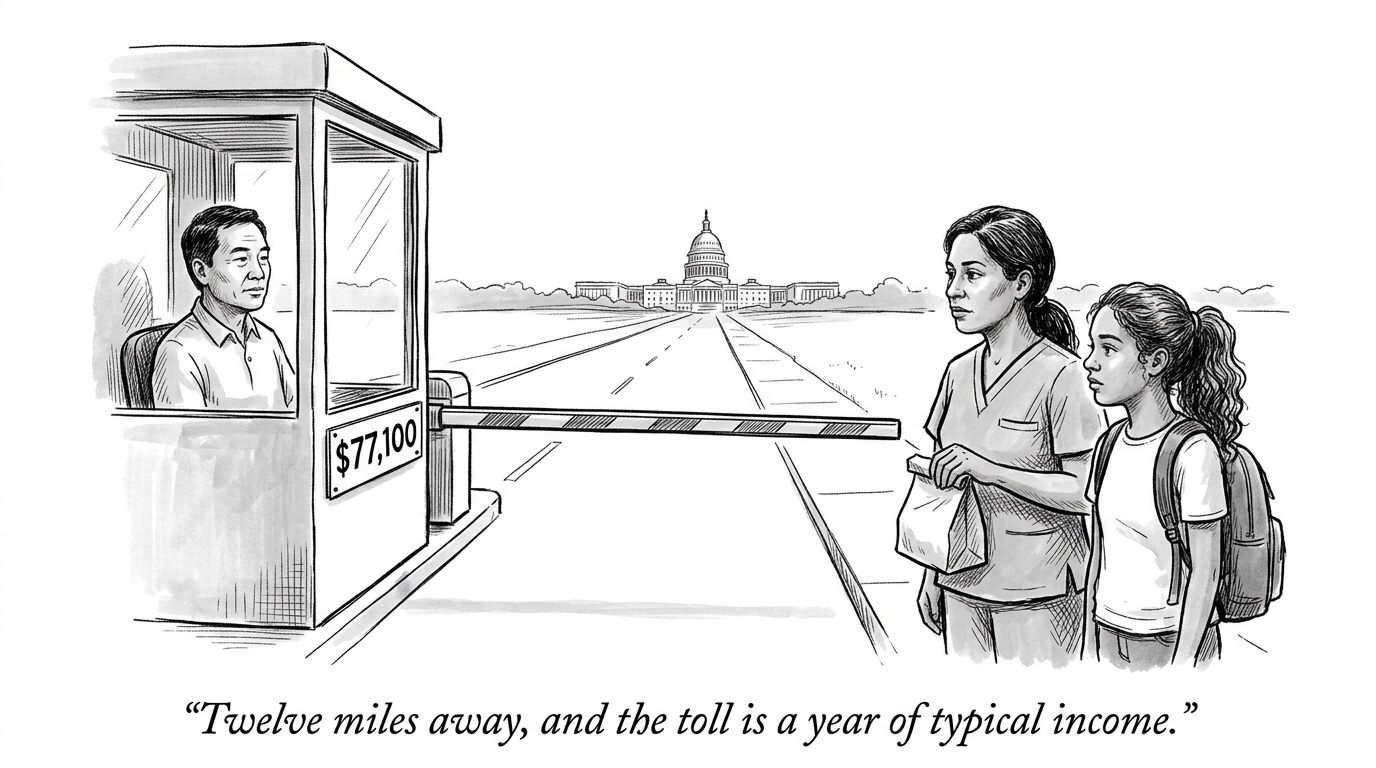
The Madeira School sits in McLean, Virginia, roughly 10 to 12 miles -- about a fifteen-minute drive -- from the US Capitol. Boarding tuition runs $77,100 a year; day tuition, $60,000. Students there have gone through placements inside sitting members of Congress's own offices -- real proximity to the actual rooms where federal decisions get made, not a class trip past the building. My own kids go to schools like this. I know exactly what that access costs, because I'm the one who paid for it.
Here is the number I want to sit with before I explain around it. US median household income is roughly $80,000 a year. A single year of boarding tuition at a school like Madeira is nearly that entire amount, for one child, before a single other family expense gets paid. Even inside Fairfax County itself -- the county Madeira sits in, one of the five wealthiest counties in the entire United States, with a median household income above $153,000 -- that tuition figure is still roughly half of what the typical household earns before taxes. The school is not far from Washington. The price of attending it is far from almost everyone, including plenty of people who could drive there faster than I can.
Not a story about race. A story about what I bought for my own kids, and what a fifteen-minute drive actually costs everyone else when the destination is power instead of a grocery store. A family of any background, living two miles from the Capitol in a modest rowhouse, and a family living twelve miles away in a much larger house, face the identical hard gate if neither one can clear a private school's tuition line -- and a family that can clear it gets the access regardless of how far away they started. Money, not distance, decided who got into the room. I got my kids into that room. Most families, of every background, standing exactly as close to the same door, did not and will not.
Proximity to power and access to power are two different variables, and treating them as the same one is the actual error underneath most of the comfortable stories people tell about this. Geography is, in principle, democratic -- a subway fare, a bus route, a short drive can put almost anyone within a few miles of the Capitol, the White House, or any other center of federal power. What geography cannot do is put anyone inside the specific institutions that convert nearness into an actual relationship with that power -- a named congressional internship, a placement inside a senator's own office, the kind of exposure that turns "I drove past it" into "I worked inside it." That conversion runs through a small number of gated institutions, and the gate is priced in tuition dollars, not miles. I know the price because I've paid it, more than once, for more than one of my own kids, in the same year.
I've already written about a version of this same mechanism running through public education itself -- money buying a materially different version of a system that was supposed to be the "great equalizer," even inside some of the best-funded public districts in the country. This is the sharper, further-along version of the identical problem, and it's closer to home than that one was. It isn't a better education purchased inside a shared system anymore. It's a direct pipeline into the literal room where federal power operates, purchased entirely outside of any system a family without the tuition could ever opt into at all -- and I am, right now, one of the people who bought it.
I want to hold the other side of this honestly too, because it's real and I don't think naming my own advantage should pretend it away. I don't think refusing to pay for that access would have fixed anything. It wouldn't have opened the door for anyone else standing at it. It would have just meant my own kids didn't get the internship, and some other family who could also afford it got the seat instead. Any parent who can clear that tuition line and chooses to is doing something close to the most ordinary thing there is -- buying every legal advantage available for their own kids. I'm not arguing I was wrong to do it. I'm arguing that being right to do it, for my own family, and the door itself being wrong, for everyone else standing exactly as close to it, are both true at the same time, and one doesn't cancel the other.
So let me say the plain version instead of the mechanism version, because the plain version is the one that's actually true. This is an advantage most families do not have. Not a metaphor, not a structural tendency I'm describing from a safe distance -- a specific, priced, currently operating advantage, and I hold it. It is available to whoever can pay for it and unavailable to almost everyone else standing exactly as close to the same door I walked my own kids through.
The same mechanism, in a different system: "The Great Equalizer, For Sale."
- The Madeira School, Tuition & Financial Aid
- U.S. Census Bureau, Income in the United States
- USAFacts, What Is the Income of a Household in Fairfax County, VA?
- DoAyni, The Great Equalizer, For Sale