The Navy Designed a Semicircular Steel Hut in 1941 So Sailors With No Training Could Build It Anywhere. In 1946, 600 Veterans Showed Up to a Single Sale and Claimed 811 of Them for Housing.
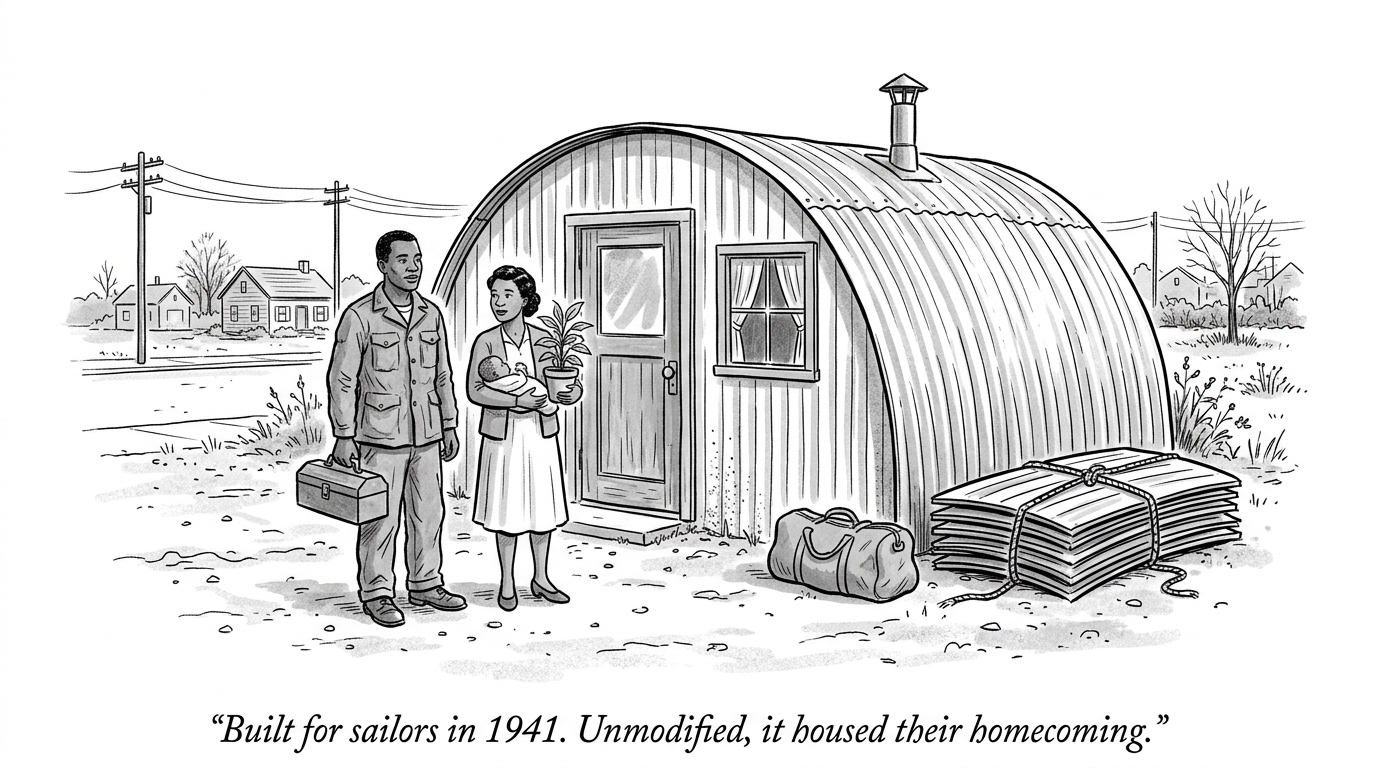
In 1941, the Navy needed a building it could ship anywhere on earth and have assembled by sailors with no construction training at all. The design it got -- a semicircular arch of corrugated galvanized steel -- solved that problem so completely that five years later, the exact same design, unmodified, solved a second problem it was never built for: where to put the returning soldiers a country suddenly had nowhere to house.
A logistics answer, not an aesthetic one
The Navy approached the George A. Fuller Company about the problem at its new base at Quonset Point, Rhode Island. Fuller's only staff architect, Otto Brandenberger, and an engineer named Peter Dejongh designed the structure in 1941, working from an existing template -- the semicircular Nissen hut the British Army had developed during World War I.[1] The shape wasn't chosen to look like anything. A curved steel arch needs no internal support trusses to hold its own roof up, which means more usable floor space per pound of shipped steel than a rectangular building would need, and the whole structure could be flat-packed, shipped to any port in the world, and bolted together by people who had never built anything before. It was named for the base where it was designed: the Quonset hut.
The same object, repurposed for a completely different institution eighteen months later
In 1945, Congress instructed the military to hand its surplus wartime buildings and materials over to the Federal Housing Administration, specifically so they could go to college campuses as emergency housing for veterans and their families.[2] The GI Bill was pulling students onto campuses faster than any university could build for them -- enrollment at UNC alone went from about 4,100 students before the war to 7,250 by the fall of 1947, and the school assembled thirty-six Quonset huts on its old tennis courts to absorb the overflow, in use from 1946 to 1950.[2] Northwestern put up roughly a hundred huts in 1946 to house single male students. The University of Iowa set up twenty-five huts, each split into two apartments. In July 1946, the War Assets Administration ran a public sale at Port Hueneme, California, offering 811 surplus huts directly to veterans -- 600 of them showed up and claimed three-quarters of the stock in a single day. Los Angeles city and county governments each received 1,500 huts of their own that same year to house returning veterans directly.[3]
Nobody redesigned the Quonset hut for civilian housing. That's the actual finding. The exact same semicircular arch, the same corrugated steel, the same no-skilled-labor assembly that let the Navy ship a building to any beachhead on earth, turned out to be the identical answer to "build shelter fast, cheap, anywhere, for people who need it now" when the emergency changed from an invasion to a housing shortage. The engineering didn't have to be reinvented. The problem it was built to solve -- speed, portability, minimal skill required -- was structurally the same problem on both ends, wearing two different names five years apart.
Rural Colorado shows the same design going a third direction: hidden rather than adapted, and not purely for looks. The base military hut shipped with wood-fiber insulation and a Masonite interior lining, but most of the surplus units that ended up in civilian hands as barns, garages, and storage sheds had lost that lining or never had it in the first place -- and bare corrugated steel has a real, well-documented physical problem: warm, humid interior air hits the cold metal skin and condenses, dripping down the inside of the arch like rain whenever the temperature swings.[5] Building a conventional wood-frame front onto a hut, the way one Colorado owner did at a camper park and motel in Limon -- documented directly in the Library of Congress's own photo collection -- solved two problems in the same motion: it hid the shape behind a front the town already recognized, and the added frame and air gap cut down on exactly the condensation a bare steel arch is prone to.[4] The hut didn't need to be redesigned to fit a town that didn't build things that way, or to stop sweating on whatever was stored inside it. It needed one wall in front of it doing both jobs at once.
Why does this matter? Most infrastructure gets built for the emergency in front of it and scrapped or forgotten once that emergency passes. The Quonset hut didn't get scrapped -- it got handed directly to the next emergency, unmodified, because whoever built it in 1941 had solved a problem general enough to outlive the war it was designed for. The form is still being manufactured and sold today, for the same reason it worked the first two times: when the actual constraint is speed and cost rather than appearance, the shape that wins doesn't change just because the emergency does.
- Los Angeles City Planning, The Quonset Hut, 1920-1965
- UNC University Archives & Records Management Services, A Can for All Seasons: Quonset Huts at Postwar UNC
- South Bay History, Quonset huts once a familiar sight in South Bay and Harbor Area
- Library of Congress, Quonset hut, camper park and motel, Limon, Colorado
- Agribilt, Quonset Hut Condensation | Ventilation & Insulation Guide