Sixty Years Ago, the Women Around Me Would Have Been Hidden
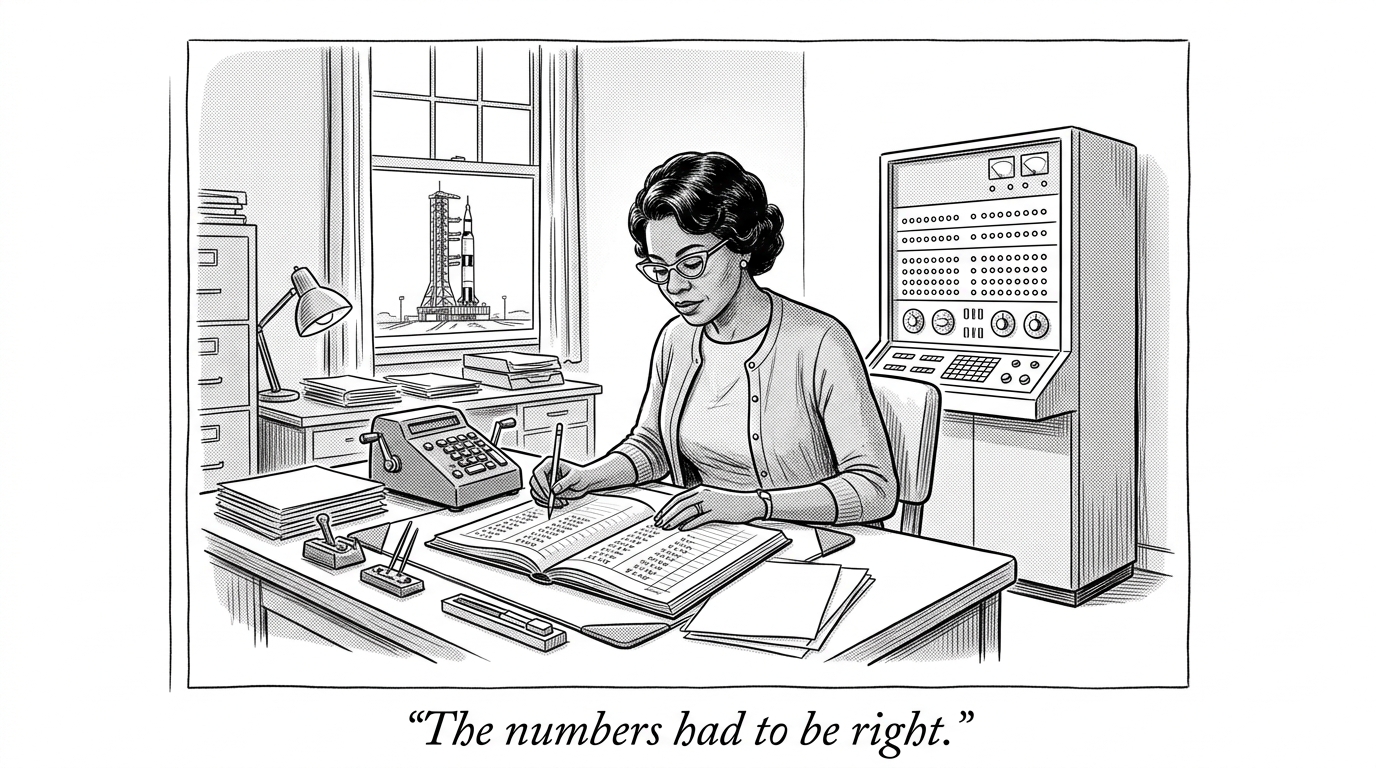
I own the book and I have seen the film. Hidden Figures, by Margot Lee Shetterly, tells the story of the Black women mathematicians who worked at NASA's Langley laboratory in Virginia and helped win the space race.[1] I am surrounded by female engineers. Sixty years ago they would have been hidden.
This piece sets out what the book describes, what the numbers say about how much has changed, and what has not.
What the work was Before electronic computers, a computer was a person. Langley employed people to carry out the calculations that aeronautical research produced, and wartime demand opened those jobs to women. The Black women among them worked in a separate unit, the West Area Computers, a name that comes from the segregated "colored" section of the laboratory's west wing under Virginia's Jim Crow laws.[1] They were largely cut off from the wider collegial life of the lab, and it took decades for the public to learn what they had done.[1]
Three of them are the best known. Dorothy Vaughan became acting supervisor of the West Area Computers in 1949, the first Black woman to supervise a staff at the center. When machines arrived she taught herself and her staff FORTRAN, an early programming language, and later headed the programming section of the Analysis and Computation Division.[2] Mary Jackson joined the group in 1951, moved on to work for an engineer in a supersonic wind tunnel, took graduate-level classes after hours, and is widely reported to have become NASA's first Black female engineer, in 1958.[2] Katherine Johnson worked on trajectories. NASA says she verified the orbital equations for John Glenn's Friendship 7 flight, from liftoff to splashdown.[3]
The one who checked the machine The Glenn episode is the one most people remember. The Computer History Museum says Glenn, nervous about trusting his life to the new electronic computers, asked that Johnson redo the computer's work, and she confirmed its numbers with a desktop mechanical calculator.[3] The film dramatizes the request, and its famous wording is the film's. Shetterly places the check in the three days before the February 20, 1962 launch, but it is unclear exactly when it happened.[3]
I have written elsewhere about who checks a machine's answer. Who Checks the Answer ends on the point that the person who reads the output is the one who checks it. Johnson is the clearest case I know. The machines were new and the astronaut did not fully trust them. The check was a person who understood the work.
What the numbers say Here is how much has changed. In the 1965–66 academic year, women earned 166 of the 37,972 bachelor's degrees awarded in engineering and engineering technologies in the United States, 0.4 percent. By 2020–21 they earned 33,310 of 145,041, 23.0 percent.[4] At the master's level the share rose from 78 of 13,719, about 0.6 percent, to 15,260 of 53,632, about 28.5 percent.[4]
The workforce moved less. One paper citing the Bureau of Labor Statistics puts women at about 3 percent of practicing engineers around 1970, and the Society of Women Engineers, summarizing federal data, puts them at about 15 percent of engineering occupations in 2023.[5]
Two things in those numbers are worth saying together. Sixty years ago a woman who wanted an engineering degree was, in the numbers, almost alone. And the change since is large and unfinished: about a quarter of degrees, about a seventh of the workforce. The share also fell between 2000–01 and 2010–11 before it rose again.[4]
Why this is not only history The women around me in engineering are extremely competent. Sixty years ago they would have been hidden.
What I do not know - I do not know how much of the rise in degrees reflects women entering engineering and how much reflects changes in what counts as engineering. The table I cite combines engineering and engineering technologies. - I have not sourced a workforce figure for 1960 or a primary Bureau of Labor Statistics series. The workforce numbers above are secondhand. - I have not verified every detail of Mary Jackson's path in primary records. I have left out a court petition that appears in some accounts, because I could not confirm it. - I am describing a book and a film from memory and from secondary sources, not from NASA's own archive.
The paragraph about the women in my own circle is my account and is not sourced. The reading that Johnson's check connects to the question of who verifies a machine is mine. Where the book and the film differ, I have said so. How I work with the AI assistant that helps me write, and why the read stays mine, is set out in The Harness Is the Mechanism. The Read Is Still Ours..
Sources
- Hidden Figures: The American Dream and the Untold Story of the Black Women Mathematicians Who Helped Win the Space Race, Margot Lee Shetterly, 2016; Reading Margot Lee Shetterly's "Hidden Figures," Charles Petzold
- Dorothy Vaughan, Britannica Kids; Brilliance Revealed: In-Depth Profiles of the Women of Hidden Figures, The Christian Recorder
- Katherine Johnson, Computer History Museum; Katherine Johnson, the Hidden Figures Mathematician Who Got Astronaut John Glenn into Space, IEEE Spectrum; 'Hidden Figures': When Did John Glenn Ask for 'the Girl' to Check the Numbers?, Space.com
- Table 325.45, Degrees in engineering and engineering technologies conferred by postsecondary institutions, by level of degree and sex of student, Digest of Education Statistics 2022, National Center for Education Statistics
- U.S. Employment, Society of Women Engineers; Women in Mechanical Engineering: Representation Trends in Education and the Workforce, ASEE