The Smithsonian Removed Two Impeachment References From an Exhibit, Then Restored Them in Smaller Type. That One Edit Is a 16-Month Campaign in Miniature.
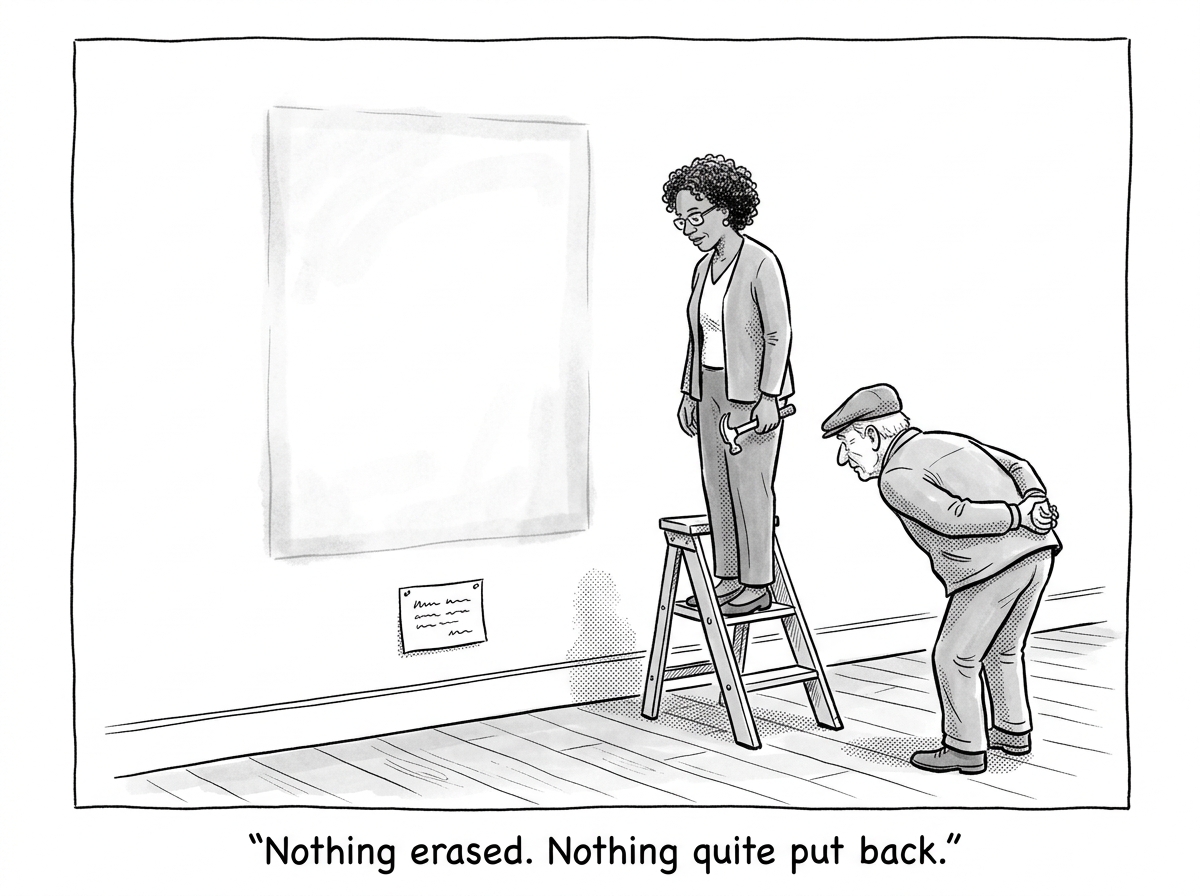
Start with the smallest, most concrete edit, because it shows the whole mechanism in one move. Following a White House-ordered review, the National Museum of American History removed references to Donald Trump's two first-term impeachments from a public exhibit. After the edit drew attention, the museum restored the references -- but with revised language, in a less prominent location than before.[1] Nothing was erased permanently. Nothing was left exactly as it was, either. That small, reversible-but-not-quite-reversed edit is the entire campaign compressed into a single museum wall label.
The timeline, because "pressure" undersells what actually happened
On March 27, 2025, the administration signed an executive order titled "Restoring Truth and Sanity to American History," asserting the Smithsonian had "come under the influence of a divisive, race-centered ideology" and directing Vice President JD Vance to "remove improper ideology" from its properties.[2] On August 12, 2025, the White House sent a letter demanding a "comprehensive internal review" of eight Smithsonian museums -- American History, Natural History, African American History and Culture, the American Indian, Air and Space, American Art, the Portrait Gallery, and the Hirshhorn -- ordering exhibition plans, educational materials, and internal policies turned over, curator interviews, on-site walkthroughs, and revised public-facing content within 120 days, explicitly framed around the country's upcoming 250th anniversary.[3] One exhibit was named directly in administration materials as an example of "improper ideology": "The Shape of Power: Stories of Race and American Sculpture," at the Smithsonian American Art Museum.[3]
On July 4, 2026, the administration's Domestic Policy Council released a 162-page report, "Saving America's Story," concluding that "the Smithsonian Institution, and the National Museum of American History in particular, under its current leadership and current interpretive ideology, cannot be trusted to tell America's story honestly."[4] Twenty days later, on July 24, 2026, a second executive order -- "Restoring Trust in the Smithsonian Institution" -- directed the Interior Department, the Office of Management and Budget, the General Services Administration, and the White House Domestic Policy Council to use "every available authority" to push the reforms outlined in that report.[4] Separately, the National Park Service was ordered to install signage near the American history museum warning visitors of "inaccurate information" inside, alongside a temporary "corrective" exhibit.[2] By September 3, 2026, the administration was telling federal agencies they could stop working with the Smithsonian altogether.[5]
The actual lever isn't rhetoric. It's money and who sits on the board.
The July 2026 order does not simply criticize -- it ties federal appropriations directly to whether the museum "corrects" its exhibits, giving the Interior Department, OMB, and GSA administrative and financial tools to enforce compliance rather than leaving the fight as a public argument.[4] A second, quieter lever runs through governance rather than money: Vice President Vance, who chairs the Smithsonian's Board of Regents confirmation process, has been delaying action on new Regent nominees specifically because the administration wants to seat "more like-minded candidates" instead.[4] Funding pressure changes what an exhibit says this year. A reshaped board changes who gets to decide what every future exhibit says, long after any single administration is gone.
This is not, at its core, a personnel story about one man's retirement. Lonnie Bunch announced his own departure this month, and told the New York Times the decision "doesn't have to do with the pressure from the Trump administration... it was really just saying, now's the time" -- while also acknowledging "it has been stressful" and that he'd "like to wake up in the morning and not look at my cellphone."[6] CBS News, reporting the same retirement, frames it plainly as coming "after months of Trump administration criticism."[1] Both things can be true without contradicting each other -- a 73-year-old choosing his own moment to leave, inside sixteen months of sustained, funding-backed pressure that made staying meaningfully harder than it would otherwise have been. The retirement is the visible event. The sixteen-month campaign around it is the actual story, and it does not end with his successor.
Why does this matter? A national museum system's job is to hold the full, complicated version of what actually happened, including the parts that are uncomfortable to look at directly -- because the version that gets told publicly is the version most people will ever learn at all. The impeachment references that got quietly restored in smaller type are a small, literal example of a much larger and more consequential fact: what a country's institutions are pressured to leave out of the record doesn't stay abstract. It becomes what the next generation assumes was simply normal, unremarkable, never worth mentioning -- not because it didn't happen, but because the version of history that reached them was already edited before they ever saw it.
Companion piece on this outlet: "An Automated Filter Flagged the Enola Gay for Deletion Because Its Name Contains 'Gay.' It Also Caught Jackie Robinson, the Navajo Code Talkers, and the Tuskegee Airmen..." -- the same erasure pattern, government-wide, not confined to one museum.
- CBS News, Lonnie Bunch, Smithsonian leader, announces retirement after months of Trump administration criticism
- Wikipedia / Fox News, Executive Order 14253 -- Restoring Truth and Sanity to American History
- NPR, White House Calls for a 'Comprehensive Internal Review' of 8 Smithsonian Museums
- The White House / Federal Register, Executive Order 14416 -- Restoring Trust in the Smithsonian Institution
- CNN Politics, Trump Administration Says Agencies May Stop Working With the Smithsonian
- NPR, Smithsonian Chief Lonnie G. Bunch III Resigns