Someone Has to Say What a Thing Is
By Troy M. Pearsall
In the second chapter of Genesis, the first book of the Torah, the animals are brought to the man "to see what he would call them; and whatsoever the man would call every living creature, that was to be the name thereof." [1]
Read it slowly. The text does not say what the man was supposed to call them. It does not say the names were right. It says only that whatever he called them was to be the name. The one who made the animals waited, and let the names stand.
That is the first thing a name is: a gift of authority. Someone is trusted to say what a thing is, and the saying counts.
Naming is also a hold. Vernor Vinge's 1981 novella True Names made that the plot. To know a person's true name is to hold power over them, so the people in it go by handles and guard the real one. [2] The name that is given can be kept by whoever knows it.
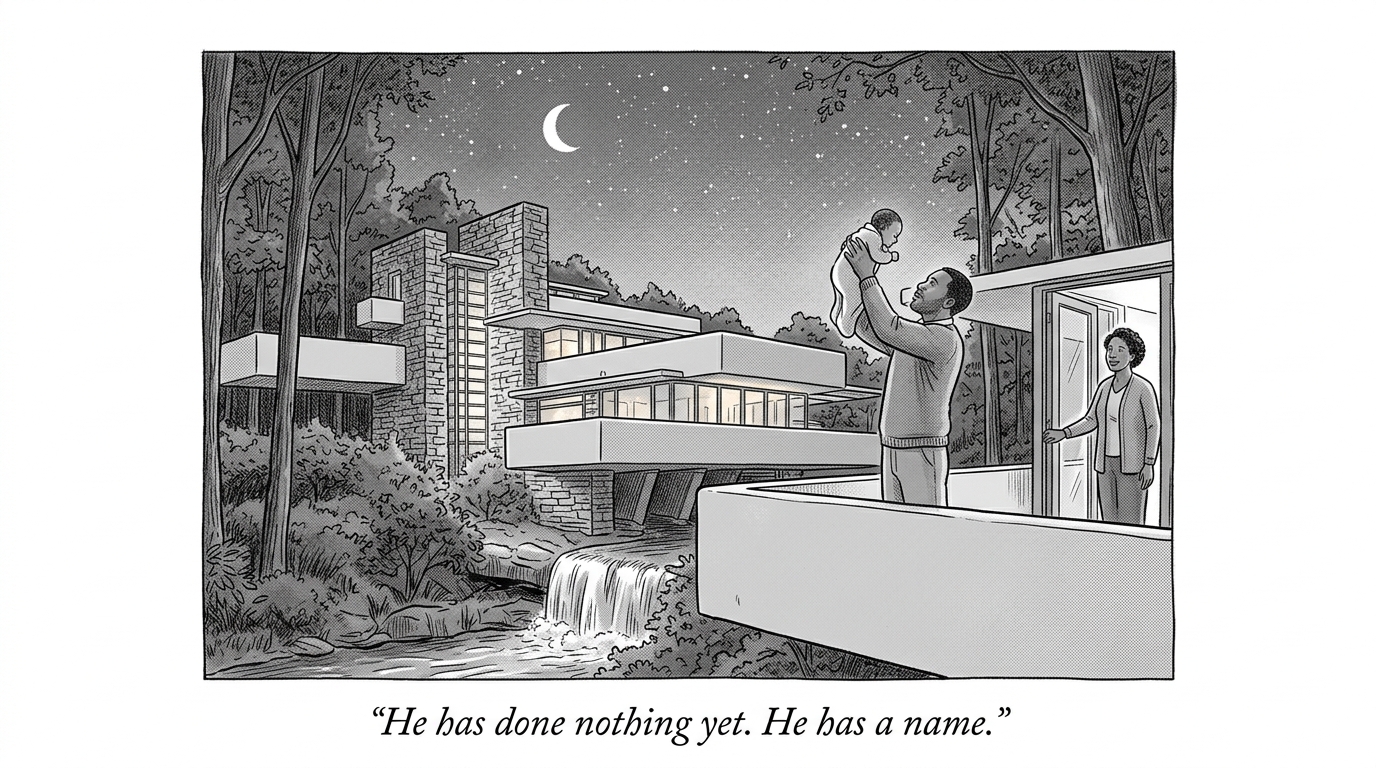
A third picture comes from Alex Haley's Roots. On the eighth day of his life, a Mandinka father whispers his newborn son's name into the child's ear three times, so that the boy hears it before anyone else does. That night he carries the boy out under the stars and lifts him toward the heavens. The name the boy carries, Kunta, was his late grandfather's middle name. [3]
Nothing about the child has been decided yet. The name does not describe him. We name on trust, on expectation, not on achievement. In my reading, the name is what a family hopes a person will carry into a future that neither the father nor the child can see.
The same story shows the other end of the act. Years later, in the story, a planter in Virginia buys the young man at auction and gives him a different name, Toby. [3] A name can place a person in the world, and a name can be used to take a person out of it. In my own family the rule is that the first name is the child's own and the rest carry the weight of the people they come from.[8] The difference is who holds the power to say it, and whether the person was the first to hear it.
Three of the texts here come from one family of traditions. The author was raised in it and reached for its stories first, and does not know whether every tradition has a naming story. The author's tenth-grade English teacher kept a Bible on the desk beside the Iliad and the Odyssey, as a work of literature, and that is how it is read here.
The people who wrote the Constitution of the United States were also naming for a future they could not see. The original runs four pages, and one article of it provides the means to change it. [4] In my reading, that is what makes it a constitution and not a wish: it says what a government may be, and it carries its own way of being revised.
Now models name for models. In one method, a language model is trained to judge which of two answers is better, standing in for the person who used to rank them, and the paper describes the human part of it this way: "the only human oversight is provided through a list of rules or principles." [5] Google's test of the same idea found that the model's judgments produced results comparable to human ones. [6] In another, a model is shown 175 tasks written by hand and writes about 52,000 instructions of its own. [7]
The person who writes the list of principles is doing what the father did under the stars and what the framers did in a room in Philadelphia. They are naming for a future they will not see, in words short enough to be applied to cases they cannot imagine.
The paper calls its method Constitutional AI. A company's training document is not a ratified constitution, and the comparison should not be allowed to carry more than it can. What a constitution does is bind the maker. For an AI constitution that would take two things: that it be public, so that anyone can compare behavior to it, and that there be a way of changing it that the author cannot skip.
In Genesis, the one who made the animals lets the names stand. For as long as there have been names, a person gave them to something whose future they could not see, and whoever received them was in some way held by them. Now a model names for a model, and the last person in the loop is the one who writes the principles. Whether the name binds the one who wrote it is the question that is left.
The account of the author's own family's naming rule is the author's. The accounts of the author's English teacher and of the choice of these texts are the author's own. The readings of what each passage shows, and the comparison of a company's list of principles to a constitution, are the author's interpretation. The renaming of the character in Roots is cited to a secondary source, and the accuracy of Haley's account of his family's history has been disputed (Mills and Mills, 1981, as described there), so the book is read here as literature.
Sources
- Genesis 2:19-20, in the Torah: The Holy Scriptures, Jewish Publication Society translation, 1917 (public domain), via Sefaria; the King James Version of 1611 reads "whatsoever Adam called every living creature, that was the name thereof" (https://bible-api.com/genesis+2:19-20?translation=kjv)
- Vernor Vinge, True Names, 1981 (novella)
- Kunta Kinte Is Born, from Roots: The Saga of an American Family, Alex Haley, 1976 (chapter excerpt on alexhaley.com); Roots: The Saga of an American Family, Wikipedia (for the renaming of Kunta Kinte as Toby)
- The Constitution of the United States: A Transcription, National Archives
- Constitutional AI: Harmlessness from AI Feedback, Bai and others, Anthropic, 2022
- RLAIF vs. RLHF: Scaling Reinforcement Learning from Human Feedback with AI Feedback, Lee and others, Google, ICML 2024
- Self-Instruct: Aligning Language Models with Self-Generated Instructions, Wang and others, ACL 2023
- Someone Has to Tell You What You Are, Troy M. Pearsall, oluwadi.com