A French Fur Trader Picked This Spot in 1764 for the River Access. Forty Years Later, Two Flags Came Down and Went Up in Two Days -- and Lewis and Clark Left From Right There Ten Weeks After That.
In the fall of 1763, a French fur trader named Pierre Laclède and his 13-year-old stepson, Auguste Chouteau, traveled up the Mississippi River from New Orleans looking for a place to build a trading post. They picked a spot roughly 18 miles south of where the Missouri and Mississippi rivers meet -- high ground, safe from flooding, with river access in every direction that mattered for moving furs. Construction began in February 1764, with around 30 settlers, most of them French and connected to the fur trade.[1] They named it for Louis IX, the sainted 13th-century French king, patron saint of the reigning Louis XV. Nobody founding a trading post in 1764 had any reason to think the spot would matter to a country that didn't exist yet.
Forty years later, the site becomes the literal hinge of a continent changing hands
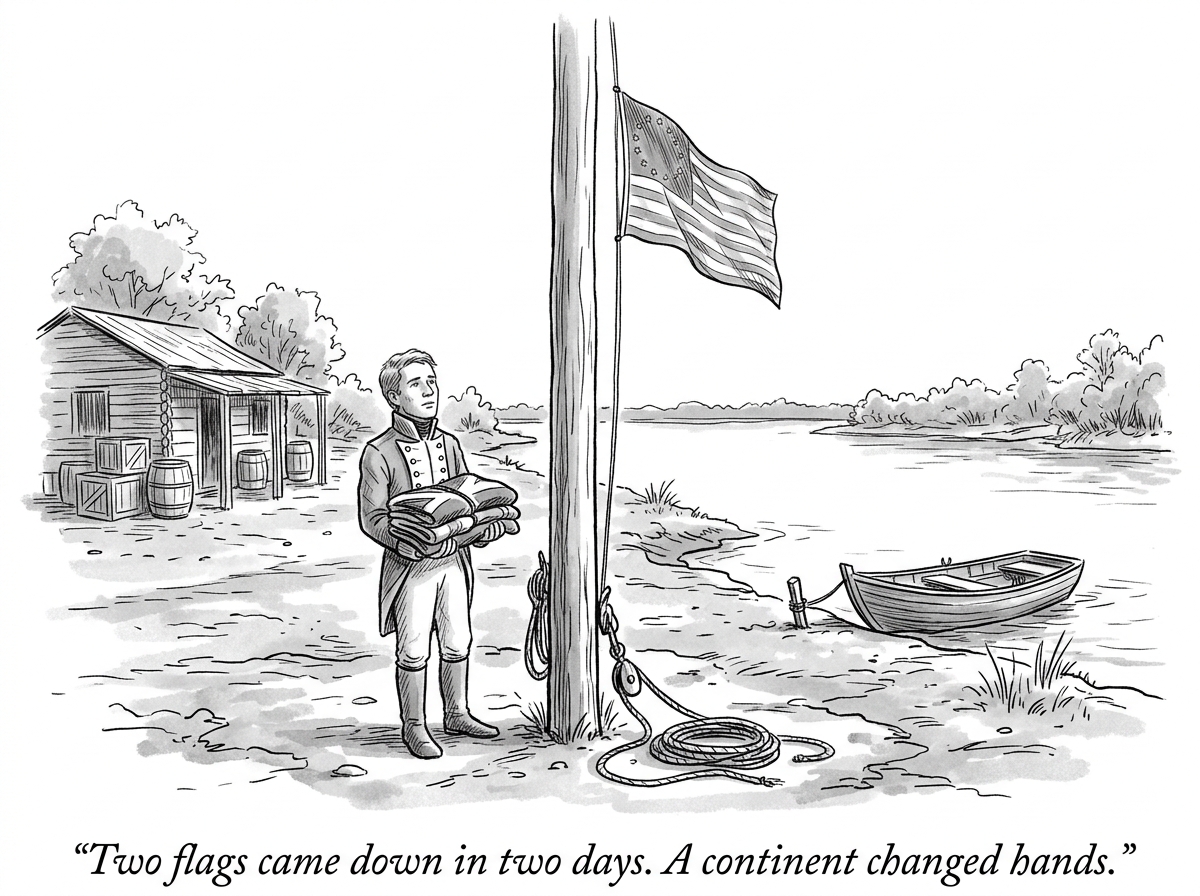
On March 9, 1804, the Spanish flag came down over St. Louis and the French flag went up -- a formality, since Spain had secretly ceded the territory back to France in 1800 and never gotten around to lowering its own flag. The next morning, March 10, the French flag came down and the American flag went up, finalizing the Louisiana Purchase and doubling the size of the United States in a single ceremony.[2] Two flag changes, on consecutive days, at the same flagpole -- St. Louis is the one place in the country where you can point to the literal spot where three different nations held sovereignty inside 24 hours.
Ten weeks after the flag changed for the last time, the expedition that used it left
Meriwether Lewis spent the winter of 1803-1804 in St. Louis itself, preparing and waiting specifically for that transfer ceremony to complete -- the expedition could not legally depart into US territory until the flag actually changed. On May 14, 1804, the Corps of Discovery pushed off from Camp Dubois, just upriver from St. Louis, into the Missouri River, beginning the trip that would reach the Pacific.[3] The sequence is direct, not coincidental: a fur-trading post built for river access in 1764 became, within ten weeks of the specific ceremony that made the land legally American, the literal launch point for the expedition that mapped the country's claim to the rest of the continent.
"Gateway to the West" reads like a slogan a chamber of commerce invented later. It is instead a literal, dated description of what happened at one location in the spring of 1804. St. Louis did not become important to westward expansion because of later boosterism -- it was the actual, physical point where the legal transfer completed and the first federally organized expedition into the new territory departed, within the same season. The 630-foot Gateway Arch, completed in 1965 on the riverfront near the original trading post site, commemorates a fact, not a metaphor.[4]
Why does this matter? This outlet's only piece touching St. Louis is actually about Kansas City -- a real, distinct metro 250 miles away, mentioned only as a demographic data point in a piece about that city's own congressional districts. Greater St. Louis is one of the largest metro areas in the Midwest and its own founding story has never been told here. It is not a generic colonial trading-post story. It is the specific site where a fur trader's choice of riverbank in 1764 put the location exactly where a continent-defining transfer of sovereignty, and the expedition that followed it by ten weeks, both had to happen.
Related piece on this outlet: "Kansas City Was One Congressional District for Nearly 60 Years..." (this outlet's existing Missouri piece, a different metro's story).
- St. Louis Public Radio, Was St. Louis Actually Founded by Pierre Laclède and Auguste Chouteau in 1764?
- Wikipedia, Three Flags Day
- National Park Service, Camp Dubois
- Gateway Arch Park Foundation, Resurrecting History in St. Louis