The Army Bought 13,000 Interceptor Drones in About Eight Days at About $15,000 Each. A Patriot Missile Costs About $4 Million.
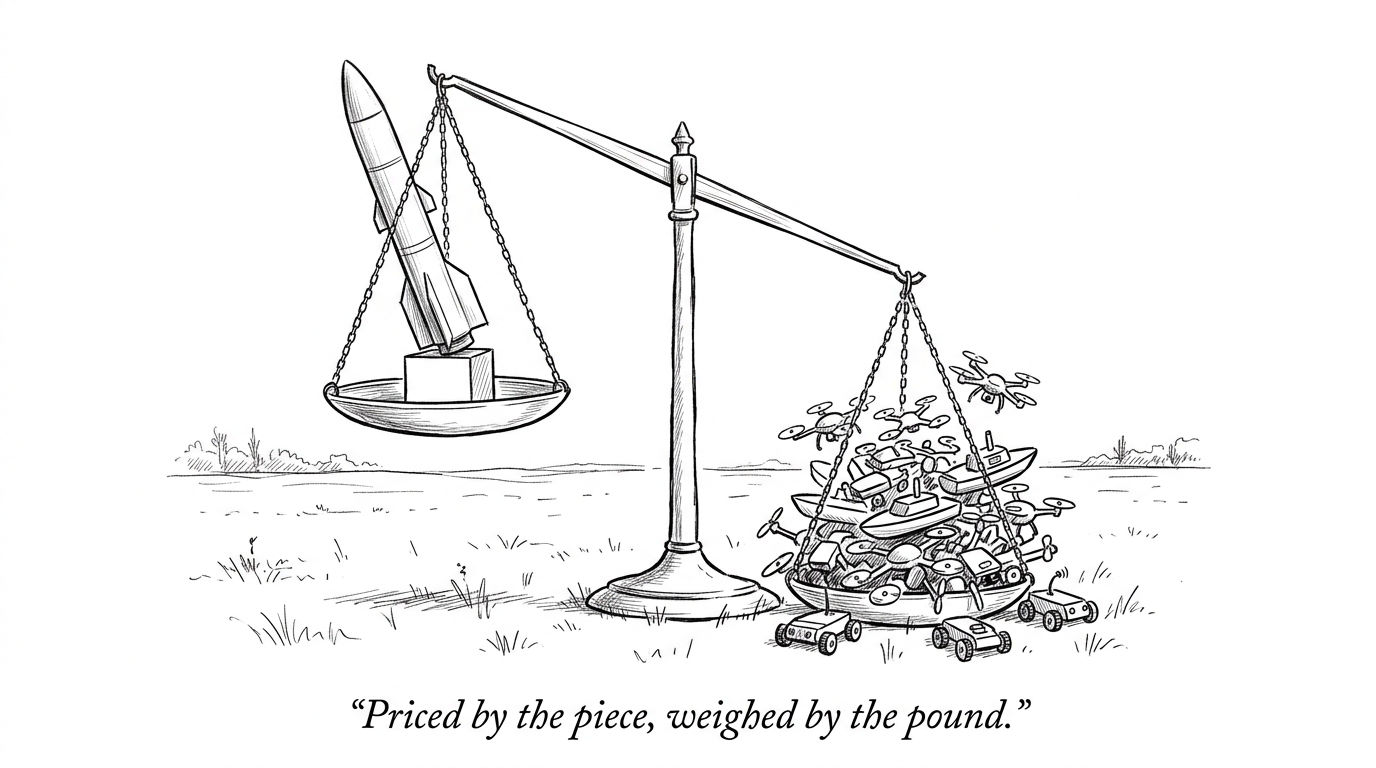
The Army bought 13,000 drones in about eight days, at about $15,000 each. A Patriot missile costs about $4 million. The gap between those two numbers is not only a price. The country's systems are complex and expensive, the other side's are cheap and quick to build, and so the limit in this war is not money. It is capacity: how many can be made, and how fast. The country is now learning from Ukraine how to build the cheap kind.
The price of the machine
In April 2026 Army Secretary Dan Driscoll told Congress that when the conflict with Iran began, "within about eight days, we were able to purchase … 13,000 Merops," a drone built to intercept the Iranian Shahed, for about $15,000 each.[1] Merops is an American system first used in Ukraine in 2024, so "Ukraine-tested" is accurate and "Ukraine-made" is not.[1]
The weapon it is bought to stop, the Shahed, costs about $35,000 on the New York Times's chart, though other sources put it anywhere from $20,000 to $50,000.[2] The missile traditionally used against it, the Patriot PAC-3 MSE, is priced around $4 million on the same chart.[2] A first-person-view drone of the kind both armies fly by the thousands is cheaper still: Ukraine's defense ministry budgeted about $2.6 billion for 4.5 million of them in 2025, which works out to roughly $580 each by simple arithmetic.[3]
Two cautions the arithmetic needs. A unit cost is not a cost per kill, because one cheap drone can miss and one expensive missile can be fired in pairs. And the chart's figures are the Times's; several of them are not independently confirmed in what I could read.
What it costs the country
The bill is running. The Pentagon's latest estimate, reported in September, put the cost of the Iran war at $43.6 billion: $11.2 billion already obligated for operations and $32.4 billion in unfunded costs to replace munitions and lost or damaged aircraft, a figure that leaves out damage to U.S. bases in the region.[4] In July Defense Secretary Pete Hegseth put the cost at $37.5 billion and asked the Senate for another $67.1 billion, about $32.7 billion of it for the operation itself and the rest for munitions, drones, and other priorities.[5] Early on, the Pentagon told Congress the first six days had cost $11.3 billion, and CSIS estimated $16.5 billion by the twelfth day, noting that daily costs fell as cheaper short-range munitions replaced the expensive ones.[6]
Nothing in what I found shows a new tax or an offsetting cut. The Congressional Budget Office estimated in August that the federal deficit for fiscal 2026 would come to $2.1 trillion, and Treasury's own figures put the gross debt at $40.3 trillion on October 9.[7][8] The war is therefore being paid for with borrowed money, and each day it runs is added to that debt. In proportion the war is a small part of the deficit. What is large is what it is being spent on.
The limit is capacity
Money is not the binding limit. Capacity is. The country's interceptors are complex, expensive machines that take years of factory expansion to make in greater numbers, and the other side's are simple enough to be built quickly and in bulk. Lockheed Martin delivered 620 PAC-3 MSE interceptors in all of 2025, and under a January 2026 framework agreement it plans to raise capacity from about 600 a year to about 2,000 over seven years.[9] CSIS estimates the U.S. has used roughly two-thirds of its pre-war Patriot inventory, leaving fewer than 1,000, and the analyst Mark Cancian has said that money put into the system today would not produce a missile for three or four years, sometimes five.[10]
The other side of the ledger runs at a different scale. Ukraine's defense intelligence told a Ukrainian outlet in August 2026 that Russia was producing about 3,000 Geran-4 and Geran-5 attack drones a month.[11] That is a Ukrainian official claim, and capacity is not output, but the contrast in order of magnitude is the point: hundreds a year on one side, thousands a month on the other.
Nor is the other side's capacity only its own. North Korea is a supplier. Ukraine's military intelligence said in July 2026 that North Korea covers between a quarter and two-fifths of Russia's artillery ammunition needs, and that since June 2023 it has delivered more than 100 ballistic missiles, more than 600 artillery systems and more than 7 million rounds.[12] A RUSI commentary in May 2025, building on satellite analysis of ship voyages, put the share at 29 to 40 percent of the rounds Russia had fired and called it an incomplete estimate.[13] A March 2026 investigation by the Open Source Centre and the Russian outlet Important Stories estimated that between 8 and 11 million rounds had moved in about 30,000 containers over 112 shipments since mid-2023, and cited Ukrainian intelligence that shipments had fallen by more than half as of November 2025.[14] Ukraine's military intelligence also said in November 2025 that Russia planned to employ roughly 12,000 North Korean workers at the Tatarstan plant that makes the Geran,[15] and its chief said in June 2025 that Russia was helping North Korea start producing its own copies of the drone.[16] These are mostly Ukrainian claims. The shape is not in doubt. One side's capacity is shared with allies; the other's is supplemented by a partner that has been supplying ammunition by the million.
The same output is also promised abroad. The United States sells and gives these interceptors to its allies, and they draw on the same production line. Lockheed describes its production agreement as supporting "U.S. forces, allies and partner nations,"[9] and the April 2026 production contract of $4.76 billion drew only about $265 million from the Army's own missile procurement, with roughly 94 percent of the initial obligation coming from foreign military sales accounts.[17] Ukraine has made an urgent plea for more Patriots, no country has publicly pledged to send more, and the Gulf states are asking when they will get more of their own.[18] The allies who give to Ukraine are giving from inventories they bought from the same maker, so the donations draw on capacity that was already built. When Germany assembled 35 interceptors for Ukraine in March, about 30 came from European partners and five from its own reserves, which by the report's arithmetic is about two weeks of Ukraine's use.[19] It is the same small straw, passed from hand to hand.
Against that, 13,000 Merops were bought in about eight days. A drone and a missile are not interchangeable, and the Patriot does things the drone cannot. But a stockpile that takes years to rebuild is a different kind of asset from a product that can be reordered in days, and a country at war is exposed to the difference.
The same pattern in the water
Naval News reported that satellite imagery showed moderate damage to two Russian frigates at Novorossiysk after an attack on August 12 that Ukraine reportedly carried out with jet-powered drones, cruise missiles and sea drones.[20] Moderate is the word the analysts used, and it is the right one. The point is not that a drone sank a fleet. It is that the cheapest object in that attack was able to be in the picture at all.
And on the ground
Ukraine's defense minister, Mykhailo Fedorov, said in April that the country would contract 25,000 ground robots in the first half of 2026, with the goal that "100% of frontline logistics should be performed by robotic systems." About 300 ground-drone companies now sit in the government's defense-tech cluster, up from zero in 2022.[21] Fedorov said the military ran more than 9,000 ground-robot missions in March. The 25,000 is a contracting target and the 100 percent is a goal, not delivered counts.
Building their own
Ukraine has been trying to get out of the queue. After meeting President Zelenskyy at the NATO summit in July, President Trump pledged a license for Ukraine to produce the PAC-3 MSE, the newest and hardest to build of the Patriot interceptors.[22] It was not signed, and the details were undecided: Lockheed and Raytheon called their talks "early," the U.S. ambassador to NATO said a long-term production agreement "will not be concluded before this winter," and on July 31 Trump said "We have not agreed to that."[23] Even if it is signed, it will take years. Defense News reported that each interceptor takes about 24 months to build and its solid rocket motor about 30 months, and that a single Boeing plant makes the seekers.[22] A country can be allowed to build a machine long before it can.
A market, not a program
What Ukraine built is less a weapon than a place where machines are bought. Its government's defense-tech cluster, Brave1, runs a marketplace where combat commanders choose the equipment their units need, and the ministry said units ordered $1 billion worth of it in the marketplace's first year.[24] The ministry planned to buy 4.5 million first-person-view drones in 2025, up from about 1.5 million in 2024; those are purchases, not production.[3]
The United States, catching up
Washington's response has the same shape. The 2023 Replicator initiative was renamed the Defense Autonomous Warfare Group, and Admiral Paparo said of it, "the quality of it is the same."[25] A program the Pentagon calls Drone Dominance placed delivery orders worth about $150 million for 30,000 one-way attack drones in March 2026, about $5,000 each by simple arithmetic, with three more rounds planned.[26] The buyer has changed from one that writes a specification and waits to one that buys what is on the shelf, in lots.
What Ukraine is teaching
The lesson is not a weapon. It is a way of making one. Ukraine builds its small drones the way a consumer-goods industry builds products: many small makers, commercial parts, orders in the thousands, and a design that changes as fast as the battlefield does. Not bespoke arms. A mass market.
The best way to see the difference is in a factory. Injection molding has a large sunk cost, the mold, and then makes cheap parts quickly. A 3D printer has no mold and charges about the same for every part, but changing the design is a file edit. A mass market in drones uses both, and Ukraine's makers do so literally: one maker runs rows of 3D printers for frames and braces so that variants can be flown and revised quickly,[27] and another had its propellers made at Ukrainian plastics companies on injection molding machines, with a "very simple two-component mold," after a shipment of Chinese propellers arrived with a 90 percent defect rate.[28] A Patriot has the sunk cost of a mold without the cheap part. Its factories exist, each unit still costs millions, and changing it takes years.
The Pentagon has said as much. Reuters reported in July that Travis Metz, deputy director of the Defense Innovation Unit, acknowledged the United States is significantly behind Ukraine in making attack drones. Ukraine expects to build 6 to 6.5 million small first-person-view attack drones in 2026, about 500,000 a month, while the Pentagon's $1.1 billion Drone Dominance program aims to buy just under 200,000 by February 2027.[29] Ukrainian firms are now inside the American programs. A British and Ukrainian team won the first Drone Dominance round,[26] and Ukrainian Defense Drones plans to open its first U.S. assembly site in Ohio, an $18.4 million investment announced after its first Pentagon contract.[30] The Pentagon is requiring Ukrainian entrants to form joint ventures and produce in the United States, and a draft agreement reported in May would let Ukraine export military technology and build drones jointly with American companies. Nothing in it had been signed.[31]
The limit, again, is capacity. The new rules require military drones to be built with U.S.-made components, and Metz called securing a reliable supply of key components, particularly semiconductors, one of the biggest challenges. Starting production from scratch, he said, is far more difficult than scaling up existing manufacturing capacity.[29]
What the exchange looks like
The Center for Strategic and International Studies estimates the Russia-Ukraine casualty ratio has likely risen to nearly 8 to 1 in the first half of 2026, up from between 2 to 1 and 3 to 1 for much of the war.[32] That counts killed, wounded and missing, over six months, and it does not say drones alone explain it. Copying runs both ways, too: both sides have tried to copy the other's successful designs and develop countermeasures.[33]
Who writes the need
This is the same argument as a piece published here earlier, from the other end. In 1940 the Army wrote the Jeep's specification and asked 135 companies to build it. In 2026 the buyer buys finished machines by the thousand. See Who Writes the Need.
Why does this matter?
A machine priced like a consumable changes who can field it, how fast it is replaced, and what a country has to keep making. A missile that costs $4 million and a drone that costs $15,000 can both do the job on a given day, and only one of them can be made in the quantities the other side is making theirs. The war is paid for in borrowed money every day, but the harder bill is capacity: what can be made, how fast, and how much of it is already promised to someone else. The question for a country, a company, or a family deciding where to put capital is not which machine is better. It is which one it can afford to lose, and how long it would take to get it back, and whether the line that makes it has room to spare.
Part of a longer argument about what the next decade's machines will be made of. See also DoAyni's piece on what a Jeep and a drone maker have in common.
- Defense News, U.S. Army turns to Ukraine-tested drones to counter Iranian UAV threat (Apr 20, 2026)
- The New York Times, Cost of select munitions, U.S.-Iran war (interactive chart, Apr 18, 2026)
- Kyiv Independent, Ukraine to buy 4.5 million FPV drones in 2025 (Mar 10, 2025)
- Roll Call, Pentagon's latest Iran war cost estimate: $43.6 billion (Sep 18, 2026)
- Military Times, Cost of Iran war rises to $37.5 billion, Pentagon requests $67.1 billion more (Jul 21, 2026)
- Center for Strategic and International Studies, Iran war cost estimate update: $11.3 billion at day 6, $16.5 billion at day 12
- The Fiscal Times, Deficit will top $2 trillion this year, CBO says: estimate of $2.1 trillion, about $200 billion above February (Aug 10, 2026)
- U.S. Department of the Treasury, Fiscal Data, Debt to the Penny: total public debt outstanding, $40,301,480,531,899.65 on October 9, 2026 (read via the Fiscal Data API)
- Lockheed Martin, Lockheed Martin and Department of War advance PAC-3 MSE production acceleration (Jan 6, 2026)
- Defense News, Iran war depleted US Patriot missile stockpiles, creating readiness challenges, experts say (Jul 30, 2026)
- Militarnyi, Russia produces around 3,000 Geran-4/5 kamikaze drones per month (Defence Intelligence of Ukraine, Aug 12, 2026)
- Kyiv Post, North Korea supplies up to 40% of Russia's artillery shells, Ukrainian intel says (Jul 8, 2026)
- RUSI, Brothers in arms: assessing North Korea's contribution to Russia's war in Ukraine (May 6, 2025; OSC analysis with Reuters, Apr 15, 2025)
- Open Source Centre, with Important Stories, On the Bridge: Russian Military Logistics and DPRK Munitions Transfers (Mar 16, 2026)
- FDD's Long War Journal, North Korean workers to make Russian drones, Ukrainian intel says (Nov 2025)
- NK News, Russia is helping North Korea produce knockoff Iranian attack drones, Kyiv says (Jun 10, 2025)
- Army Recognition, U.S. Army awards $4.76B PAC-3 MSE contract as allies fund Patriot missile surge (2026)
- NPR via Michigan Public, The soaring demand for Patriot missiles, from the Middle East to Ukraine (Aug 4, 2026)
- Euromaidan Press, Germany secures 35 Patriot missiles from European allies for Ukraine (Mar 10, 2026)
- Naval News, Ukrainian drone strike on Russian frigates at Novorossiysk (Aug 13, 2026)
- Defense News, Ukraine to field 25,000 ground robots in push to replace soldiers for frontline logistics (Apr 24, 2026)
- Defense News, Ukraine can soon build its own Patriots, but it could take years (Jul 10, 2026)
- Defense News, Patriot makers hedge on Ukraine production deal as officials question cause of hold-up (Aug 14, 2026)
- Ukraine Ministry of Defence, Troops have placed $1 billion in orders in the first year of Brave1 Market (Aug 5, 2026)
- Breaking Defense, It's alive: Biden-era Replicator drone initiative lives on as DAWG (Dec 6, 2025)
- DefenseScoop, British company tops leaderboard for Pentagon's Drone Dominance Program (Mar 9, 2026)
- Fabbaloo, Ukraine's homegrown 1 million unit drone industry takes flight with 3D printing (Sparrow)
- Militarnyi, No more "Made in China": Ukraine inches closer to self-sufficient FPV drone manufacturing (Dec 31, 2024; Vyriy)
- Militarnyi, US acknowledges it is lagging behind Ukraine in drone production (Reuters report, Jul 27-28, 2026)
- The Defense Post, Ukrainian drone maker picks Ohio for its first U.S. production site (Jul 1, 2026; $18.4 million per Rep. Kaptur)
- CBS News, Ukraine and U.S. move toward landmark drone defense deal as Iran war highlights capabilities, and necessities (May 12, 2026)
- Center for Strategic and International Studies, Russian Blood and Treasure: the ballooning costs of Putin's war (Jul 1, 2026)
- Center for Strategic and International Studies, Russia-Ukraine drone war: innovation on the frontlines and beyond (May 28, 2025)