Only 8 of the Fortune 500's CEOs Are Black. A Government Loan Program Financed 70,242 Paths Around That Gate Last Year Alone.
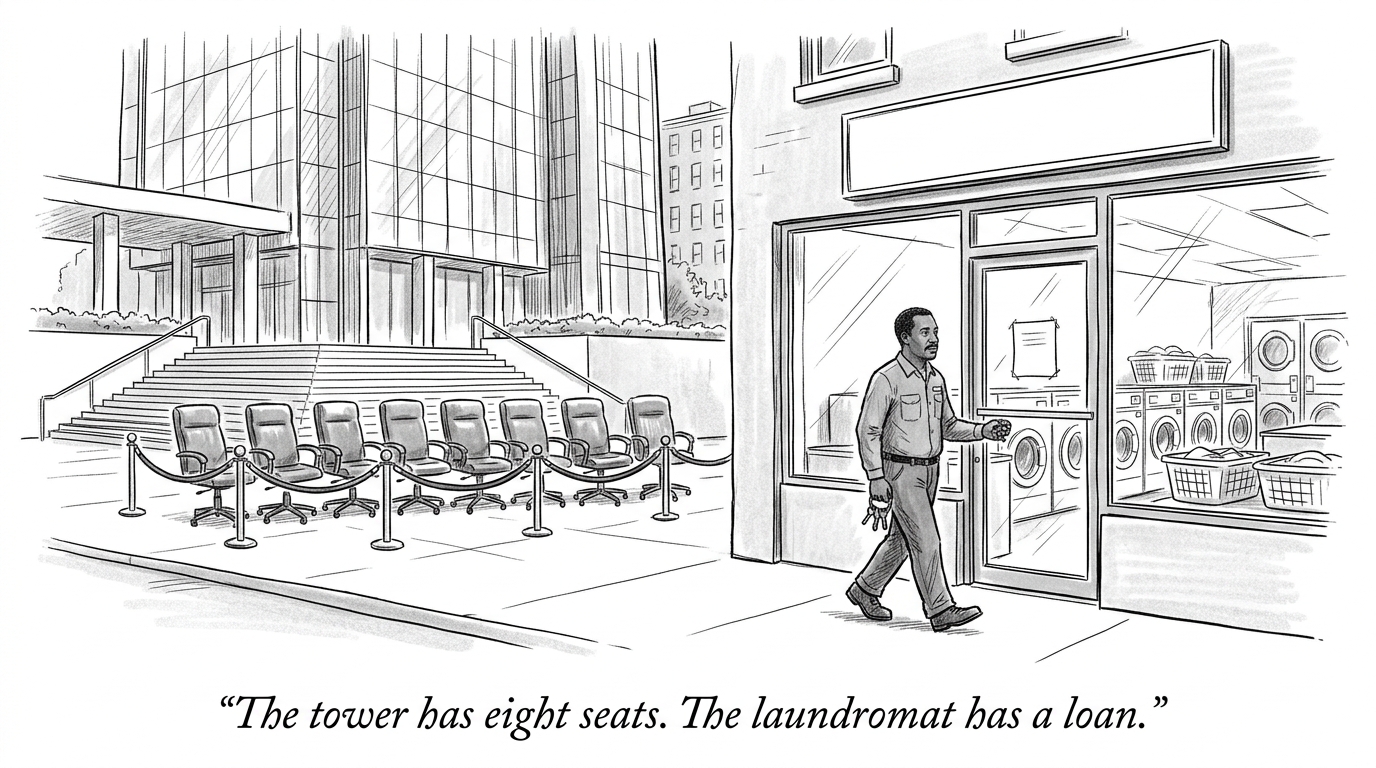
Start with the gate, stated plainly rather than implied. In 2026, women hold 11% of Fortune 500 CEO seats -- 55 companies, a record high and the fourth straight year above 10%.[1] Black executives hold 8 of the 500.[2] These numbers describe a real gate: the traditional path to a CEO chair runs through elite credentials, insider sponsorship, and decades of climbing inside institutions, and that path has historically favored a narrow set of backgrounds. None of what follows argues that gate doesn't matter or shouldn't change. It argues there is a second, almost entirely separate path to the actual outcome most people want from the CEO title -- wealth, and control over your own work -- that was never gated the same way to begin with.
The research on who actually becomes wealthy in America already found this, and it has nothing to do with corner offices. Thomas Stanley and William Danko's two-decade study of American millionaires, published as The Millionaire Next Door, found that most self-made millionaires are not corporate executives or celebrities at all -- they are small business owners and the self-employed, disproportionately concentrated in unglamorous trades, who built wealth through ownership and control of a cash-flowing operation rather than through climbing someone else's ladder.[3] Dry cleaners. Laundromats. HVAC companies. Janitorial services. Waste management. None of it requires a degree, a name, or a network to get in the door.
The federal government already built the financing mechanism for this, at real, checkable scale. The SBA 7(a) program lets a qualified buyer purchase a cash-flowing small business with roughly 10% down instead of the 20-30% a conventional bank loan requires, for deals up to $10 million in combined program exposure as of a July 2026 rule change.[4] The SBA approved approximately 70,242 of these loans in FY2024 alone, averaging $443,097 each, for a program total near $31 billion.[4] None of it runs through a board search committee or an MBA network. It runs through a bank loan officer and a business with real financial statements.
The businesses themselves are not spread evenly, and where they concentrate is its own overlooked fact. More than half of U.S. business owners are already over 55, and an estimated 6 million small and mid-sized businesses face an ownership transition by 2035.[6] That risk is not evenly distributed -- in Maine, Montana, Vermont, and Wyoming specifically, the value of small businesses facing succession represents as much as 3.2% of the entire state's economic output, concentrated in rural areas where small businesses often account for more than half of total local employment.[6] The overlooked-ness compounds rather than cancels out: 78% of business owners nationally have no formal succession plan at all, and rural communities specifically lack the business brokers and financing infrastructure that would normally surface these deals to a buyer looking for one.[6] The opportunity is real and it is disproportionately sitting in exactly the places least equipped to advertise that it exists. The financing gap specifically is not unsolvable -- SBA's 7(a), 504, and Microloan programs carry no rural exclusion and are fully available to rural business owners on paper.[7] The friction is practical, not legal: rural applicants have a harder time finding an SBA-approved lender nearby and navigating a documentation-heavy process without local support, and in 2024 rural small businesses received partial or no funding at nearly twice the rate of urban ones.[7] The mechanism exists everywhere. Reaching it does not, yet, exist evenly.
One distinction worth stating plainly, because it is the actual reason this lever is so accessible: none of this is venture capital. There is no pitch deck, no investor to convince, no board seat traded away, no equity given up in exchange for the money. SBA 7(a) financing is debt, serviced by the business's own cash flow and personally guaranteed by the buyer -- a bank loan officer evaluating whether the numbers work, not an investment committee evaluating whether the founder and the story are compelling enough to bet on. That difference in kind, not just in degree, is why this path was never gated by the same things that keep Fortune 500 boardrooms so narrow.
The results this path already produces are real and quantified, not speculative. Across a sample of 66 tracked acquisition-entrepreneurship deals, more than 70% of the buyers held equity worth over $1 million at the point of exit.[5] One documented case: a 35-year-old bought a 2,500-square-foot laundromat for $425,000, put 10% down through an SBA loan -- $42,500 -- and grew the business's annual profit from $48,000 to $72,000 within 18 months, a 169% return on the actual cash he put in.[5] No corner office. No board seat. No search committee ever had to say yes.
Someone has already built a career out of saying exactly this in public, and it worked. Nick Huber co-founded Storage Squad as a Cornell student in 2011 -- a valet-style storage service for college kids -- and grew it into a 35-school, 10-state operation before selling it to 1-800-PACK-RAT for a seven-figure sum.[8] He now runs a storage-focused private equity firm, a real estate consulting business, and a staffing agency, and coined the term "sweaty startup" for exactly the category this piece is describing -- businesses deliberately chosen because they are boring, not despite it.[8] The mechanism this piece traces isn't hypothetical or rare. It has its own public advocate, with a following built specifically on making it visible.
A companion piece names exactly what's still missing. That piece is here -- checked against this site's own archive, not a hypothetical: the data exists, a real, visible person doing it does not, yet.
- Fortune, Women Run a Record 11% of Fortune 500 Companies in 2026
- Yahoo Finance, Meet the 8 Black Fortune 500 CEOs Leading Companies With Over $228 Billion in Combined Revenues
- Thomas J. Stanley & William D. Danko, The Millionaire Next Door: The Surprising Secrets of America's Wealthy
- U.S. Small Business Administration / Comerica, The Buyer's Guide to SBA Financing for Small Business Purchases
- BUY THEN BUILD, Closing the Wealth Gap With Acquisition Entrepreneurship
- Project Equity / Kansas Public Radio / Extension services (Missouri, Minnesota), The Silver Tsunami Hitting Rural America -- Business Succession Without Replacements
- CEDCO Small Business Finance / SBA, Financing Rural Businesses: Challenges and SBA Lending Options
- Learning from a self storage tycoon: Nick Huber