The pit was already there when the fire started
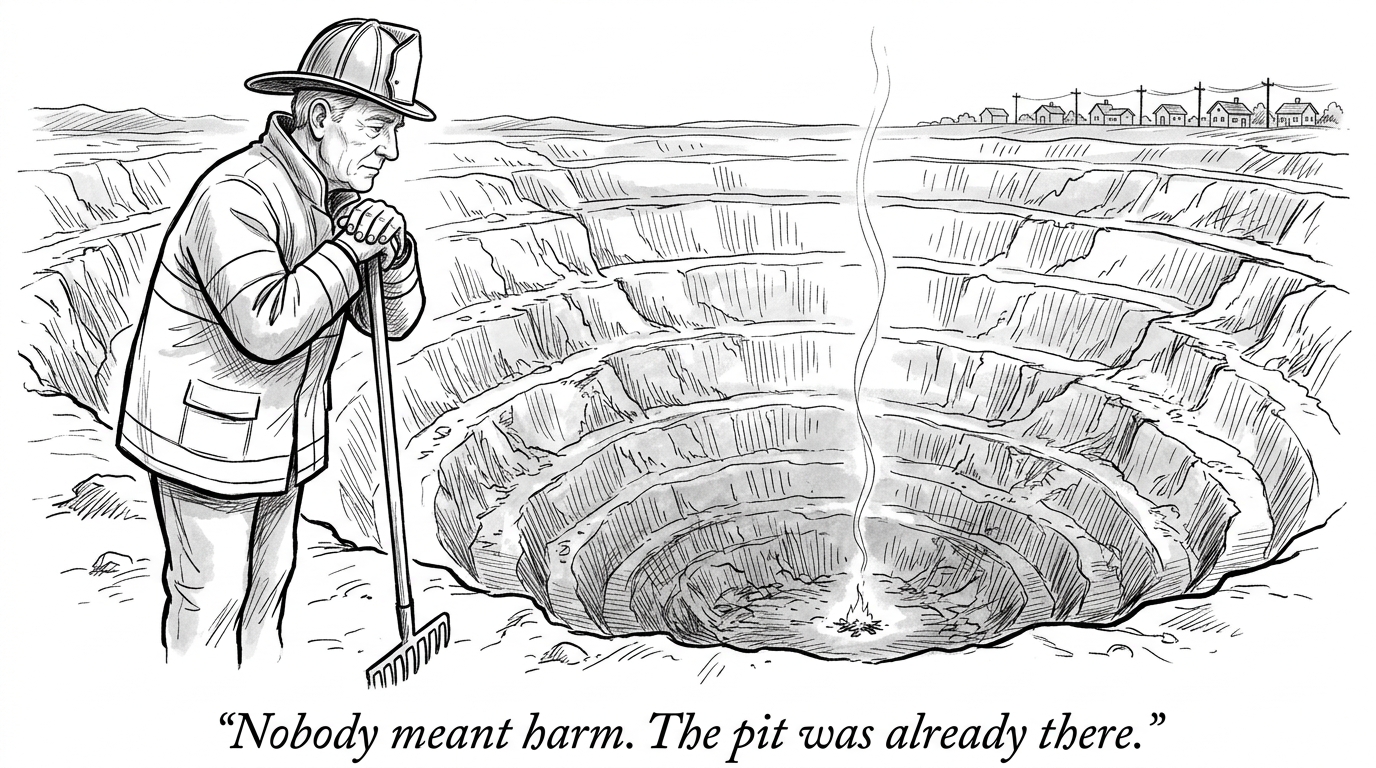
In 1935, a coal company strip-mined a pit on the edge of Centralia, Pennsylvania, cutting down to an anthracite seam and exposing it to open air. When the company finished working the pit, it left the excavation open rather than filling it back in — a common practice at the time, and nobody's specific decision to endanger anyone; simply the cheapest way to close out a strip mine once it stopped being profitable.[1] The empty pit sat there for close to three decades, and the borough eventually began using it as the town landfill.
In May 1962, with Memorial Day approaching, the Centralia borough council hired five volunteer firemen to clean out the landfill by burning the trash in the pit — a routine, unremarkable municipal decision, the kind made in small towns every year. The fire burned down through the trash and reached the exposed coal seam at the bottom of the pit their predecessors had left open twenty-seven years earlier. It has been burning through the Buck Mountain coal seam, underneath the town, continuously, ever since.[1] Federal estimates give the fire enough remaining fuel to keep burning for roughly another 250 years.[1]
An underground anthracite fire is a genuinely different kind of problem than a fire above ground. It has its own continuous fuel supply in the seam itself, its own air channels through the abandoned mine tunnels honeycombing the rock, and no surface for firefighters to reach or smother. The Office of Surface Mining Reclamation and Enforcement's own accounting of the problem names Eastern Pennsylvania's anthracite fields specifically, for the angled seams that make a fire's underground path especially hard to trace, and lists trenching, excavation, and foam injection among the available responses — each expensive, each uncertain, and none guaranteed to work once a fire has established itself in a mine's old workings.[2]
The government's response ran through decades of its own decisions, each one arriving after the fire was already unstoppable. Congress appropriated more than $42 million in 1983 to relocate the town, and most of Centralia's roughly 1,000 residents took the buyout and moved to nearby Mount Carmel, Ashland, and Bloomsburg over the following years.[3] In 1992, Pennsylvania Governor Bob Casey declared eminent domain over every remaining property in the borough, condemning homes whose owners had chosen to stay.[3] A handful of residents refused to leave anyway, living for decades above ground that vented carbon monoxide and occasionally opened into sinkholes, and their final legal fight over the right to remain wasn't settled until October 2013 — fifty-one years after the fire started — when the last seven holdouts accepted $218,000 plus $131,500 in exchange for the right to live out their lives in their own condemned houses, with no right to sell the property or leave it to their children.[4]
Centralia gets remembered as a singular, almost supernatural place — a ghost town on fire. It is neither singular nor supernatural. The same federal office responsible for tracking these fires counted at least 98 of them burning underground across nine states as of 2013 alone, and says plainly that the true number is almost certainly higher.[2] Pennsylvania's coal country is dense with exactly the physical precondition Centralia had: a century of mining left thousands of exposed seams and abandoned workings sitting under towns that were built directly on top of the industry that dug them out, waiting for an ordinary, unremarkable decision — a trash fire, a brush clearing, a lit cigarette — to reach the coal. This site has already argued that a private decision can outrun the law built to reach it; Centralia is the same shape turned toward geology instead of the courts. The room — the open pit, the exposed seam — was already there, decades before anyone made the small decision that walked into it, and once that decision was made, no institution built on human timescales, a fire department, a legislature, a court, has ever been able to reach the actual process burning underneath.
- Wikipedia, Centralia mine fire
- Office of Surface Mining Reclamation and Enforcement, Coal Mine Fires and Burning Refuse
- CentraliaPA.org, History of Centralia PA, 1984 to Present
- Yahoo Finance / Associated Press, Pa. residents living above mine fire free to stay