The United States Can Listen. It Has Nowhere to Put What It Hears.
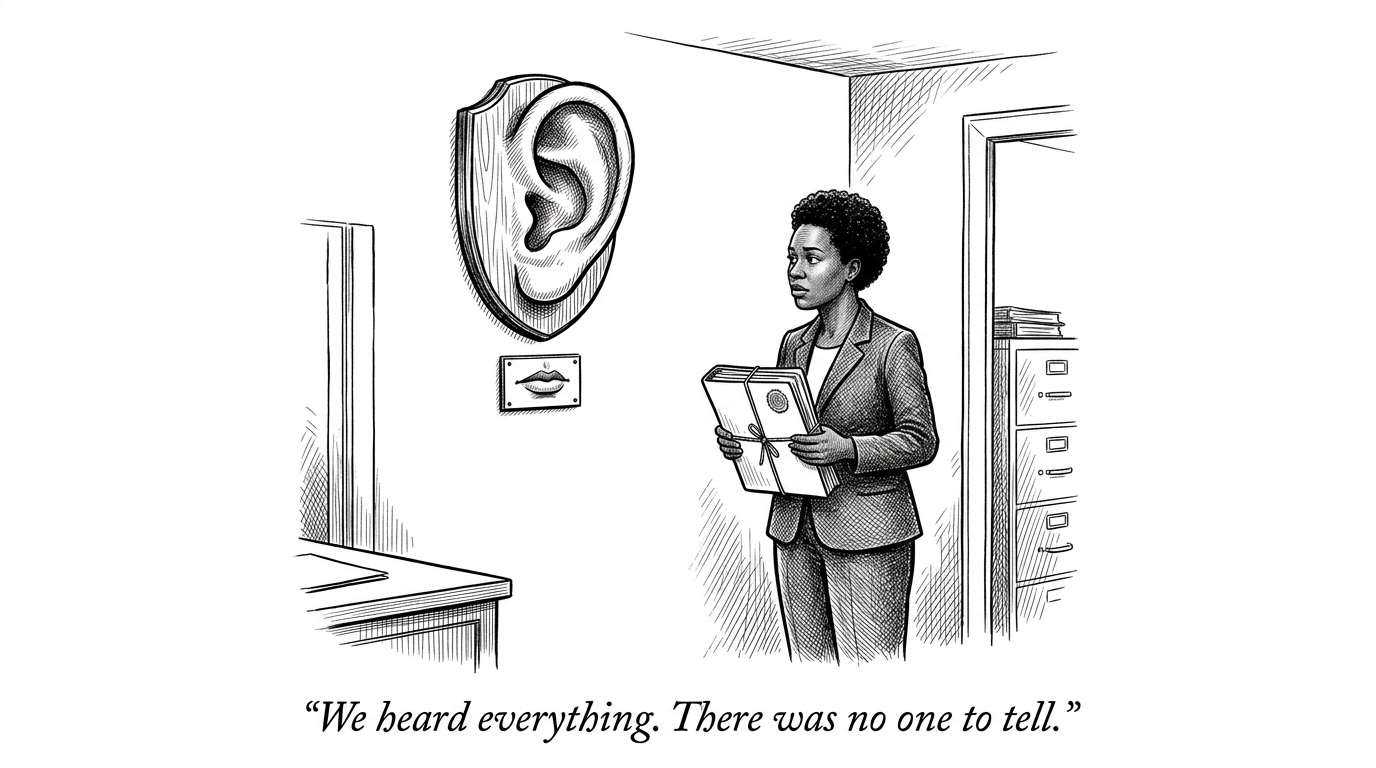
I took a drive, and a guest on public radio was lamenting that the United States, by and large, does not conduct economic espionage. My reaction was not about ethics. It was: where would we put it? A state that steals a design needs a company to hand the design to, and the United States, by design, had built none. This is a piece about the ear, the mouth, and who holds the switch in between.
The question on the drive
I think the program was All Things Considered. The guest was lamenting the restraint. My thought was about what happens next. Suppose we learned how a rival's AI chips got so good, or how a robot motor got more efficient, or the molecule that treats bird flu. Who would the government tell?
A state-capitalist rival has a plain answer. The design goes to the company the state owns or steers. The United States has agencies built to know: signals, mapping, human sources on what other governments do. It has had no equivalent of the company at the end of the line.
The one time there was a place to put it
For most of the twentieth century, one firm sat at the center of the country's communications. In 1956 AT&T settled an antitrust suit with a consent decree that left Western Electric intact but confined the company to common-carrier communications and barred it from the computer business. It also required Bell Labs to license its patents to others.[1] Economists who studied the decree describe the patents it already held as licensed royalty-free, and the Federal Judicial Center describes licensing on payment of reasonable royalties.[2][1] I have not read the decree text, so I will not choose between the two wordings. Either way, the closest thing the United States had to a national vessel was legally obliged to license its inventions to anyone who asked. The best-known result was an operating system. Bell Labs built Unix, and the decree meant AT&T could not turn it into a business: its own lawyers concluded that, in the EFF's account, the decree "meant that they couldn't start a new business based on Unix."[3] So AT&T licensed it for a modest sum. A 1975 ARPANET note, as Wikipedia relays it, put a license at $20,000 for non-university institutions and a nominal $150 for universities.[4] One licensee later recalled the fee covering the paperwork and copying the tape. Universities took it, improved it, and passed the improvements around, and Berkeley's version became one of the lines modern computing grew from. The only time the state required its vessel to give the invention away, the invention went everywhere.
In January 1982 the company and the Justice Department agreed to break the Bell System up, and the local operating companies were divested on January 1, 1984, with the old restrictions modified so AT&T could enter computers.[1] After that there was no single firm the state could tell and that could act on what it was told.
The sphere, and the island
The firm that was the vessel also drew a map. AT&T created the North American Numbering Plan in 1947, and it is the reason a phone number in Toronto, Kingston and Nassau begins with a 1. The plan now covers twenty countries: the United States and its territories, Canada, Bermuda, Anguilla, Antigua and Barbuda, the Bahamas, Barbados, the British Virgin Islands, the Cayman Islands, Dominica, the Dominican Republic, Grenada, Jamaica, Montserrat, Sint Maarten, St. Kitts and Nevis, St. Lucia, St. Vincent and the Grenadines, Trinidad and Tobago, and Turks and Caicos.[5] It is a hemisphere's address space, and one American company drew it.
Haiti is not on the list. The Dominican Republic, which shares its island, is. I do not know the telephone history that explains it, and I will not guess. What the State Department's own record shows is that Haiti won its independence in 1804 and the United States did not recognize it until July 12, 1862, under Lincoln, and that the United States occupied Haiti for nineteen years, from 1915 to 1934.[6] My reading is that Haiti is an outcast because its slave rebellion succeeded. The record supports a pattern of delay and punishment. It does not tell me why a numbering plan left it out.
The ear it kept
The 1984 breakup did not end the listening. Fairview, a program the NSA began in 1985, a year after the breakup, was in ProPublica's description a partnership "with a single partner, AT&T." The documents never name the company. The reporters tied them to it through a constellation of evidence: a damaged cable repaired on the same date as an AT&T cable, AT&T's technical jargon in the documents, and a court order carried out on the line AT&T provides to the United Nations.[7]
Be exact about what it collected. The domestic phone part was records, not conversations. AT&T gave the agency bulk call detail records, at a reported 1.1 billion cell phone records a day.[7] A call detail record says who called whom, when, and for how long. It does not say what was said. The government knew who talked. It did not know what they said. Fairview as a whole was broader. ProPublica reported that it also forwarded email content, and that by 2013 it was processing 60 million foreign-to-foreign emails a day.[7]
The first public sign of it came earlier. An AT&T technician, Mark Klein, disclosed in 2006 a room in San Francisco where fiber trunks were split into NSA equipment. The Electronic Frontier Foundation sued AT&T, and the case was dismissed in 2011 on immunity Congress had granted to the telecommunications companies.[8] The company that listened was shielded by the state that asked it to.
In its 2015 report ProPublica and the New York Times, working from NSA documents, quoted one document calling the relationship "highly collaborative" and another praising AT&T's "extreme willingness to help."[7]
So the pattern was this. The state kept the ear, and in the domestic case the ear heard the pattern of who spoke to whom. It lost the mouth. A country can know a great deal and have no single place to act on it.
What the law allowed
It was also not every call. The content of a communication could be intercepted only where the law allowed it, and the law required a foreign link. Under a traditional FISA order the government must show probable cause that the target is a foreign power or an agent of one.[9] Under Section 702 the target must be a non-United States person reasonably believed to be outside the country, and the statute bars targeting anyone in the United States, or any United States person, including by "reverse targeting."[10] The records were the exception to that rule. They were collected in bulk under court orders. Congress banned bulk collection under that authority in the USA Freedom Act of 2015, it ended on November 29, 2015, and the records now stay with the phone companies, searchable only on a court order for a specific selection term.[11]
A word on that phrase, "a foreign link." Most people hear it as "a foreigner," and the law does not. The term it uses is "United States person," and it is wider than a citizen. It covers citizens, lawful permanent residents, an association a substantial number of whose members are citizens or permanent residents, and any corporation incorporated in the United States, and it leaves out a corporation or association that is a foreign power.[12] So a green card holder abroad is a United States person, a Delaware company is one, and a Canadian visiting Boston is not. Where a person is matters separately: Section 702 bars targeting any United States person or anyone assessed to be located in the United States.[10] A visitor on American soil has that protection by being there. That distinction was drilled into me, and into everyone I worked beside in that world, and it is the one most outside it have never heard.
I spell this out because it shows the restraint a country puts on its own government, and because the picture in most heads is different. People imagine the machine in a Batman film: every phone in the city turned into a microphone, every conversation drawn in and every word tracked. The record is more pedestrian and more bounded. Content needed a foreign link and a court or a statute behind it. The records were collected on a court's say-so and, when the country decided that was too much, Congress ended it. The scale was real: 1.1 billion records a day is not small. The restraint was real too, and it arrived through exposure and a statute, not through the program's own design. Both facts belong in the picture.
Now the question that is new. Suppose a government could take the content of every call between this country and another, and run it through a machine. What could it do? More than it could have five years ago. A machine can turn speech into text, translate it, search it by meaning, and boil a day of calls down to a page. The limit used to be people: there were never enough listeners. That limit is gone. Other limits are not. A call on an encrypted app leaves nothing to transcribe. Most calls are ordinary, and a machine that flags one in a thousand wrongly still hands a person thousands of false alarms. Anyone in cyber security has lived this. A 2015 Ponemon Institute survey of 630 IT and security professionals found organizations averaging 16,937 malware alerts a week, only 19 percent of them considered reliable and only 4 percent actually investigated.[13] False positives will kill a system like this, because the more it sees the less anyone can act on, and the people who work it spend their days hunting ghosts. And a perfect transcript does not tell you who to give it to. If the machine pulled a foreign firm's supplier terms out of a call, we would be back where this piece began. What a country can hear is a question about machines. What it does with it is a question about law, and about whether anyone is on the other end to receive it.
Wall one: the company that receives
Federal law makes the receiving end a crime. The Economic Espionage Act makes it an offense to steal a trade secret, and also to knowingly "receive, buy, or possess" one that has been stolen or taken without authorization. For a company the fine runs to the greater of $5 million or three times the value of the secret, and ten years for an individual.[14] When the offense benefits a foreign government, the figures rise to $10 million for a company and fifteen years for a person.[14]
The statute does carve out "any otherwise lawful activity conducted by a governmental entity of the United States."[15] It names the government's own activity. It says nothing about a private firm that receives something from the government. That silence is where the question lives, and the text does not answer it.
Wall two: telling is the leak
Suppose a firm could lawfully receive it. There is a second problem, one anyone who has held a clearance knows. What you learned came from somewhere, and the act of using it tells the other side that you can learn it. If a United States company suddenly makes a motor like the rival's, the rival can work back from the product to the channel. You have spent the source to get the advantage.
Disclosure runs in a chain. Say what, and you invite the question of how. Answer how, and you invite why, and the why names the source. This is the land Donald Rumsfeld called the known unknowns, and the people who lived in it were not stupid. You know, and you cannot speak.
The chokepoint
States seek to control communications chokepoints, and that is how a government can shut the internet off for everyone who does not have a satellite phone or a Starlink terminal. In the United States the chokepoint was held privately and regulated publicly. The thing that has changed is that the path that works when a state closes the gate is now owned by one company.
I write with Claude, made by Anthropic. I used Twitter before Elon Musk bought it, and I stopped afterward. I do not use X or Grok. Weigh what follows accordingly.
Starlink became a chokepoint in a war. Musk has said that in 2022 he refused an emergency request from Ukrainian authorities to activate Starlink all the way to Sevastopol, and that doing so would have made SpaceX complicit in a major act of war.[16] Walter Isaacson's biography first told the story as Musk secretly switching coverage off near Crimea; Isaacson later retracted that, writing that the Ukrainians thought coverage was enabled all the way to Crimea and it was not.[17] Either way, the decision about where the service worked was a company's. In June 2023 the Defense Department formalized a contract with SpaceX for Starlink in Ukraine that, as one account puts it, gave the Pentagon control of where Starlink works inside the country, on terms that have not been disclosed.[17] A contract is a brake. Its terms are not public. In February 2026 Starlink cut service to terminals in Ukraine that were not on a whitelist, aimed at Russian forces using it without authorization, and partisan accounts claim a large effect at the front. The scale has not been independently verified.[17]
A company can be reasoned with
The old AT&T was a firm with shareholders, a board, counsel, a regulator and a consent decree. Each of those is a process that slows one decision and gives an outsider someone to argue with. A chokepoint held by one controlling owner has none of those brakes by default. A company can be reasoned with. A person is will.
I want this to hold for any person and any politics, because it is the structure that matters and not one man's views. The same property that makes a founder effective, the capacity to decide and to act, is the property that makes a chokepoint unaccountable. I have praised that capacity elsewhere on this site. This is the other side of it.
Why does this matter?
The state that cannot place what it learns keeps listening anyway, and the path that carries the conversation has moved from a firm it could regulate to a firm it depends on and cannot hold. The question I would put to any country is not whether its agencies are good. It is who it can reason with when the chokepoint is not its own.
Part of a longer argument about who holds what the state funds, learns and relies on. See also America Invents the World's Most Important Technology and Owns Almost None of It, and DoAyni's piece on the government taking equity.
- Federal Judicial Center, The Breakup of "Ma Bell": United States v. AT&T
- AcaWiki, How Antitrust Enforcement Can Spur Innovation: Bell Labs and the 1956 Consent Decree (Watzinger, Fackler, Nagler and Schnitzer, 2017; AcaWiki summary)
- Electronic Frontier Foundation, Unix and Adversarial Interoperability: The "One Weird Antitrust Trick" That Defined Computing (Cory Doctorow, May 6, 2020)
- Wikipedia, relaying a 1975 ARPANET RFC on licensing, Unix
- NANPA, North American Numbering Plan Administrator: About
- Office of the Historian, U.S. Department of State, A Guide to the United States' History of Recognition, Diplomatic, and Consular Relations: Haiti
- ProPublica, with The New York Times, NSA Spying Relies on AT&T's "Extreme Willingness to Help" (Aug 15, 2015; Angwin, Larson, Savage, Risen, Moltke, Poitras)
- Wikipedia, Room 641A
- Congressional Research Service, via EveryCRSReport, Foreign Intelligence Surveillance Act (FISA): An Overview (IF11451)
- Office of the Director of National Intelligence (intel.gov), Targeting under FISA Section 702
- Lawfare, NSA Ends Bulk Collection of Telephony Metadata Under Section 215
- Legal Information Institute, Cornell Law School, 50 U.S.C. § 1801, Definitions ("United States person," subsection (i))
- eWeek, Malware Containment Continues to Weigh Heavily on Organizations (reporting the Ponemon Institute / Damballa "Cost of Malware Containment," January 2015)
- Legal Information Institute, Cornell Law School, 18 U.S.C. § 1832 and § 1831, Theft of trade secrets; Economic espionage
- Legal Information Institute, Cornell Law School, 18 U.S.C. § 1833, Exceptions to prohibitions
- CBS News, Elon Musk says he denied Ukraine satellite request to avoid complicity in "major act of war" vs. Russia
- Wikipedia, Starlink in the Russo-Ukrainian war