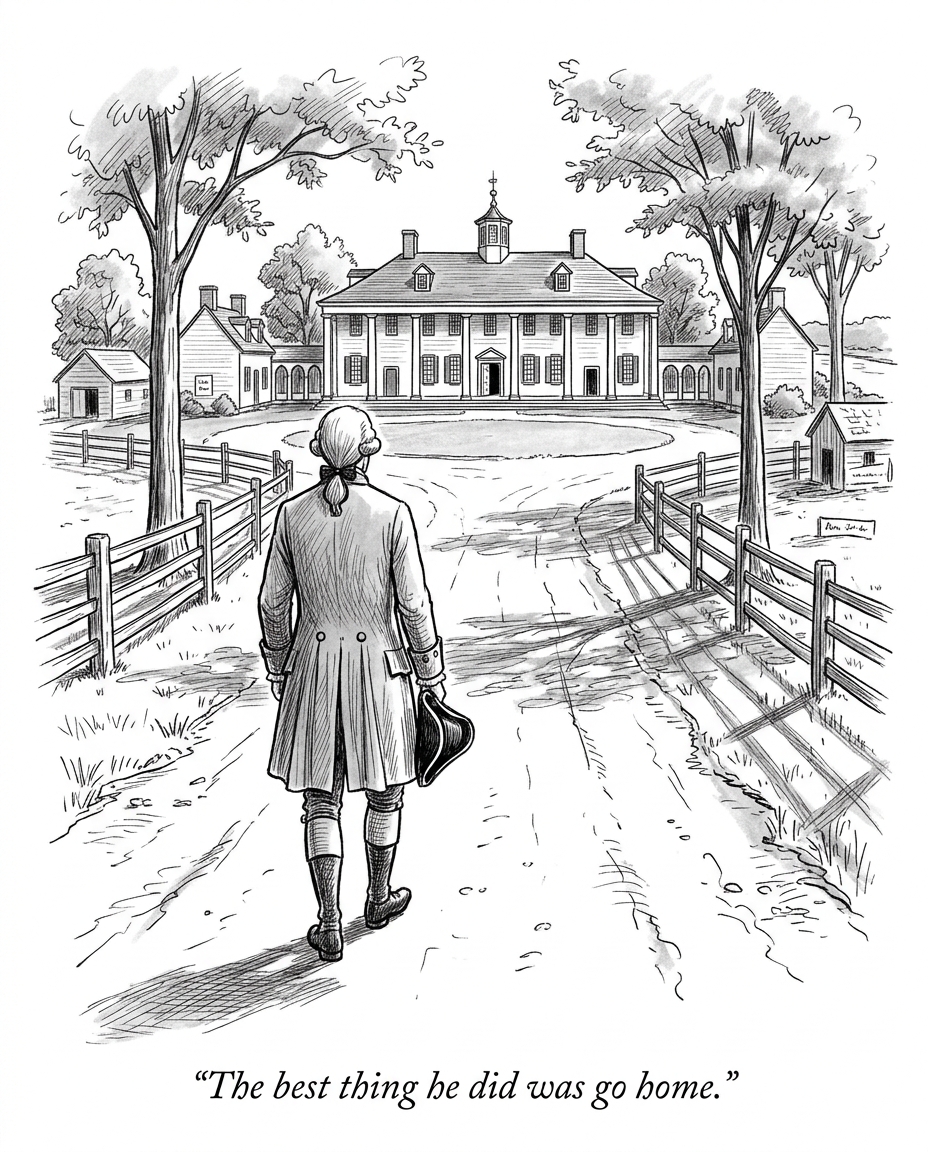
The Best Thing He Did Was Go Home
In September 1796 a Philadelphia newspaper printed a long letter from the President of the United States. It was not about a war or a treaty. It was a goodbye.[2] George Washington was telling the country he would not run again, and then, at length, telling it how to keep a republic after he was gone.
In my opinion, the best thing Washington did was go home. This piece is about why that was so rare, why it mattered, and what we did when the habit of going home was no longer enough.
What he wrote
Washington said plainly why he was leaving. He had stayed in office out of duty, not wish: "a uniform sacrifice of inclination to the opinion of duty." He had hoped to return to the retirement "from which I had been reluctantly drawn," and had even prepared an address before the last election, but a dangerous moment in foreign affairs and "the unanimous advice of persons entitled to my confidence" made him stay. Now the danger had passed, and he wrote that "the shade of retirement is as necessary to me as it will be welcome."[1]
The address did not come from him alone. James Madison had written a draft in 1792, when Washington first thought of retiring. Alexander Hamilton then did an extensive rewrite in 1796, keeping only the first few paragraphs of Madison's version, and Washington made the final edits.[2] It is the same Hamilton who built the country's financial system and whose wife built an orphanage, in a piece this outlet has already published.[12]
A man who could have been king
Going home meant something because Washington could have stayed. He was elected president unanimously, twice: all 69 electoral votes in 1789 and all 132 in 1792, the only president ever elected unanimously, twice.[3] And he had been offered more.
In May 1782, during the Revolution, an army colonel named Lewis Nicola wrote to him proposing that Washington become king of the United States.[4] Washington's reply is one of the great refusals in American history. He wrote that "no occurrence in the course of the War, has given me more painful sensations" than learning such ideas existed in the army, that he viewed them "with abhorrence," and that "you could not have found a person to whom your schemes are more disagreeable."[4]
A general who refused a crown, a president who won unanimously and walked away: that is what the address is explaining.
Why he warned about party
The most important part of the address is the warning that comes after the goodbye. Washington told the country to beware "the spirit of party." He described a chain: one faction dominates another, the cycle of revenge gets worse, and people grow tired of it. Then:
"The disorders and miseries which result gradually incline the minds of men to seek security and repose in the absolute power of an individual; and sooner or later the chief of some prevailing faction, more able or more fortunate than his competitors, turns this disposition to the purposes of his own elevation, on the ruins of public liberty."[1]
He allowed that parties in free countries can act as useful checks within limits, but in governments "purely elective" he called it "a spirit not to be encouraged," a fire that "demands a uniform vigilance to prevent its bursting into a flame."[1]
Notice what he was describing. It was not an invasion or a coup. It was the ordinary working of politics ending in one person who rose on the country's exhaustion. The remedy he offered was a person, himself, declining to be that person.
The pull the other way
The habit he started held for a long time. A president could stay as long as the voters kept choosing him, but until 1940 none did. The tradition was tested in 1912, when Theodore Roosevelt, who had already served nearly two terms, lost the Republican nomination to William Taft by 561 votes to 187, led his followers out of the convention, formed the Progressive Party, and ran under its banner. He did not win.[6]
Then in 1940 Franklin Roosevelt ran for "an unprecedented third term, breaking the tradition set by George Washington that limited Presidents to eight years in office."[7] What he wanted is a real question. At the 1940 convention, Senator Alben Barkley read a message from him saying he "has never had, and has not today, any desire or purpose to continue in the office of President" and that delegates were free to vote for anyone.[8] The Miller Center's account is more complicated: FDR had been "coy" for most of his second term, told confidants he would run only if the situation in Europe got worse and his party drafted him, the fall of France in the spring of 1940 took care of the first condition, and his political operatives arranged the second. He won, and again in 1944, in the middle of the war.[7]
My own view is that he did not want to stay, and the war is why he did. That is an opinion. His words are above, and so is the evidence against taking them at face value. What is not an opinion is what happened next.
The law
For 144 years the limit on a president's time in office was nothing but a habit of will. Once a president broke it, the country wrote it down. Congress passed the Twenty-Second Amendment on March 21, 1947, and the states ratified it on February 27, 1951: "No person shall be elected to the office of the President more than twice."[9]
That is the pattern worth seeing. Norms hold until they don't, and then we write laws to make them hold. When leaders give up power, we call it character. When one does not, we write a law for the next one.
Madison said it before any of this. In Federalist No. 51 he wrote, "Ambition must be made to counteract ambition," and then asked the question the whole matter turns on: "But what is government itself, but the greatest of all reflections on human nature? If men were angels, no government would be necessary." He added that "experience has taught mankind the necessity of auxiliary precautions."[5] The Twenty-Second Amendment is an auxiliary precaution. Washington's going home was the first one, and it had no text at all.
Fiction's version of the test
The novelist Orson Scott Card built a book on the same fear. In Empire (2006), America falls into a second civil war after the President and Vice President are assassinated. Afterward, a professor named Averell Torrent is elected in a landslide, nominated by both the Democratic and Republican parties, and the sitting president steps down at once to let him start. Torrent, a character whom the book's plot has the protagonist's wife come to suspect of having instigated the crisis, is obsessed with the transition from the Roman Republic to the Empire.[11] The sequel, Hidden Empire, shows him holding "a tight grip on the reins of both political parties."[11b] I disagree with Card's politics, and I think his read of how people behave is accurate. Torrent is the person Washington warned about, a faction chief who becomes the country's only choice. He is also the man who does not go home.
What to ask
The next time someone is described as indispensable, ask three things:
- What would it cost them to leave, and would they? Washington could have stayed, was asked to be king, and went home.
- Who or what restrains them if they will not? A habit, a law, the other branches, the voters. Madison wrote that these must be built because we are not angels.
- Who decided? None of this happened by itself. Someone stood on a lever. This outlet has made that argument before in Someone moves the lever.[12] Washington's lever was the one he did not pull.
Some leaders give up power and some want to hold it. Norms hold until they don't. Then we write laws to make them hold, and we remember the ones who held without them.
This is the author's reading of the record. The sources are listed below. Where the sources disagree, or where the piece gives the author's opinion, it says so.
Sources
- George Washington, "Farewell Address," 1796, Yale Law School Avalon Project: https://avalon.law.yale.edu/18th_century/washing.asp (read in full).
- "George Washington's Farewell Address," George Washington's Mount Vernon digital encyclopedia: https://www.mountvernon.org/library/digitalhistory/digital-encyclopedia/article/george-washington-s-farewell-address (read in full; Madison's 1792 draft, Hamilton's rewrite, publication on September 19, 1796).
- Miller Center, University of Virginia, "George Washington: Campaigns and Elections," https://millercenter.org/node/67 (read; 69 unanimous electoral votes in 1789; 132 in 1792, "the only president to be elected unanimously, twice").
- George Washington to Lewis Nicola, May 22, 1782, Founders Online, National Archives: https://founders.archives.gov/documents/Washington/99-01-02-08501 (read in full).
- "Newburgh letter," Wikipedia, https://en.wikipedia.org/wiki/Newburgh_letter (read; Nicola's May 22, 1782 letter proposed that Washington become king of the United States, as a constitutional monarchy).
- James Madison, The Federalist No. 51, Yale Law School Avalon Project: https://avalon.law.yale.edu/18th_century/fed51.asp (read).
- Miller Center, "William Taft: Campaigns and Elections," https://millercenter.org/node/269 (read; the 1912 Republican convention, 561 to 187, the Progressive Party).
- Miller Center, "Franklin D. Roosevelt: Campaigns and Elections," https://millercenter.org/president/fdroosevelt/campaigns-and-elections (read; 1940 and 1944).
- Franklin D. Roosevelt, "Statement on Candidacy for a Third Term," July 16, 1940 (read by Senator Alben Barkley), The American Presidency Project: https://www.presidency.ucsb.edu/documents/statement-candidacy-for-third-term (read in full).
- "The Constitution: Amendments 11-27," National Archives: https://www.archives.gov/founding-docs/amendments-11-27 (read; Amendment XXII, passed by Congress March 21, 1947, ratified February 27, 1951).
- "Empire (Card novel)," Wikipedia: https://en.wikipedia.org/wiki/Empire_(Card_novel) (read; the plot summary).
- "Summary and Reviews of Hidden Empire," BookBrowse: https://www.bookbrowse.com/bb_briefs/detail/index.cfm/ezine_preview_number/4408/hidden-empire (read; the publisher-derived summary).
- DoAyni: "Two Lessons in Civics" (https://doayni.com/analysis/alexander-hamilton-bank-reynolds-pamphlet-eliza-orphan-asylum-words-and-actions) and "Someone moves the lever," August 13, 2026 (https://doayni.com/analysis/someone-moves-the-lever): this outlet's earlier pieces.