We Train Them. Then What?
9 min read
Engineers design and build. What happens next may be out of their control. That is true of every design, and it is the reason a question about who gets trained, and where they end up, is also a question about who decides what the training is for.
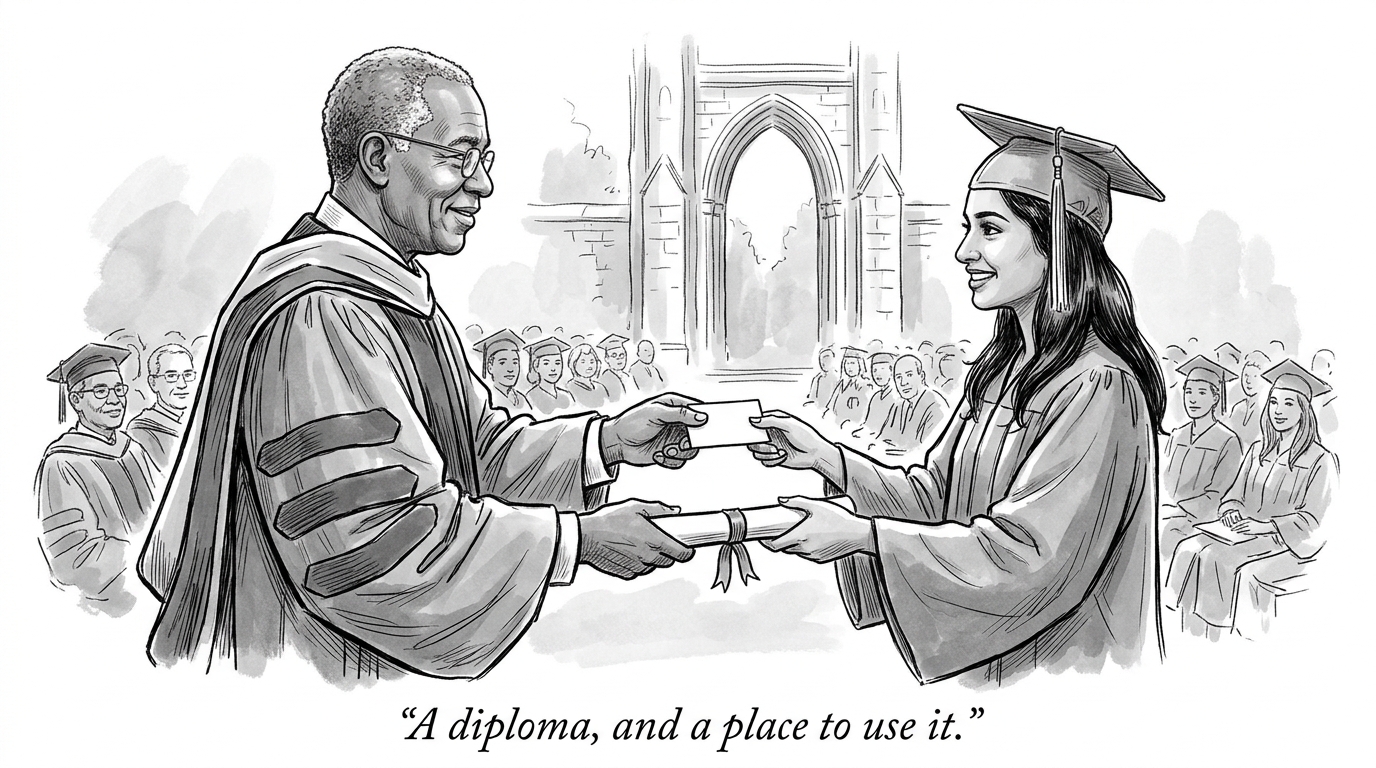
Engineers design and build. What happens next may be out of their control. That is true of every design, and it is the reason a question about who gets trained, and where they end up, is also a question about who the training benefits.
## Who earns the degrees
In 2024, people on temporary visas earned 6 percent of U.S. science and engineering bachelor's degrees, 42 percent of master's degrees, and 38 percent of doctorates.[1] The pattern is a pipeline: most arrive with a first degree from home and come to the United States for graduate school. The degree shares fit that, though they do not count who arrives already holding a bachelor's.
The concentration is in the fields that build things. Temporary-visa holders earned more than half of the doctorates in computer and information sciences (61 percent), engineering (54 percent) and mathematics and statistics (52 percent) in 2024, and more than half of the master's degrees in each of those fields.[1] Physical sciences is not a majority: 39.5 percent of doctoral recipients in 2023.[2] China and India together accounted for 71 percent of international science and engineering master's enrollment in fall 2025.[1]
## Most of them stay
The common picture is that we train foreign students and send them home. The data does not support it as the typical outcome. Among temporary-visa holders who earned science and engineering doctorates between 2017 and 2019, about 73 percent were still living in the United States about five years later, and about 68 percent of those who earned them between 2012 and 2014 about ten years later.[1] The five-year rate was 83 percent for China, 86 percent for India and 50 percent for South Korea.[3] Roughly three-fourths say at graduation that they intend to stay, and that share has been steady from 2012 to 2023.[1]
Two cautions. This covers doctorates only; I found nothing on how many master's graduates stay or leave. And "non-U.S. residence" does not mean "went home." The data cannot say where the remaining quarter went.
## What changed in 2025
The stay rates above describe graduates of 2017 to 2019. The door has narrowed since. In fall 2025, new international student enrollment at U.S. institutions fell 17 percent, the largest decline outside the pandemic in 11 years, according to the Institute of International Education; graduate enrollment fell 12 percent, while the overall total fell only 1 percent because students on optional practical training rose 14 percent.[31][32] The head of NAFSA, an association of international educators, attributed the decline to difficulty getting a U.S. visa.[32] On September 19, 2025, a presidential proclamation restricted entry of H-1B workers unless the employer paid $100,000 per petition, effective September 21; on October 20 the administration said students changing to H-1B status while still in the United States, and current holders changing employers, would not pay it.[33] So the fee lands on hiring from abroad and not on graduates already here. The State Department reportedly revoked about 8,000 student visas during 2025; I could confirm that figure only through a news report, not the department's own release.[34]
On enforcement, the record is narrower than the word "deportation" suggests. DHS counts removals, which follow a final order and carry penalties on reentry, separately from returns such as voluntary departures.[37] ICE reported about 271,000 removals in fiscal year 2024 and about 320,000 in fiscal year 2025, and the count for the administration through mid-November 2025 was about 7 percent above fiscal year 2024 alone.[38] What changed was who was held: on November 16, 2025, 65,135 people were in ICE detention and about 74 percent of them had never been convicted of a crime.[38] Thousands of international students had their records in the federal status database terminated in spring 2025, and on April 25 the Justice Department said it would stop seeking removal of students terminated without cause.[39] I found no ICE or CBP figure for students or graduates removed, and I am not claiming one.
Other countries moved the other way. China added a K visa for young science and technology professionals, effective October 1, 2025, which does not require a domestic employer to invite the applicant.[35] A Nature reader poll in March 2025 found that 75.3 percent of about 1,600 respondents were considering leaving the United States; the poll was self-selected, and it measures what people said, not what they did.[36]
What I take from this is my view and not a finding of any source. The government made it harder to come and harder to stay, detained more people who had no criminal record, and terminated thousands of students' records before the Justice Department said it would stop seeking removal of those terminated without cause. That changed what an American graduate degree is worth to the person who earns it. The sources show the policies and the drop in enrollment. They do not show where the missing students went. What we have decided, whether or not anyone said so, is to let other countries benefit from the brain shift.
## The ones who leave carry it with them
Iran is the case I keep returning to. Its nuclear program began in 1957 under the American Atoms for Peace initiative, and the United States supplied the Tehran Research Reactor, which went critical in 1967.[4] In the mid-1970s, with Washington encouraging its then-ally to build a nuclear power program, MIT ran a special program to train Iranian nuclear engineers; the department's acting chairman at the time said he interviewed about fifty students in Tehran, and one of them remembers arriving in August 1975 in a group of close to twenty-nine.[5] Another student in the program, Ali Akbar Salehi, earned an MIT nuclear engineering doctorate in 1977.[5][6] He later headed Iran's Atomic Energy Organization and, in 2015, sat across the table from the U.S. Secretary of Energy, who had been starting out as a professor at the same university.[5]
Not everyone at MIT wanted the program. Noam Chomsky says he was strongly against it.[5] The former acting chairman's own view of the result is that the training did little to help Iran produce weapons material, because the technologies are so different.[5] That is one man's opinion, not a measured finding. And most of that student group did not go home: most of them now live in the United States and Canada, though some, Salehi among them, stayed in Iran.[5]
I think this bears on the present conflict over the Strait of Hormuz: we helped train some of the people on the other side. I cannot show that from these sources, and the one expert quoted says the training mattered little to weapons. What the case does show is that the people we train are not ours to direct after they leave, and that some of them will be on the other side of a table from us.
## Knowledge is not contained
After the first American test in July 1945, the Soviet Union tested in 1949, the United Kingdom in 1952, France in 1960, China in 1964, India in 1974, Pakistan in 1998 and North Korea in 2006.[7] That is seven more states in sixty-one years, which is not fast and not everywhere. The routes were mixed: spying and its own work in the Soviet case, Soviet help that ended in 1960 in China's, a Canadian-supplied reactor with American heavy water in India's, and centrifuge knowledge carried out of a European enrichment firm in the 1970s and later passed to Iran, North Korea and Libya by a network around A. Q. Khan.[8][9][10] And some of the knowledge was published on purpose: the U.S. government released the Smyth Report on August 12, 1945.[11]
It is tempting to say that before the bomb, knowledge could be contained, and that only the speed of ships and mail slowed ideas down. The sources I read complicate that. Atlantic liners took about five and a half days in 1900.[12] But the durable transatlantic cable has run since 1866, and X-rays, discovered on November 8, 1895, were in a newspaper by January 5, 1896 and in clinical use in Birmingham by January 11.[13][14] Cost mattered more than distance for who got the news: the 1866 cable price was about ten weeks' wages for one message, and business made up about 90 percent of early traffic.[15] My reading is that ideas moved at the speed of the cheapest channel open to the people who needed them, and that after 1945 that channel included published reports, spies and suppliers.
## We name the others
A country finds an "other" and names it. The Chinese Exclusion Act, signed May 6, 1882, barred Chinese laborers by name and was repealed in 1943, when China was an ally; even then it left a quota of 105 a year.[20][21] On February 19, 1942, Executive Order 9066 let military commanders exclude civilians from military areas, and the curfews that followed applied only to Japanese Americans; about 120,000 people were incarcerated, about two-thirds of them U.S. citizens.[22][23] Iran was a partner under the Shah and an adversary after 1979, the same country that sent students to MIT in 1975. The label moves with the alliance.
The line has also been drawn inside the country: around who counts as White, who counts as a citizen, and who counts as a voter. The first naturalization law, enacted March 26, 1790, limited naturalization to "free white person(s)" of good character.[24] In 1857, in Dred Scott v. Sandford, the Supreme Court stated that enslaved people were not citizens of the United States.[25] The 14th Amendment, in 1868, granted citizenship to "all persons born or naturalized in the United States," formerly enslaved people included.[26] Who counted as White was itself unsettled. In Ozawa v. United States, decided November 13, 1922, the Court held that a Japanese man whom it conceded was "well qualified by character and education for citizenship" was not eligible, reading "white person" as the Caucasian race.[27] In United States v. Bhagat Singh Thind in 1923, it said "Caucasian" and "white persons" were not synonymous after all, that "white persons" were "words of common speech and not of scientific origin," and answered that a high-caste Hindu of full Indian blood was not a white person under the statute.[28] The Court gave two different tests for the same word in two cases a few months apart. Women's standing moved on its own track. The 19th Amendment, ratified August 18, 1920, says the right of citizens to vote shall not be denied or abridged "on account of sex."[29] And citizenship itself followed the husband: under the Expatriation Act of 1907, an American woman who married a foreigner lost her citizenship if her husband was not naturalized. The Cable Act of 1922, short-titled the Married Women's Independent Nationality Act, loosened that, but a woman whose husband was ineligible for naturalization could not regain hers.[30] In each case the other was defined by law, and the law moved. That last sentence is my reading; the sources report the laws and rulings.
I also think we need an other, and that we will keep naming one. That is my view, not a finding, and any rule built on who is "hostile" this year inherits the instability.
## My view
This is my view and not policy: every diploma in these fields should come with the option to become a U.S. citizen.
The argument is short. If most of the graduates we train already stay, and the ones who leave carry the knowledge with them, then the choice we have left is whether to offer the people we train a place here, with the option of citizenship. We cannot contain what we teach. We can decide whether to open the door. No one belongs to a country; the option is theirs to take or leave.
## The strongest objection
Offering that option with every diploma in these fields would end the screening that now applies to students in sensitive fields. The State Department reviews applicants whose background or proposed activity could involve exposure to technologies on its watch list, and Commerce treats the release of controlled technology to a foreign person in the United States as an export to that person's country.[16][17] I could not read the current State Department rules, because the pages were blocked, so I cannot say how that screening works in practice today. I also did not research per-country green-card limits and backlogs, which would shape any such policy. The history above cuts both ways: screens that rest on nationality have repeatedly swept in people who were not threats, and the concern behind them is not imaginary.
There is a second thing to hold. The enrollment trend has turned: international science and engineering enrollment fell 9 percent in fall 2025, to about 463,000, and master's enrollment fell by nearly a quarter.[1] The source does not say why; the Institute of International Education's separate survey and NAFSA point to visa difficulty.[31][32] If the people we train do not come, the question of where they end up changes.
## Does anyone win?
Robert Wright's argument is that cooperation can leave both sides better off. The evidence I found on the American side points that way: immigrants were about 16 percent of U.S. inventors but about 23 percent of patents, and immigrants founded about a quarter of new employer firms.[18][19] I found no data on what the home countries gain, so only half of that test has been run.
We decided long ago to train them. What is still undecided is whether we offer them the option to become citizens.
*This is the author's account and is not investment advice.*
Sources
- National Science Board, National Science Foundation, *Science and Engineering Indicators 2026: State of U.S. Science and Engineering* (May 2026), pp. 32-35 (read as text):
- National Center for Science and Engineering Statistics, *Doctorate Recipients from U.S. Universities: 2023* (NSF 25-300), Figure 8 (chart data read through a fetch summarizer):
- National Center for Science and Engineering Statistics, stay rates of temporary-visa science and engineering doctorate recipients (NSF 25-325, February 2025), Table 1:
- Wikipedia, "Nuclear program of Iran" (read as text; secondary):
- WBUR, "For 2 Key Iran Deal Negotiators, MIT Experiences Created A Helpful Connection," July 27, 2015 (read as text):
- Wikipedia, "Ali Akbar Salehi" (read as text; secondary):
- Wikipedia, "List of nuclear weapons tests" (secondary):
- Wikipedia, "Klaus Fuchs" and "Soviet atomic bomb project" (secondary):
- Wikipedia, "Chinese nuclear weapons program" and "Smiling Buddha" (secondary):
- Wikipedia, "Abdul Qadeer Khan" (secondary; IAEA and government documents on the network were not read):
- Wikipedia, "Smyth Report" (secondary):
- Wikipedia, "Blue Riband" (secondary):
- Wikipedia, "Transatlantic telegraph cable" (secondary):
- Wikipedia, "X-ray" (secondary):
- PBS, American Experience, "How early cable was used" (read through a fetch summarizer):
- U.S. Government Accountability Office, GAO-05-198 (February 2005), on the Visas Mantis review (the data are from 2004-05; current figures not found):
- Bureau of Industry and Security, "What is a deemed export?" (read through a fetch summarizer):
- Bernstein, Diamond, Jiranaphawiboon, McQuade and Pousada, "The Contribution of High-Skilled Immigrants to Innovation in the United States," NBER Working Paper 30797 (abstract read through a fetch summarizer):
- Chodavadia, Kerr, Kerr and Maiden, NBER Working Paper 32400, on immigrant founders (abstract read through a fetch summarizer):
- National Archives, "Chinese Exclusion Act (1882)" (read as text):
- DoAyni, "A Law Named One Nationality and Barred It by Name," on the Chinese Exclusion Act and its 1943 repeal:
- National Archives, "Executive Order 9066: Resulting in Japanese-American Incarceration (1942)" (read as text):
- Wikipedia, "Internment of Japanese Americans" (read as text; secondary):
- Wikipedia, "Naturalization Act of 1790" (read as text; secondary, the statute itself was not read; gives the March 26, 1790 date and the "free white person(s) ... of good character" limit):
- National Archives, "Dred Scott v. Sandford (1857)" (read as text):
- National Archives, "14th Amendment to the U.S. Constitution: Civil Rights (1868)" (read as text):
- Ozawa v. United States, 260 U.S. 178 (1922), opinion of Justice Sutherland (read as text; Cornell LII):
- United States v. Bhagat Singh Thind, 261 U.S. 204 (1923), opinion (read as text; Cornell LII):
- National Archives, "19th Amendment to the U.S. Constitution: Women's Right to Vote (1920)" (read as text):
- Wikipedia, "Cable Act" (read as text; secondary; the statute itself was not read):
- Institute of International Education, "Four Things To Know About the Fall 2025 Snapshot" (read as text; preliminary data from a portion of institutions):
- NBC News, Melinda Yao, "New international student enrollment fell sharply this year amid the Trump administration's immigration crackdown," November 17, 2025 (read as text):
- American Institute of Physics, "Policy primer: A new $100,000 fee on H-1B visas" (read as text; includes the October 20, 2025 update):
- Fox station report, "Trump administration revokes more than 100,000 visas in first year back" (read through a search summary only; secondary; the State Department's own release was not found):
- China State Council information site (english.gov.cn, via english.beijing.gov.cn), "China to Launch New Type of Visa for Young Science, Technology Professionals," August 15, 2025 (read as text):
- Eos, "Majority of polled scientists considering leaving United States, signaling brain drain" (read as text; reports a Nature poll; the Nature poll itself was not opened):
- DHS Office of Homeland Security Statistics, "DHS Repatriations (Key Homeland Security Metric)" (read as text):
- TRAC Immigration, "Taking Stock: Trump Administration Record on Detention and Removals," November 24, 2025 (read as text; reports figures ICE posted; ICE's own year-end page was not available):
- New Hampshire Bar Association, Scott Merrill, "Student visa crackdown reversed amid lawsuit as ICE enforcement escalates" (read as text):